
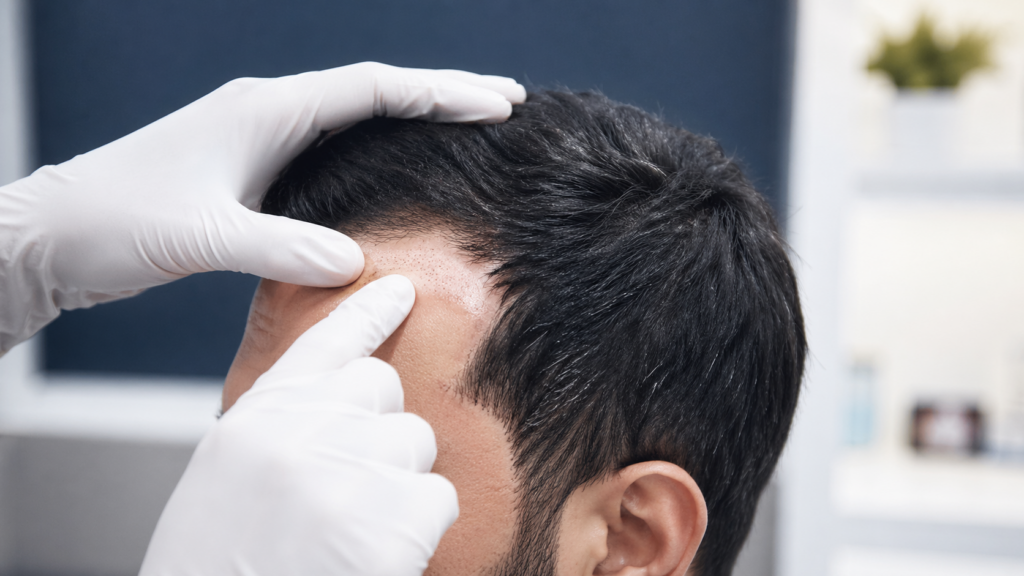
Determining the exact number of hair grafts needed for a successful transplant requires a clinical assessment of your hair loss pattern and donor area capacity. While many patients look for a single number, the requirement varies based on the size of the balding area and the density you want to achieve. A graft is a single unit of skin that contains one to four hair follicles, and the total count depends on your specific stage on the Norwood Scale.
Overestimating or underestimating the number of grafts can lead to poor results or permanent donor area damage. For UK patients considering a procedure at Hairtec in Delft, we prioritize a technical analysis to find the right balance between coverage and donor preservation. This guide explains how surgeons calculate these requirements and why a high graft count is not always the best choice for your scalp.
How Does A Surgeon Calculate The Number Of Grafts Needed?
The calculation starts with measuring the square centimeters of the thinning or bald area. A natural looking density usually requires between 40 and 60 grafts per square centimeter. If a surgeon tries to place too many grafts in a small space, it can cut off the blood supply to the skin, which leads to graft failure.
The surgeon must also look at:
- Hair Texture: Thicker hair provides more coverage with fewer grafts.
- Hair Color: A low contrast between your hair and skin color makes thinning less noticeable.
- Donor Density: The number of healthy hairs available at the back of your head.
- Scalp Laxity: How tight or loose your skin is, which affects extraction safety.
Average Graft Counts Based On The Norwood Scale
The Norwood Scale is the medical standard used to classify male pattern baldness. It helps surgeons provide an initial estimate before a physical examination.
Patients who want a rough figure before that examination can use the hair graft calculator as a starting point.
| Norwood Stage | Area Of Loss | Estimated Grafts Needed |
|---|---|---|
| Stage 2 | Receding temples and minor hairline loss | 800 to 1,200 |
| Stage 3 | Deeper recession at temples and early crown thinning | 1,500 to 2,500 |
| Stage 4 | Significant hairline loss and a distinct bald spot on the crown | 2,500 to 3,500 |
| Stage 5 | Large bald areas with only a thin strip of hair between them | 3,500 to 4,500 |
| Stage 6+ | Massive hair loss requiring multiple sessions | 5,000 or more |
Are More Grafts Always Better For My Result?
High volume “hair mills” often promise 5,000 or more grafts in a single session to attract patients with a low price per graft. This is often a dangerous strategy. Extracting too many grafts at once can overharvest the donor area, leaving you with visible patches or thin hair at the back of your head.
A boutique clinic focuses on donor preservation. If you use all your donor hair in one surgery and your hair loss continues as you age, you will have no hair left for a future touch up. A professional surgeon will always leave enough hair in the donor area to keep it looking natural and to provide security for any future needs.
Why Technical Precision Matters For Graft Survival
Graft count is only one part of the equation. Technical precision during the extraction and implantation determines if those grafts actually grow. In a surgeon led environment like Hairtec Delft, every follicle is handled with care to minimize time outside the body.
If a clinic treats dozens of patients a day, technicians often rush the process. This leads to “transection,” where the hair root is cut and the graft becomes useless. Choosing a boutique facility in the Netherlands means you get a higher survival rate per graft, which often results in a better look than a high count procedure at a low quality clinic.
Calculating Graft Requirements At Hairtec Delft
Hairtec operates on a specialist model in Delft, Netherlands, focusing on patients who want an honest, clinical assessment. We do not use sales tactics to inflate graft counts. Instead, we perform a detailed analysis of your scalp fysiologie to give you a realistic number that protects your donor area.
UK patients from London, Manchester, and Birmingham choose Hairtec for this boutique approach. The travel process is straightforward. A quick flight to Amsterdam Schiphol followed by a short journey to Delft allows you to receive a surgeon led consultation and procedure in a strictly regulated Dutch medical setting. We calculate your needs based on long term stability rather than temporary high numbers.
Frequently Asked Questions About How Many Grafts Do I Need
What is the maximum number of grafts in one session?
Most surgeons agree that 3,500 to 4,000 grafts is the safe limit for a single day to protect the donor area and the patient.
Can I get 5000 grafts if I am at Norwood Stage 6?
It is possible, but it usually requires two separate sessions or a multi-day procedure to make sure the blood supply to the scalp is not compromised. See what a 5000 grafts session involves.
Do I need to pay per graft or a fixed price?
Boutique clinics often charge based on the complexity and time of the procedure, while high volume clinics usually offer fixed price packages for “unlimited” grafts.
Will my donor area grow back after extraction?
No, once a hair follicle is extracted, it will not grow back in the donor area. This is why preserving the donor zone is so important.
Why do some people need fewer grafts for the same bald spot?
People with coarse or curly hair often get better coverage with fewer grafts because the hair occupies more visual space on the scalp.
Is DHI better for high density graft placement?
DHI is excellent for high density because the Choi pen allows for very precise, close placement of follicles without damaging the surrounding skin.
Can I have a second transplant if I am unhappy with the density?
A second procedure is possible only if your first surgeon was careful not to overharvest your donor area during the initial surgery.
How we reviewed this article:
Hairtec.co.uk has strict sourcing guidelines and relies on peer-reviewed studies, academic research institutions, and medical journals and associations. We only use quality, credible sources to ensure content accuracy and integrity. You can learn more about how we ensure our content is accurate and current by reading our editorial policy.
- Norwood OT (1975). Male pattern baldness: classification and incidence. Southern Medical Journal https://pubmed.ncbi.nlm.nih.gov/1188424/
- Jimenez F, Ruifernández JM (1999). Distribution of human hair in follicular units: a mathematical model for estimating the donor size in follicular unit transplantation. Dermatologic Surgery https://pubmed.ncbi.nlm.nih.gov/10417585/
- Bernstein RM, Rassman WR (1997). Follicular transplantation: patient evaluation and surgical planning. Dermatologic Surgery https://pubmed.ncbi.nlm.nih.gov/9311372/
Our experts continually monitor the health and wellness space, and we update our articles when new information becomes available


