Hairtec Hair Transplant Clinic

Female pattern hair loss requires a highly specific diagnostic approach. Unlike male pattern baldness, which typically presents as a distinct receding hairline and isolated crown balding, female genetic hair loss manifests as diffuse thinning across the entire top of the scalp. To accurately diagnose and treat this unique biological presentation, the medical community relies on a standardized measurement tool known as the Ludwig scale.
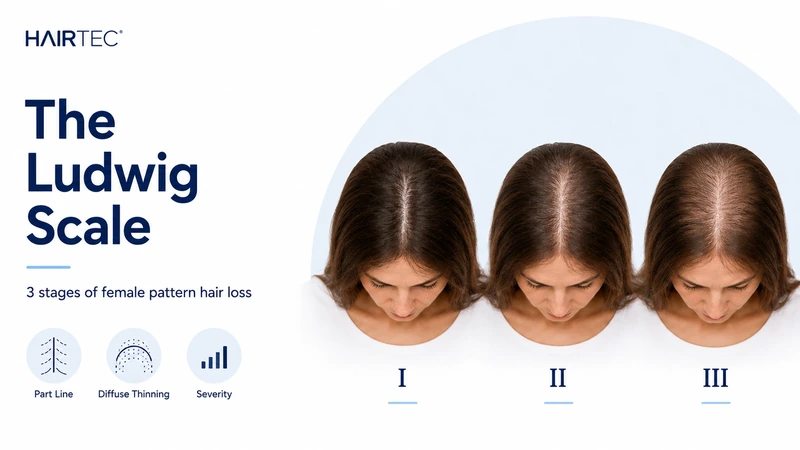
By utilizing this clinical classification system, dermatologists and hair restoration specialists can visually assess the severity of follicular miniaturization in women. This standardized metric is essential for tracking active shedding over time, determining the underlying hormonal triggers, and establishing a scientifically viable treatment protocol to halt further density loss.
Developed by Dr. Erich Ludwig in 1977, the Ludwig scale is the internationally recognized medical standard for classifying female androgenetic alopecia. It provides a clear visual reference guide that maps the progressive disappearance of terminal hair specifically along the central parting and the mid scalp.
When a patient visits a medical clinic for a hair loss consultation, the specialist uses this scale to establish a clinical baseline. This baseline dictates which medical interventions are appropriate. Attempting to treat a patient without first confirming their exact position on the female Ludwig scale often leads to ineffective therapies and continued structural degradation.
While the original Ludwig hair scale focuses purely on the widening of the central parting, modern clinics often reference the closely related Savin scale. The Savin scale operates on the exact same principles but adds a specific sub category to measure general diffuse thinning that may also affect the frontal hairline.
A formal clinical evaluation using these metrics focuses on specific diagnostic criteria:
Unlike the male diagnostic systems which feature seven complex categories, the Ludwig scale female classification is divided into three primary stages. These stages represent a linear progression of genetic hair loss. A patient will gradually transition from one stage to the next if the biological triggers are left untreated.
Medical clinics categorize the patient into one of the following specific stages to map out the required clinical interventions.
Type I represents the earliest phase of female genetic hair loss. At this stage, the follicular miniaturization has just begun to alter the cosmetic appearance of the scalp.
Clinical indicators for Type I include:
At this early stage, surgical intervention is completely unnecessary. Dermatologists strongly recommend initiating preventative medical therapies immediately to halt the shedding and reverse the miniaturization process before structural damage occurs.
If the hormonal triggers are not addressed, the condition progresses to Type II. This stage marks a significant and highly visible reduction in overall scalp density. The biological miniaturization has successfully forced a massive percentage of hair follicles into a premature resting phase.
Clinical indicators for Type II include:
Patients presenting at Type II require aggressive clinical therapies to stabilize the hair loss. In some specific cases, a small volume hair transplant may be mathematically viable to restore density to the central parting.
Type III is the most advanced and severe stage of female pattern baldness. The genetic sensitivity to androgens has successfully destroyed the vast majority of the hair follicles across the mid scalp and crown.
Clinical indicators for Type III include:
| Ludwig Stage | Visual Presentation | Primary Clinical Recommendation |
|---|---|---|
| Type I | Mild thinning along the central parting. Easily hidden with styling. | Preventative medical therapies to halt progression. |
| Type II | Moderate volume loss. Scalp is visible under lighting. Hard to hide. | Aggressive medical protocols; potential minor surgical filling. |
| Type III | Severe baldness across the top of the head. Parting is completely lost. | Surgical restoration if donor hair permits; cosmetic systems. |
While the metric is specifically designed for women, the concept of a ludwig scale male diagnosis does exist in clinical dermatology. Not all men experience the classic receding hairline and distinct bald patches.
A small percentage of the male population suffers from Diffuse Patterned Alopecia. This is a unique genetic presentation where the male patient loses hair evenly across the entire top of the scalp while keeping the frontal hairline completely intact. Because this presentation perfectly mimics female pattern balding, physicians will often use the Ludwig hair loss scale to accurately measure the severity of the diffuse thinning in these specific male patients.
When assessing a male patient with diffuse thinning, the clinical approach requires careful blood analysis. Diffuse hair loss in men can sometimes indicate an underlying medical issue rather than standard genetic balding.
Doctors must rule out severe nutritional deficiencies, thyroid disorders, and autoimmune conditions before confirming a diagnosis of Diffuse Patterned Alopecia and establishing a treatment plan based on the Ludwig measurements.

Selecting an effective treatment protocol relies entirely on identifying the patient’s specific stage on the ludwig scale women metric. The primary clinical objective is to alter the hormonal environment of the scalp to protect the remaining follicles and stimulate new growth.
Because female pattern hair loss is heavily influenced by endocrine fluctuations, a multidisciplinary approach is often required. Dermatologists will review extensive blood panels to identify hyperandrogenism, iron deficiencies, or vitamin D shortages before prescribing clinical therapies.
For patients categorized as Type I and Type II, non surgical medical therapies are the absolute gold standard for treatment. The goal is to mathematically increase the diameter of the existing miniaturized hairs.
Surgical hair transplantation for female pattern baldness is highly complex and is typically reserved for late Type II or Type III patients. The feasibility of surgery depends entirely on the stability of the donor area.
Unlike men, who usually retain a thick, permanent horseshoe of hair at the back of the head, women with advanced androgenetic alopecia often experience thinning globally. If the hair at the back of the head is also miniaturizing, the patient is not a candidate for surgery, because the transplanted hair will simply fall out later. If the donor area is biologically stable, surgeons can utilize advanced extraction techniques to relocate healthy follicles directly into the widened central parting, permanently restoring visual density.
It is a standardized medical classification system used by dermatologists to diagnose and measure the severity of female pattern hair loss. It maps the progressive diffuse thinning across the top of the scalp.
The clinical scale is divided into three primary stages. Type I represents mild thinning. Type II represents moderate volume loss and a highly visible parting. Type III represents severe, extensive baldness across the entire mid scalp.
Yes, in specific clinical cases. Men who suffer from Diffuse Patterned Alopecia experience an even loss of density across the top of the head without a receding hairline. Doctors use this scale to measure that specific type of male thinning.
At this stage the central parting is distinctly wide and a significant amount of bare scalp is visible. The overall volume of the hair is noticeably reduced making cosmetic camouflage very difficult under normal lighting.
You cannot alter your genetic code to cure the condition permanently. However, using continuous clinical therapies you can successfully reverse the visible symptoms by forcing miniaturized follicles to produce thicker hair shafts again.
Both scales measure female pattern baldness. The primary difference is that the Savin scale includes additional sub categories to measure general diffuse thinning that may also affect the anterior frontal hairline.
No. The core characteristic of female androgenetic alopecia is that the frontal hairline remains structurally intact. The scale specifically measures the density loss directly behind the hairline and along the central parting.
Medical intervention should begin immediately at Type I. The earlier preventative clinical therapies are initiated the more native hair density can be preserved. Waiting until the follicles completely die makes restoration significantly harder.