Hairtec Hair Transplant Clinic

Estimate how many grafts you may need for a fuller beard, moustache, goatee or targeted patchy areas. Choose a beard style or select individual facial zones, then adjust the target density to create your personalised estimate.
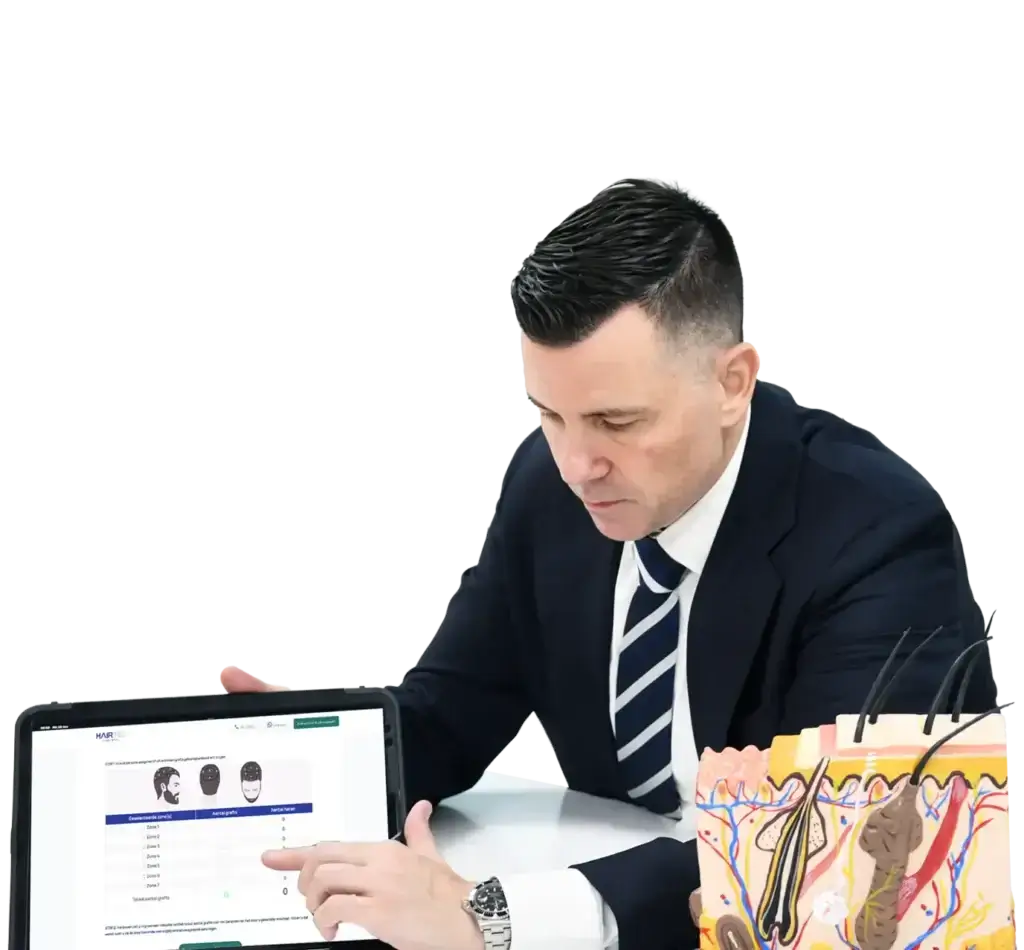
Your result is an interactive planning estimate. Final graft numbers, density and treatment suitability must be confirmed during a clinical consultation.
Our beard transplant graft calculator helps you build an initial estimate based on the facial areas you would like to improve and your preferred target density. If you are still comparing your options, our beard transplant treatment page explains how the procedure is planned and performed at Hairtec.
You can begin by choosing a predefined beard style, including Full beard, Goatee, Van Dyke, Moustache only, Chin strap, Sideburns or Patchy cheeks. Alternatively, select individual areas directly from any of the three facial views.
Matching areas remain synchronised between the left, front and right profiles. You can also review each selected area in the table, adjust individual graft values and change the overall target density.
The calculator automatically updates:
The result is intended as a planning guide. Your final treatment plan will depend on your existing beard growth, facial proportions, donor hair characteristics and clinical assessment. If you want an estimate for the scalp instead, use our hair transplant graft calculator.
There is no single graft number that applies to every beard transplant. A person filling one small patch will normally need considerably fewer grafts than someone creating a full beard from minimal existing facial hair.
Your estimate is affected by:
This is why two people selecting the same beard style may receive different treatment plans after consultation.
A full beard plan can include the moustache, soul patch, chin, cheeks, jawline and sideburn areas. It usually requires the highest number of grafts because it covers the largest surface area.
The final number depends heavily on how much beard hair is already present. Creating a beard from minimal facial hair is different from adding density to an existing but patchy beard.
Use the Full beard preset to select all seven calculator areas automatically.
A goatee focuses primarily on the chin and central lower-lip area. It can be a suitable option for someone who wants greater definition without extending the treatment across the cheeks and jawline.
Use the Goatee preset for a targeted central estimate.
A Van Dyke combines the moustache with the central beard and chin areas. Because the moustache is included, it generally requires a broader treatment area than a simple goatee.
Select Van Dyke to activate the moustache, soul patch and chin areas together.
A moustache transplant targets the area above the upper lip. Accurate placement is particularly important because the direction, angle and outline of the hairs strongly influence how natural the result appears.
The Moustache only preset isolates this area so you can calculate it separately.
A chin strap follows the lower face and jawline. The design may include the chin and both sides of the jaw, depending on the desired shape and existing facial hair.
Use the Chin strap preset to select the chin and jawline zones.
Sideburn restoration focuses on the upper facial hair zones in front of the ears. The required graft number depends on the desired width, length and density on each side.
The calculator allows both sideburn areas to be selected together or adjusted individually.
Patchy cheek treatment is intended to improve uneven or sparse growth across the cheeks and adjacent jawline areas. The estimate can vary significantly depending on whether the goal is to fill isolated gaps or increase density across both sides of the face.
Select Patchy cheeks for an estimate covering both cheek and jawline regions.
Density refers to the estimated number of grafts placed within each square centimetre of the selected treatment area.
A higher density setting increases the estimated graft requirement, but the highest setting is not automatically the best choice. A natural-looking result depends on the balance between coverage, existing hair, hair calibre, donor capacity and safe placement.
The calculator uses 35 grafts per cm² as a neutral planning baseline. This is not a prescription or guaranteed surgical density. Your clinical team may recommend a different distribution for separate parts of the beard.
For example, the outline and moustache may require finer placement, while the chin and jawline may need a different approach to create the appearance of fullness.
A graft is a naturally occurring follicular unit that may contain one or more hairs. This means the estimated number of hairs will normally be higher than the estimated number of grafts.
Single-hair grafts can be valuable around visible outlines where precision is important. Multi-hair grafts may contribute more visual density in suitable central areas.
The calculator uses an estimated hairs-per-graft value for each facial zone. The actual composition of your donor grafts can only be assessed during treatment planning and extraction.
The calculator is designed to provide a structured initial estimate, not a final surgical quotation.
Its result is based on:
It cannot evaluate your skin, existing follicle distribution, hair diameter, donor density or medical suitability. Photographs and a clinical assessment are therefore required before confirming the final graft number.
Beard transplant cost is usually influenced by the scale and complexity of the treatment rather than a simple online graft calculation. Our hair transplant cost page sets out current pricing for scalp and facial procedures.
Your result displays a graft band such as:
A graft band makes it easier to discuss the likely scope of treatment without implying that the calculator has produced a final medical or financial quotation.
The final cost can also depend on the treatment method, clinical complexity, number of sessions and the individual treatment plan. You can compare our hair transplant methods and see how the DHI and FUE techniques differ before your appointment.
Save or make a note of your result and book a free consultation with Hairtec. During your assessment, the clinical team can review your existing facial hair, donor area and preferred beard design.
Your consultation may include:
The calculator gives you a useful starting point. The consultation turns that estimate into an individual treatment plan.
Everything patients ask before using a beard graft estimate, from graft numbers and target density to donor hair, treatment suitability and what happens during a clinical consultation.
A full beard transplant may require several thousand grafts because it can include the moustache, chin, cheeks, jawline and sideburns. The exact number depends on your existing facial hair, face size, desired density and donor capacity. Use the Full beard preset for a personalised initial estimate.
A full beard transplant may require several thousand grafts because it can include the moustache, chin, cheeks, jawline and sideburns. The exact number depends on your existing facial hair, face size, desired density and donor capacity. Use the Full beard preset for a personalised initial estimate.
The number varies according to the width of the moustache, existing growth and desired density. Moustache transplantation also requires careful control of hair angle and direction. Select Moustache only to isolate this area in the calculator.
Yes. Select Patchy cheeks to activate the cheek and adjacent jawline areas. You can then deselect individual zones if only one side or a smaller area requires improvement.
Yes. Every mapped facial area is individually clickable. You can select areas from the left, front or right view, and matching zones will remain synchronised across all three views.
Yes. The Areas table allows you to manually change the graft estimate for each selected zone. Moving the main density slider again will recalculate the area values using the selected density.
Graft density is the planned number of grafts within each square centimetre of the recipient area. The ideal density varies according to existing growth, hair characteristics, donor capacity and the location being treated.
No. The calculator uses 35 grafts per cm² as a planning baseline, not as a universal surgical recommendation. Your clinical team must determine an appropriate and safe density after examining your beard and donor area.
Not necessarily. A follicular graft may contain one or more hairs. For this reason, the calculator displays separate estimates for the number of grafts and the number of hairs.
Not necessarily. A follicular graft may contain one or more hairs. For this reason, the calculator displays separate estimates for the number of grafts and the number of hairs.
No. The calculator cannot diagnose hair-loss conditions or assess medical suitability. A clinical consultation is required before any treatment recommendation can be made.
Many estimates may fall within a single-session range, but larger or more complex cases can require a different plan. The calculator provides an indicative session value; the final decision belongs to the treating clinical team.
Cost depends on the number of areas treated, the approximate graft band, the treatment method and the complexity of the procedure. The calculator does not provide a final price. Hairtec can confirm the available options after assessment.
Donor follicles are commonly selected from a suitable area of the scalp. Hair calibre, texture and donor density must be evaluated to determine whether the available follicles can create a natural-looking facial result.
A consultation allows the clinical team to assess factors an online calculator cannot measure, including donor density, hair calibre, skin condition, existing beard direction, facial symmetry and medical suitability.
Every step toward a fuller head of hair starts with good advice. Schedule a free, no-obligation consultation and find out which treatment is right for you.
A personal consultation with our specialists to discuss your needs and options.
A detailed analysis of your scalp and hair follicles to determine the right approach.
The chosen hair transplant technique is carefully performed by our experienced team.
Professional support after your treatment to ensure optimal recovery and lasting results.