Hairtec Hair Transplant Clinic

Hair loss is a universal clinical condition affecting millions of men and women across various age demographics globally. While often perceived strictly as an aesthetic or cosmetic issue, the underlying causes are deeply rooted in genetics, hormonal fluctuations, environmental stressors, and physiological health. Analyzing global clinical data reveals the true scale of androgenetic alopecia and other forms of thinning across different populations.
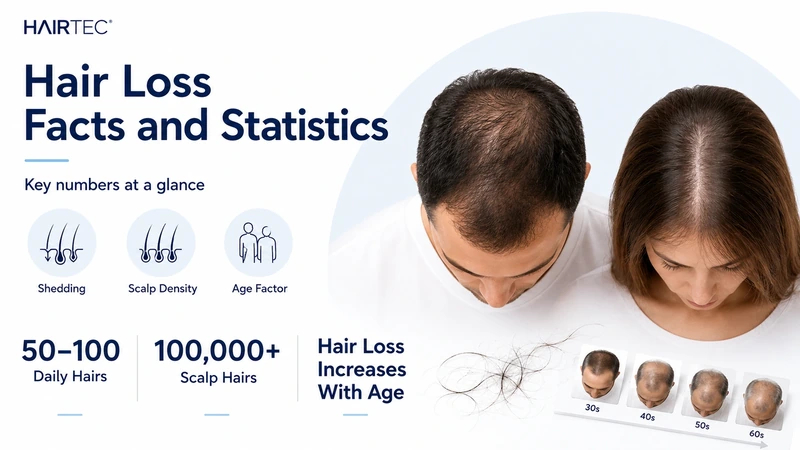
Medical statistics demonstrate that hair shedding is not an isolated occurrence but a highly predictable biological process, allowing medical specialists to map its progression accurately. By examining age brackets, gender distribution, and geographical variations, dermatologists and restoration surgeons develop targeted protocols to combat the specific mechanisms driving follicular degradation.
Tracking the exact number of individuals experiencing hair loss is complex due to the gradual, progressive nature of the condition. However, clinical dermatological studies indicate that a massive portion of the adult population will experience visible thinning at some point in their lives.
In the United Kingdom alone, medical data suggests that approximately 6.5 million men are actively dealing with male pattern baldness. When factoring in female pattern hair loss and temporary shedding conditions like telogen effluvium, the number of individuals affected by follicular degradation increases exponentially across the European continent.
To evaluate hair loss accurately, medical professionals first define what constitutes normal shedding. The human scalp holds an average of 100,000 to 150,000 hair follicles. The biological growth cycle dictates that a certain percentage of these hairs are always in a resting phase, ready to fall out and be replaced.
Pathological hair loss occurs when the rate of shedding significantly exceeds the rate of cellular regeneration. Clinical data provides a baseline for evaluating this physiological balance:
Androgenetic alopecia, commonly known as male pattern baldness, is the dominant cause of hair loss in men worldwide. This condition is triggered by a genetic sensitivity to Dihydrotestosterone. This potent androgen hormone binds to specific receptors in the scalp, shrinking the hair follicles over time until they lose the ability to produce terminal hair shafts.
Statistics show that male hair loss is not exclusive to older demographics. The biological trigger can activate shortly after puberty, causing aggressive recession at the hairline and temporal angles in very young men.
The prevalence of male pattern baldness correlates directly with chronological age. As men grow older, the prolonged exposure to Dihydrotestosterone results in a higher percentage of the population exhibiting advanced stages on the Norwood scale.
Clinical surveys and demographic data outline the steady progression of male hair loss across different age brackets:
| Age Demographic | Percentage of Men Affected | Typical Clinical Presentation |
|---|---|---|
| Men in their 20s | 20 Percent | Early temporal recession and hairline maturation |
| Men in their 30s | 30 Percent | Deepening temporal angles and early vertex thinning |
| Men in their 40s | 40 Percent | Visible bald spots on the crown and frontal depletion |
| Men in their 50s | 50 Percent | Severe Norwood Stage 4 or 5 pattern baldness |
| Men over 60 | 65+ Percent | Extensive loss leaving only the safe donor area intact |
Hair loss does not affect all global populations equally. Clinical studies highlight significant statistical differences in the prevalence and severity of androgenetic alopecia based on ethnic background and geographic origin.
Caucasian men exhibit the highest rates of male pattern baldness globally. Men of Afro Caribbean descent experience moderate rates but often face additional risks from traction alopecia due to styling practices. Men of East Asian and Native American descent present the lowest statistical rates of genetic baldness, often maintaining dense hairlines well into their senior years.

Hair loss is frequently categorized as a male issue, but clinical facts prove that women are severely affected by follicular degradation. Female pattern hair loss presents differently than the male equivalent. Rather than a receding hairline, women typically experience diffuse thinning across the entire mid scalp and a widening of the central parting, measured clinically by the Ludwig scale.
Because female hair loss does not follow the distinct bald patches seen in men, it often goes undiagnosed in its early stages. Women are also highly susceptible to temporary forms of hair loss triggered by physiological stress, dietary deficiencies, and thyroid imbalances.
The statistics surrounding female hair loss highlight a widespread but often hidden clinical issue. Many women utilize cosmetic extensions, scalp concealers, or specific hairstyles to camouflage the lack of density, skewing public perception of how common the condition truly is.
Hormonal stability is absolutely critical for female hair health. Major biological events that alter estrogen and progesterone levels have a profound statistical impact on hair density.
Postpartum alopecia is a highly common phenomenon. During pregnancy, elevated hormones keep hair in a prolonged growth phase. Following childbirth, hormone levels drop rapidly, causing a massive percentage of follicles to enter the shedding phase simultaneously. Clinical data shows that up to 50 percent of women experience severe telogen effluvium within three to four months after giving birth.
Similarly, the onset of menopause triggers significant shedding. As estrogen levels decline in a woman’s fifties, the protective effect on hair follicles diminishes. This exposes the roots to the miniaturizing effects of androgens, leading to a permanent reduction in overall volume.
While there are dozens of medical reasons for losing hair, the statistical distribution is heavily skewed toward genetics. Identifying the root cause is the first mandatory step before any clinical intervention, medical therapy, or surgical transplant can be approved.
Autoimmune conditions, fungal infections, and physical trauma account for a very small percentage of the global hair loss population. The overwhelming majority of patients visiting medical clinics suffer from inherited conditions or systemic nutritional deficits.
Medical science categorizes hair loss triggers into distinct primary groups. The statistics confirm that genetics dictate the vast majority of permanent baldness cases.
Environmental and physiological factors play a massive role in non genetic hair loss. Telogen effluvium is the second most common form of hair loss diagnosed in dermatology clinics. It is a rapid, diffuse shedding triggered by a shock to the system.
Clinical data shows a strong correlation between modern dietary habits and hair health. Severe nutritional deficiencies, particularly low serum ferritin (iron) levels and Vitamin D deficiencies, force hair follicles into a premature resting phase. Furthermore, statistics gathered following major global health events, such as viral pandemics, demonstrate sharp spikes in telogen effluvium as patients recover from high fevers and systemic inflammation.

The facts surrounding hair loss extend far beyond physical appearance and biological data. The psychological and emotional statistics are highly significant. Hair is deeply connected to youth, vitality, and personal identity in almost all global cultures.
Losing hair prematurely triggers severe emotional distress for a large percentage of the population. Psychological surveys conducted on hair loss patients reveal striking data regarding mental health, social behavior, and self perception.
The psychological burden of hair loss alters how individuals navigate their personal and professional lives. Clinical psychology surveys highlight the hidden cost of baldness:
The high prevalence of hair loss has generated a massive global response in the medical and pharmaceutical sectors. Statistics regarding the hair restoration industry highlight a rapidly growing demand for permanent, clinical solutions.
The International Society of Hair Restoration Surgery tracks clinical data globally. Their reports indicate that the surgical hair restoration market is valued in the billions, driven largely by advancements in Follicular Unit Extraction techniques.
Over 700,000 surgical hair restoration procedures are performed annually worldwide. The statistics show a distinct shift in patient behavior, with an increasing percentage of men in their late twenties and early thirties opting for proactive surgical intervention rather than waiting for severe baldness to set in. Furthermore, international medical travel for hair transplantation has grown exponentially, as patients seek high quality European medical standards at accessible price points.
Approximately 50 percent of all Caucasian men will experience noticeable hair loss by the age of fifty. This percentage increases with age, with over 65 percent of men showing significant signs of baldness by the time they reach their sixties due to androgenetic alopecia.
Clinical statistics indicate that roughly 40 percent of women will experience visible thinning by age forty. Throughout their entire lifespan, more than half of all women will deal with some form of diffuse hair loss or widening of the central parting.
The biological trigger for male pattern baldness can activate at any time after puberty. Approximately 20 percent of men begin to notice early temporal recession and hairline changes in their early twenties.
The genetics of hair loss are highly complex and can be inherited from either the maternal or paternal bloodlines. The widespread myth that baldness is passed down exclusively from the mother side is medically incorrect.
A healthy adult naturally sheds between 50 and 100 hairs every day. This is a normal part of the biological telogen phase. Consistent daily shedding exceeding 150 hairs indicates a potential clinical issue that requires medical evaluation.
Severe emotional or physical stress causes a condition called telogen effluvium, which forces follicles into a rapid shedding phase. However, this type of hair loss is usually temporary. The hair typically regrows within six to nine months once the stressor is removed.
Androgenetic alopecia is by far the most common type of hair loss globally. It accounts for 95 percent of all male hair loss cases and is the primary cause of permanent diffuse thinning in the female population.
While the genetic predisposition remains relatively stable, modern environmental factors, poor dietary habits, and high stress levels have led to a statistical increase in premature shedding and earlier onset of thinning in younger demographics.
The demand for permanent clinical solutions is massive. Over 700,000 hair transplant procedures are performed globally every year. The introduction of advanced FUE and DHI methods has made the surgery safer and more appealing to younger demographics.
Yes. Severe nutritional deficiencies, particularly low levels of serum iron, vitamin D, and essential proteins, can disrupt the hair growth cycle and cause temporary shedding. Correcting the diet often reverses this specific type of loss.