Hairtec Hair Transplant Clinic

The Norwood scale is the international medical standard used by dermatologists and hair restoration surgeons to measure the severity of male pattern baldness. Clinically known as androgenetic alopecia, this condition follows a highly predictable sequence of follicular miniaturization. Rather than losing hair randomly, men experience a structured retreat of the hairline and a systematic thinning of the crown.
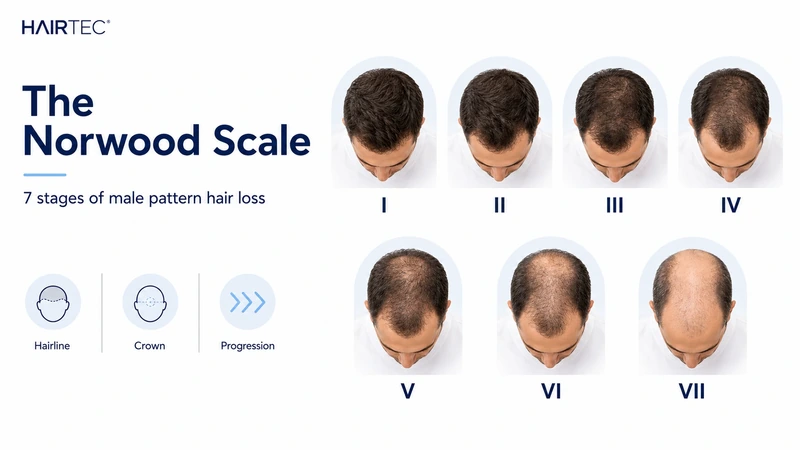
By utilizing this standardized visual metric, medical professionals can accurately diagnose the exact stage of hair loss a patient is experiencing. This classification is not merely cosmetic. It dictates which medical interventions are mathematically and biologically viable for the patient at that specific moment in their life.
Originally developed by Dr. James Hamilton in the 1950s and later updated by Dr. O’Tar Norwood in the 1970s, this diagnostic tool provides a visual reference guide for genetic hair loss. The scale divides the balding process into seven distinct categories, mapping the gradual disappearance of terminal hair from the frontal and vertex regions of the scalp.
Medical clinics rely on the scale to establish a baseline before beginning any treatment protocol. It allows surgeons to track the speed of active shedding over time and calculate the exact number of donor grafts required for a surgical transplant.
The scale specifically measures the recession of structural boundaries and the loss of overall density in DHT sensitive zones. It does not measure the quality of the hair shaft itself.
A clinical evaluation focuses strictly on three primary anatomical regions to determine the severity of the condition:

The progression of male pattern baldness is linear. A patient will not skip from an early stage directly to total baldness overnight. The transition involves a gradual weakening of the hair follicles over several years or decades.
To provide accurate medical advice, clinics categorize the patient into one of the following seven stages. Each stage represents a distinct level of structural degradation.
These initial stages do not qualify as clinical baldness. They represent the natural transition from an adolescent hairline to an adult male hairline.
Stage 3 of the Norwood scale is the most critical diagnostic threshold. It marks the first official stage of clinical male pattern balding. At this point, the hair loss becomes highly visible and permanently alters the framing of the face.
Clinical indicators for this stage include specific structural changes:
As the condition advances, the baldness in the frontal region and the crown region become highly pronounced. The defining characteristic of these middle stages is the structural bridge of hair that separates the two zones.
These final stages represent the most severe forms of androgenetic alopecia. The genetic sensitivity to Dihydrotestosterone has successfully miniaturized nearly all the hair on the top of the scalp.
The clinical presentation at these advanced stages is defined by total structural loss:
Patients frequently attempt to self diagnose by asking what Norwood scale am I. While looking in a mirror provides a rough estimate, a formal clinical diagnosis requires a strict evaluation methodology.
Dermatologists utilize specific diagnostic steps to confirm the exact stage:
A major source of patient anxiety is the timeline. Men diagnosed early often ask how long does Norwood scale 2 last for before progressing to stage 3 or 4. Clinically, there is no universal timeline.
The speed of the progression is dictated by several specific biological factors:
Some men reach Stage 2 in their late twenties and remain at that exact stage for the rest of their lives. Conversely, men with an aggressive genetic profile may transition from Stage 2 to Stage 5 within just three or four years.

Selecting a viable treatment protocol depends directly on the patient’s current stage. Treating a Stage 2 hairline requires a completely different medical approach than attempting to restore a Stage 6 patient.
The clinical objective is always twofold. First, halt the active shedding and stabilize the current stage. Second, mathematically calculate if surgical restoration is possible based on the available donor supply.
For patients categorized between Stage 2 and early Stage 4, preventative medical therapies are the primary recommendation. The goal is to protect the vulnerable follicles from permanent death.
Medical professionals typically prescribe a combination approach:
When a patient reaches Stage 4, Stage 5, or Stage 6, preventative therapies alone cannot provide a cosmetic restoration. The follicles in the bald zones have died completely and must be replaced surgically.
Specialized clinics utilize Follicular Unit Extraction methods to relocate healthy, DHT resistant hair from the Stage 7 horseshoe area to the bald zones.
| Patient Stage | Surgical Strategy | Typical Graft Volume |
|---|---|---|
| Stage 3 | Rebuilding the temporal peaks and lowering the hairline. | 1500 to 2500 Grafts |
| Stage 4 | High density frontal restoration and moderate crown coverage. | 3000 to 4000 Grafts |
| Stage 5 | Reconstructing the entire frontal half of the scalp; crown delayed. | 4000+ Grafts (Mega Session) |
| Stage 6 & 7 | Conservative hairline framing; full density is impossible due to donor limits. | Multiple Sessions Required |
It is a standardized visual classification system used by medical professionals to diagnose the severity and progression of male pattern baldness. It maps the predictable sequence of hair loss across seven distinct stages.
This stage is characterized by deep recession at the temporal angles above the eyebrows. The hairline forms a sharp M or V shape. It is clinically considered the first official stage of male pattern baldness.
No. Female pattern hair loss presents differently and is measured using the Ludwig scale. Women typically experience diffuse thinning across the mid scalp and a widening of the parting rather than a receding frontal hairline.
You cannot alter your genetic code to cure the condition. You can reverse the visible symptoms of early stages using clinical therapies that thicken miniaturized hairs. Advanced stages with complete baldness strictly require surgical transplantation.
The progression rate is highly unpredictable and depends entirely on your specific genetic sensitivity to androgens. Some men progress through multiple stages in a few years while others remain at a single stage for decades.
Surgical intervention becomes mathematically viable and cosmetically impactful starting at Stage 3. For patients at Stage 4 or higher, a transplant is the only medical option available to restore density to completely bald areas.
The scale measures both the structural recession of the hairline boundaries and the expansion of the diffuse thinning zone on the crown. The interaction between these two zones dictates the final stage classification.
Without medical intervention the progression rarely stops. It will continue advancing until it reaches the genetic limit programmed into your DNA. For many men this progression concludes at Stage 6 or Stage 7.