
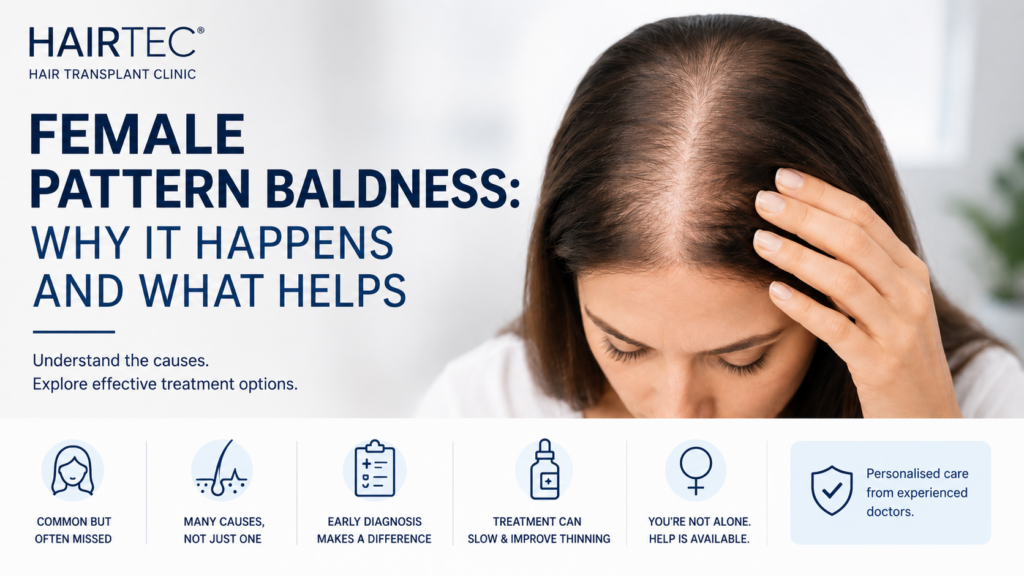
Nobody warns women about this one. Male balding is a punchline everyone recognises, so men at least know what they are looking at. Female thinning gets almost no airtime, and the result is thousands of women quietly convinced they are the only one, brushing more hair out of the plughole each month and saying nothing. They are far from alone. Female pattern baldness is common, it has causes you can actually name, and a fair amount of it is treatable, more so the earlier you catch it. The catch is that it hides. It looks nothing like the receding hairline men get, so it drifts along unnoticed for years.
What it actually looks like
Unlearn the male picture first. Women rarely go bald at the front. The hairline holds. What thins instead is the top of the scalp, spread out and even, and the first clue is usually mundane: a centre parting that looks a little wider in the mirror than it did last year, or a ponytail that needs an extra twist of the band to feel the same.
Doctors even use a different ruler. Men get graded on the Norwood scale; women get the Ludwig scale, three grades running from mild widening of the part through to sparse coverage over the crown. That distinction is on our Norwood scale page, and it is not pedantry. It is the reason a man’s treatment plan cannot just be handed to a woman unchanged.
Why it happens, and why it is rarely one thing
The word “androgenetic” points at androgens, the hormone group that includes testosterone. In plenty of women an inherited sensitivity to those hormones thins the hair over the crown, the same basic mechanism that drives loss in men. Our male pattern baldness page walks through that hormonal process in full.
Here is where women and men part ways, though. A woman’s hair loss usually has a longer suspect list, and more than one culprit is often at work at the same time. That is the single biggest reason it deserves a proper look rather than a guess off a forum.
| Possible driver | What is going on |
| Androgenetic (genetic) | Inherited sensitivity to androgens thins hair over the crown, slowly, across years |
| Telogen effluvium | A shock, illness, surgery, childbirth, a crash diet, pushes a wave of follicles into shedding, typically two to three months after the event |
| Iron deficiency | Low ferritin is a common contributor and a very treatable one |
| Thyroid problems | An under or overactive thyroid can shed hair, and a simple blood test finds it |
| Hormonal shifts | Pregnancy, coming off the pill, PCOS and the menopause all move hair, sometimes hard |
Read that list again and something stands out. Most of these are not permanent, and several are outright fixable. Thinning that turns out to be a ferritin of 15 or an underactive thyroid is a completely different problem from genetic loss, and it has a completely different fix. Which is the whole argument for diagnosing before treating.
The menopause question
Its own heading, because it lands in so many inboxes. Oestrogen falls as the menopause arrives, usually somewhere between the mid-forties and mid-fifties, and oestrogen was quietly shielding the hair. As it drops, the balance tips toward androgens, and thinning that a woman may have carried invisibly for a decade can suddenly pick up speed. Real, common, and not a thing you are meant to just live with. There is plenty that helps, which is where this goes next.
What actually helps
Same honest headline as the men’s version. No cure regrows a full head by Christmas, and anyone who says otherwise wants your card details. What real treatment does is slow the loss and, for a lot of women, thicken what is left thin. The specifics, though, break from the male script in ways that matter.
Minoxidil does most of the heavy lifting. Rubbed into the scalp, well established for women, and worth three to six months before you judge it. Like every topical, it holds the line only while you use it. Stop, and the ground gives way again. But the benefit is real, and for many women it is enough on its own.
Finasteride is a different conversation entirely for women than for men. It is not a routine treatment for female hair loss. It is used cautiously, in specific cases, under specialist care, and it carries an absolute rule that overrides everything else: never during pregnancy, or when pregnancy is even possible, because of the risk to a developing baby. If you take one thing from this article, take that. A woman’s plan is not a man’s plan with the dose changed.
And then the part people skip. Fix the underlying cause and you often fix the hair. Top up low iron, treat a thyroid that has drifted, review a medication that might be feeding into it, and you can achieve more than any lotion, because you have switched off the thing driving the loss. Our hair loss treatments page covers the full menu.
Can a transplant help women?
Sometimes. Not always, and less often than the adverts imply. A transplant works by lifting hair from a donor zone that resists thinning and moving it where it is needed. In men the back and sides usually stay put and make a dependable donor. In women the thinning tends to be diffuse, which means the donor area may be thinning too, and hair you move from a fading zone fades wherever you put it. For the right candidate it is well worth exploring. As a default answer for female loss, it is not, and only an honest assessment tells you which camp you are in.
When to get it looked at
Earlier beats later, every time. A few signals are worth acting on rather than watching:
- A parting that keeps creeping wider, or a ponytail that has visibly thinned.
- A heavier shed than normal for weeks on end, classically two to three months after an illness, a birth, or a stretch of real stress.
- Thinning that turns up with other changes, irregular periods, weight shifts, constant tiredness, which can flag a hormonal or thyroid cause worth a blood test.
- Anything patchy, or a scalp that is sore, itchy or flaking. That is a different problem and needs its own diagnosis.
The role of our doctors at Hairtec
Our team includes BIG-registered doctors, listed on the official Dutch medical register, alongside experienced hair specialists. Female loss is precisely where that medical involvement pays off, because most of getting it right happens at the diagnosis, long before any product. The doctors read the pattern, take a full history, and chase down the causes a quick fix skates straight past, iron, thyroid, the hormonal swing around the menopause. The talk about treatment comes after that, and only then, shaped to what is actually safe and realistic for you.
Frequently asked questions about female pattern baldness
Can females have pattern baldness?
They can, and it is common, though it wears a different face from the male kind. Instead of a receding hairline, women thin across the top of the scalp while the front holds. It gets graded on the Ludwig scale, not the Norwood one.
Can hair grow back from female pattern baldness?
Often, yes, within limits. Follicles that are thinning but still alive respond well to treatment, especially early. And where a reversible cause is behind it, low iron, a thyroid wobble, a stressful few months, the hair frequently returns once that is sorted. Follicles gone for years are the hard cases.
How do you treat female pattern hair loss?
Minoxidil is the mainstay, applied to the scalp and well proven in women. Just as crucial is hunting down and fixing any underlying cause, iron or thyroid especially. Finasteride is not routine in women and is used only cautiously under specialist care, never in pregnancy.
Is female hair loss permanent?
Depends what is causing it. Genetic thinning is ongoing and gets managed rather than cured. Loss from illness, stress, low iron or a thyroid problem is usually temporary and comes back once the trigger is dealt with. Same reason as always: the cause decides everything.
Does the menopause cause hair thinning?
It can. As oestrogen drops around the menopause, the balance tilts toward androgens, and mild genetic thinning can suddenly accelerate. Very common, and treatable, so it is worth an assessment rather than quiet acceptance.
How we reviewed this article:
Hairtec.co.uk has strict sourcing guidelines and relies on peer-reviewed studies, academic research institutions, and medical journals and associations. We only use quality, credible sources to ensure content accuracy and integrity. You can learn more about how we ensure our content is accurate and current by reading our editorial policy.
- Ludwig E (1977). Classification of the types of androgenetic alopecia (common baldness) occurring in the female sex. British Journal of Dermatology https://doi.org/10.1111/j.1365-2133.1977.tb15179.x
- Olsen EA (2001). Female pattern hair loss. Journal of the American Academy of Dermatology https://doi.org/10.1067/mjd.2001.117426
- van Zuuren EJ, Fedorowicz Z, Schoones J (2016). Interventions for female pattern hair loss. Cochrane Database of Systematic Reviews https://pmc.ncbi.nlm.nih.gov/articles/PMC6457957/
Our experts continually monitor the health and wellness space, and we update our articles when new information becomes available


