Female hair loss requires a highly specific medical approach. Diffuse thinning or a widening parting behaves very differently from a standard receding hairline, meaning restorative techniques must match a woman’s unique anatomy. Finding the right clinic in the UK can feel overwhelming when patients have to balance exorbitant local costs against clinical safety abroad.
A hair transplant for women is a DHI based surgical procedure tailored to female pattern hair loss and diffuse thinning across the crown. The technique places individual grafts through the existing hair using a Choi implanter pen to preserve length and density throughout the recovery period.
Procedure Method
DHI Choi pen
Session Duration
6 to 8 hours
Visibility to Others
Hidden under existing long hair
Female hair loss presents differently to male pattern baldness. It most commonly appears as diffuse thinning along the parting, widening at the hairline or reduced density around the crown, rather than a receding line. A hair transplant for women addresses these patterns by redistributing healthy follicles from the donor area to regions of visible loss, restoring the parting density and frame of the face without altering the person’s hair length. The goal is discretion: the procedure, the recovery and the result should be invisible to anyone who is not told.
Hairline: custom designed for the patient’s facial geometry.
Shaving: minimised, never full head.
Approach: discreet, long-hair preserving.
Technical Requirements for a Female Hair Transplant
A female hair transplant requires a different technical approach to the male procedure. The donor area, density pattern and hairline geometry must all be handled with a technique that does not disturb the existing long hair. At Hairtec we use DHI with the Choi implanter pen, which allows simultaneous channel opening and graft placement, minimising trauma and eliminating the need to shave the recipient area.
The procedure succeeds or fails on the assessment that precedes it. Your candidacy depends on:
Hair loss pattern. Diffuse thinning with a stable donor area is ideal. Active telogen effluvium or untreated hormonal shedding must be stabilised first.
Donor density. The occipital zone must hold sufficient follicular units to support the planned recipient area without visible harvest marks.
Hair type and texture. Thicker, wavier hair conceals grafting lines better than very fine straight hair.
Surgical team coordination. Female cases require technicians trained specifically in long-hair parting work, not generic FUE teams.
Patient expectations. Density increase is measurable but never 100% of native thickness. The correct expectation is restoration, not duplication.
Recovery is designed to return UK patients to their daily routine within 7–10 days. The first medical wash takes place 48 hours after the procedure and lifestyle restrictions ease after day 14.
Advantages of a DHI Female Hair Transplant
DHI (Direct Hair Implantation) using the Choi implanter pen is the only technique that truly protects the visible parting of female hair. Unlike Sapphire FUE, DHI does not require channel pre-opening or a shaved recipient area. The implanter delivers the graft at a controlled angle and depth in a single movement, which is why density outcomes are consistently higher for partings, hairlines and small crown areas.
Four technical advantages define DHI for women:
Immediate concealment. The recipient area is never shaved. Existing long hair covers the procedure zone from day one.
Controlled depth and angle. Each graft is placed at the exact angle of the native hair, preserving natural parting direction.
Reduced scalp trauma. No pre-made channels means less tissue disturbance and less redness.
Superior density in small areas. The implanter’s precision makes DHI the method of choice for narrow hairline zones and parting widening.
Surgical Precision in a Female Hairline Transplant
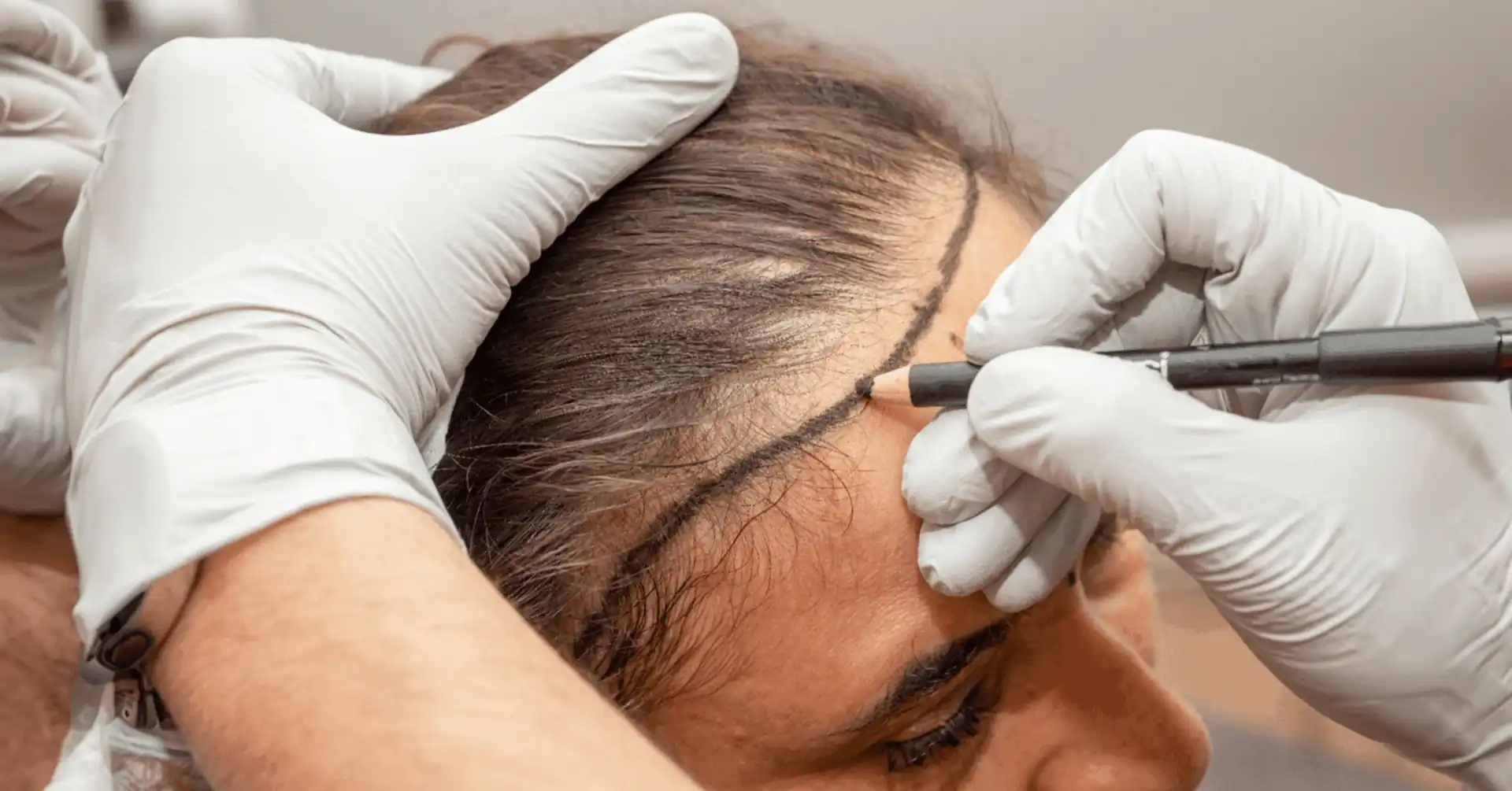
The female hairline is the most visible test of surgical precision in the entire procedure. It is not a single line. It is a gradient. The front row must contain single-follicle grafts at irregular intervals to imitate natural hair emergence, then transition through two- and three-hair units as the line moves back. A perfectly straight hairline, or one with uniform graft spacing, is the clearest sign of inexperienced work.
At Hairtec the hairline is designed in consultation with the patient before any extraction takes place. We map the forehead’s widow’s peak tendency, the lateral temple angles and the exact density the remaining zones can support without creating contrast. The full design is photographed and approved in writing before the implanter is loaded.
For patients considering combining a hairline reset with crown work, see our Crown Hair Transplant protocol.
Factors Influencing Female Hair Transplant Cost
The cost of a hair transplant for women reflects three variables: the technique used, the number of grafts planned and the level of surgical precision the case demands. Female cases are almost always DHI and almost always involve long-hair work. Both factors increase operative time and team specialisation.
Feature Comparison
Feature
Traditional Hair Transplant
Female Hair Transplant
Visual Impact
Entire scalp is shaved
Existing hair length is maintained
Discretion Level
Low
Very High
Surgical Duration
Standard
Significantly Longer
Donor Area View
Fully exposed
Hidden between long hair strands
Recipient Shaving
Required
Not required
The cost difference between a standard and a female DHI procedure reflects labour hours and team composition more than materials. A female DHI case typically runs 8–12 hours versus 4–6 for a standard unshaven FUE, and requires technicians trained in parting work.
Cost Factors
Cost Factor
Traditional FUE
Female DHI
Surgical Time
4 to 6 hours
8 to 12 hours
Graft Processing
Standard speed
Highly meticulous handling
Team Requirement
Standard clinical staff
Specialised long-hair DHI technicians
Implantation Tool
Sapphire blades and forceps
Choi implanter pen
Overall Investment
Base clinical rate
Premium technical surcharge
Hairtec publishes a single all-inclusive female package price that covers surgery, one overnight stay in Delft if needed, VIP airport transfer, medications and the lifetime growth guarantee. There are no graft-count surcharges. Transparent pricing is confirmed at the online consultation stage before any commitment.
Female Hair Transplant London and UK Quality Standards
UK patients seeking a hair transplant for women face two realistic options: a clinic in London or Manchester operating under UK regulations, or a Dutch clinic operating under the stricter BIG-register system. Price, experience and regulation diverge sharply between the two.
The Dutch medical framework requires every surgeon performing hair restoration to hold a BIG-register licence, which carries named personal accountability. Technicians must be qualified and insured under the same framework. This is not the case in the UK private aesthetic sector, where the regulatory baseline is lower and the clinic experience often reflects a marketing investment rather than a medical one.
Hairtec’s position is clinical, not geographical: we are a BIG-registered Dutch hair clinic that serves UK patients through a structured online-to-Delft model. The online stage (diagnosis, graft count, costing, surgical date) is handled before the patient leaves the UK. The surgical stage takes place in Delft under a single specialist, with no patient overlap on the same day.
Why Hairtec Prioritises Female Restoration
Female hair restoration is not a smaller version of the male procedure. It is a separate medical discipline, and we treat it as one. Our operative philosophy is built on advanced Dutch engineering: every female case is planned with parting geometry, native hair trajectory and long-term density outcomes weighted above extraction speed.
We run our Delft theatre on a strict one-patient-per-day policy. This is a capacity constraint, not a marketing claim. It means the lead surgeon performs every phase of every case personally, from hairline drawing through graft placement. Female DHI cases average 8 to 12 hours; this is only possible when no other case is scheduled against them.
UK travel logistics are built into the package: VIP airport transfer from Rotterdam-The Hague or Schiphol, premium accommodation walking distance to the clinic, all post-operative medications included. Patients fly in the evening before surgery and return two days later.
After surgery every patient joins the Hairtec digital portal for structured follow-up at month one, three, six and twelve. Aftercare is tracked, not hoped for, and backed by the Hairtec Lifetime Growth Guarantee.
Frequently Asked Questions About Female Hair Restoration
Do hair transplants work for women?
Yes. A well-diagnosed case of pattern or diffuse thinning with a stable donor area responds consistently to DHI restoration. Success depends on correct patient selection at the diagnostic stage and on using a technique suited to long hair, not on gender.
Will my result look unnaturally dense or give a transplanted appearance?
No, provided the procedure is designed around your native hairline geometry and parting direction. The frontal row uses single-follicle grafts at irregular intervals, and density is always calibrated so transplanted and native zones blend without a contrast edge.
Do I have to shave my head for a female hair transplant?
No. The Unshaven DHI protocol does not require any shaving of the recipient area. A small strip of the donor zone at the back of the head is trimmed short for extraction. This zone is fully hidden beneath the surrounding long hair within a day.
How long is the recovery for a female patient returning to the UK?
Most female patients return to the UK 48 hours after surgery, resume desk-based work within 3–5 days and can socialise without visible signs of the procedure by day 10. Hair styling tools and dye use are restricted for the first four weeks.
Is a hair transplant suitable if I have telogen effluvium or ongoing hormonal shedding?
Not immediately. Active shedding phases must be stabilised (medically and hormonally) before a transplant can be considered. Our online diagnostic stage screens for these conditions and recommends dermatological stabilisation first where relevant.
Are the transplanted hairs permanent?
Yes. Grafts are harvested from the genetically stable donor zone at the back of the scalp, which is resistant to the hormonal signals that cause female pattern thinning. Once established, transplanted hairs grow for life and are backed by the Hairtec Lifetime Growth Guarantee.
Is the procedure painful?
No. The entire surgical phase is performed under local anaesthetic with pain control monitored continuously by the lead surgeon. Most patients describe the sensation as pressure rather than pain and report sleeping normally on the night of surgery.
Can a hair transplant restore a receded female hairline or widow’s peak?
Yes. Hairline design is one of the most common requests in female cases and is handled with single-follicle grafts placed along a custom gradient. The design is always photographed and approved by the patient in writing before any extraction begins.