
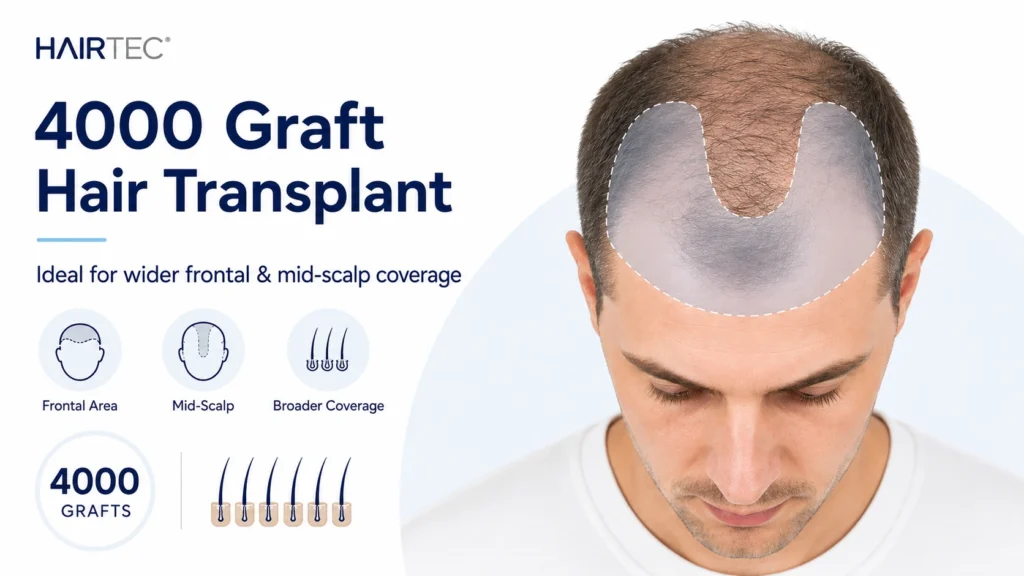
A 4000 graft hair transplant is a major reconstructive mega session designed to address extensive genetic hair loss. Relocating this massive volume of follicles effectively rebuilds a completely bald frontal third and extends significant density deep into the mid scalp.
Executing a procedure of this magnitude requires strict clinical discipline to prevent physiological failure and donor depletion. When managed under advanced European medical protocols, the surgical team can safely transfer up to 10,000 individual hairs in a single day, restoring facial proportions permanently without compromising long term scalp health.
How Much Area Does a 4000 Grafts Hair Transplant Cover?
Patients researching major restorative surgery constantly ask how much area does 4000 grafts cover in real clinical terms. Using standard surgical mathematics, a 4000 grafts hair transplant covers exactly 100 square centimeters of completely bald scalp when packed at a dense rate of forty follicular units per square centimeter.
This covers a massive physical space. It is generally enough to rebuild the entire frontal region, the temporal peaks, and the anterior mid scalp. However, the final visual impact relies heavily on the physical characteristics of the patient native hair:
- Hair Shaft Caliber. Thick, coarse hair blocks significantly more light from hitting the scalp. Patients with thick hair achieve a look of absolute density over a larger area.
- Skin to Hair Contrast. High contrast, such as dark black hair on pale white skin, requires tighter graft packing to hide the scalp. Low contrast patients require fewer grafts to achieve the same visual density.
- Follicular Groupings. A donor area rich in three and four hair units provides far more overall volume than a donor area dominated by single and double hair units.
Restoring Severe Norwood Scale Baldness
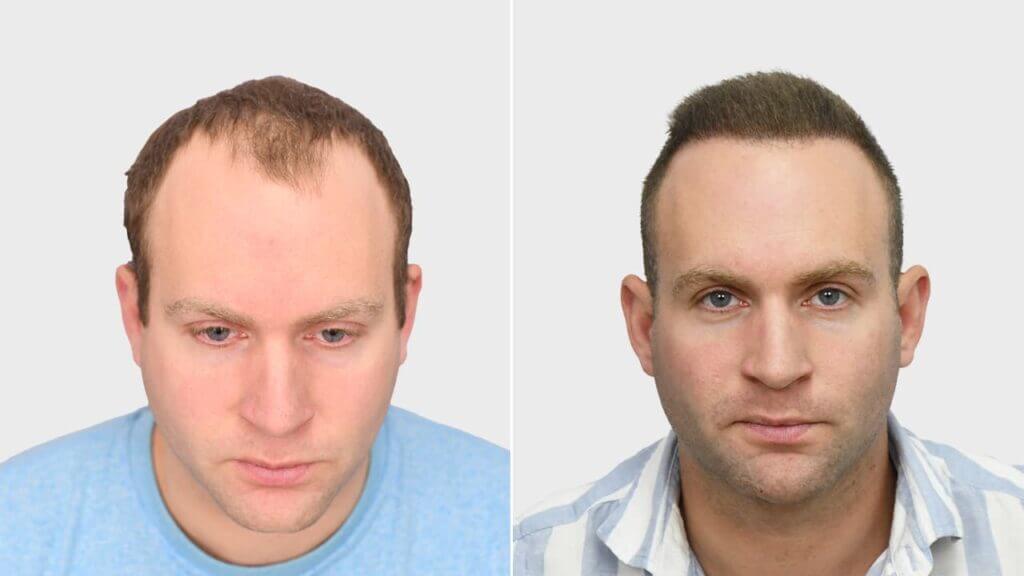
A session of 4000 grafts is rarely appropriate for minor thinning. It is specifically reserved for patients presenting at Stage 4, Stage 5, or Stage 5A on the Norwood scale of hair loss. At these advanced stages, the frontal hairline has completely receded, and the baldness extends deeply into the top of the head.
For these patients, the primary clinical objective is framing the face. A bald frontal zone ages a patient significantly. By relocating 4000 grafts, the surgeon pulls the hairline down to its youthful position and closes the deep temporal recessions. This reconstructive work fundamentally changes the proportions of the face, restoring symmetry.
Rebuilding the Frontal Band and Mid Scalp Together
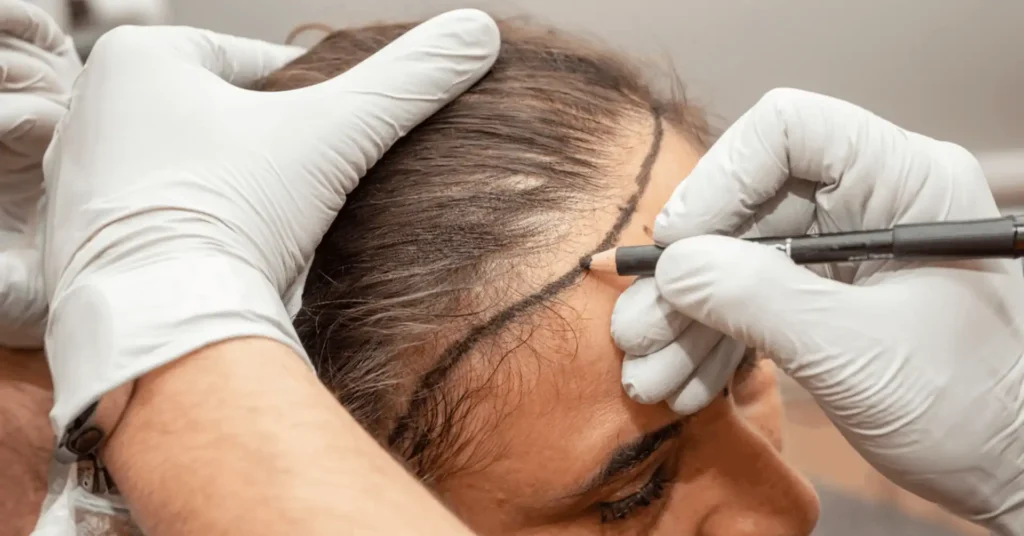
Distributing 4000 grafts requires a highly strategic mapping process. The surgeon must transition the density smoothly from the front to the back so the result looks completely natural under harsh lighting. The medical team divides the recipient area into distinct architectural zones.
| Scalp Zone | Graft Allocation Strategy | Clinical Objective |
|---|---|---|
| The Frontal Edge | 300 to 500 Single Grafts | Creating a soft, irregular natural boundary |
| The Density Core | 1500 to 2000 Multi Grafts | Building an impenetrable wall behind the hairline |
| The Mid Scalp | 1000 to 1500 Multi Grafts | Blending the volume back toward the crown |
| The Crown Vertex | 0 to 500 Grafts | Light coverage; high density reserved for front |
How Long Does a 4000 Graft Hair Transplant Take?
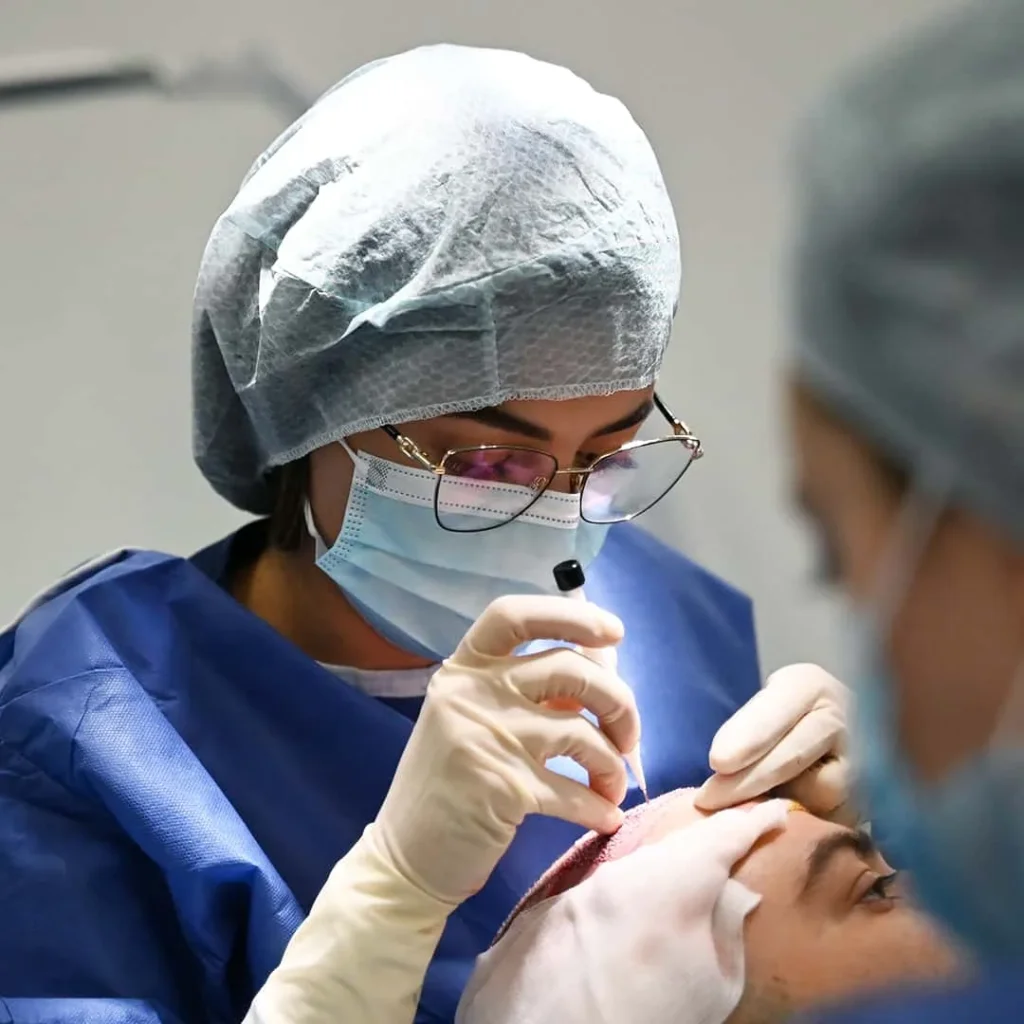
Patients planning their medical leave frequently search for how long does a 4000 graft hair transplant take to complete. Because it involves extracting and implanting thousands of microscopic organs, this is a full day medical procedure. A high quality mega session takes between eight and ten hours.
Speed is a massive risk factor in hair restoration. Rushing a 4000 graft session causes surgical transection, which destroys the follicles. A disciplined medical team works at a steady, methodical pace. This approach manages surgeon fatigue and protects the viability of the grafts.
Executing High Volume FUE Extraction Safely
The surgical timeline for a mega session is strictly divided into highly controlled clinical phases. The team must manage local anaesthesia levels continuously to verify patient comfort throughout the long day.
- Morning Phase (4 Hours). The patient lies face down. The surgeon uses micro motor punches to extract the 4000 units one by one from the occipital and parietal donor zones.
- Preservation Phase. As grafts are removed, technicians immediately sort them under microscopes and submerge them in HypoThermosol cooling baths to suspend their metabolic rate.
- Lunch Break. A short rest period allows the patient to eat and the medical team to reset for the implantation phase.
- Afternoon Phase (4 to 5 Hours). The patient sits upright. The clinical team loads the follicles into DHI implanter pens. The surgeon injects the grafts directly into the frontal and mid scalp areas.
- Biological Support. Platelet Rich Plasma is administered to flood the recipient area with growth factors, accelerating tissue repair.
4000 Grafts Hair Transplant Result Expectations
Patients investing in a mega session want to know when they will see the final 4000 grafts hair transplant result. The timeline follows a strict biological cycle. This is not an instant cosmetic fix; it is a physiological tissue transplant.
Within the first three to four weeks, the newly implanted hair will shed completely. This is a natural response to surgical trauma known as shock loss. The scalp will look exactly as it did before the surgery. Permanent new hair growth begins around the third or fourth month. Initially, this hair is fine and transparent. Between month six and month nine, the hair shafts thicken significantly. The absolute final aesthetic density is achieved between twelve and fifteen months post operation.
Managing Donor Area Depletion Risks
The biggest clinical risk of a 4000 graft session is donor area depletion. The average human donor area only contains about 6000 to 8000 lifetime available grafts. Extracting 4000 units in a single day removes roughly half of the patient total reserve.
If the medical team extracts these grafts too closely together, the back of the head will look permanently thin, patchy, and moth eaten. To prevent this, Hairtec surgeons utilize a strict geometric extraction pattern. They harvest only a fraction of the available hair in any given square centimeter. By using ultra fine 0.7mm to 0.85mm punches, the tiny circular wounds heal completely within a week, leaving no visible scarring when the surrounding hair grows out a few millimeters.
Hairtec Medical Standards for Mega Sessions in the Netherlands
Executing a 4000 graft mega session safely requires an elite and disciplined clinical environment. Hairtec operates under the stringent healthcare regulations of the Dutch medical system in Delft, Netherlands. This framework prioritizes absolute patient safety, strict cross infection controls, and data driven surgical outcomes over commercial volume.
For massive FUE procedures, minimizing tissue trauma is the primary goal. Hairtec implements specific clinical protocols to manage the biological stress placed on the scalp during a ten hour surgery.
| Clinical Protocol at Hairtec | Medical Benefit for 4000 Grafts |
|---|---|
| DHI Pen Implantation | Eliminates pre cut channels, reducing massive scalp bleeding. |
| HypoThermosol Storage | Keeps 4000 extracted follicles alive during long out of body wait times. |
| Geometric Extraction | Prevents the donor area from appearing permanently moth eaten. |
| Intraoperative PRP | Floods the damaged scalp with growth factors for rapid healing. |
Hairtec caters specifically to an international demographic requiring mega sessions. Navigating a major surgery in a foreign country requires structured support. For patients traveling from London and other UK cities, the clinic provides a fully managed logistical pathway:
- Remote Donor Assessment. Secure digital diagnostics verify that your donor area can actually support a 4000 graft extraction safely.
- VIP Logistics. Private airport transfers upon arrival in the Netherlands verify a controlled, stress free experience.
- Premium Accommodation. Private clinical accommodation allows the medical team to monitor your immediate recovery.
- Structured Aftercare. Medical washing protocols and long term digital follow ups protect the surgical investment.
How Much is a 4000 Graft Hair Transplant?
Financial planning is critical for a surgery of this magnitude. Individuals researching how much is a 4000 graft hair transplant will encounter completely different pricing models depending on the region and the operational structure of the clinic. The hair transplant cost for 4000 grafts reflects the massive clinical labor required, occupying an entire surgical theater and a full team of specialists for a ten hour day.
4000 Grafts Hair Transplant Cost UK Pricing
When searching for 4000 grafts hair transplant cost uk options, patients immediately notice the financial barrier. Clinics in central London typically operate on a strict per graft basis to cover their high real estate overheads.
Multiplying a high premium rate by 4000 grafts creates an astronomical final bill. Furthermore, local clinics often charge separate fees for necessary medical support, billing PRP therapy, blood tests, and post operative medications as expensive add ons. This makes a mega session financially unviable for many UK residents.
Hair Transplant Turkey 4000 Grafts Cost vs European Clinics
To avoid the inflated UK costs, a massive volume of patients look abroad. The hair transplant turkey 4000 grafts cost is famous for being incredibly low. However, this extreme low cost often comes with a severe compromise in medical safety. Many commercial Turkish clinics operate as high volume mills, delegating the entire surgery to uncertified technicians rather than medical doctors, leading to overharvested donor areas and failed results.
Regulated European clinics provide the ideal clinical middle ground. Facilities in the Netherlands offer comprehensive medical packages based on the surgical session rather than a per graft count. This structured pricing model provides total financial transparency. It allows patients to access doctor led surgery, advanced DHI technology, and strict European medical standards without the localized London price tag or the risks associated with unregulated commercial tourism.
Frequently Asked Questions About 4000 Graft Hair Transplant
How much area does 4000 grafts cover?
At a standard clinical packing density, it covers approximately 100 square centimeters of completely bald scalp. This provides enough volume to rebuild a completely receded frontal hairline, the temporal peaks, and carry significant density well into the mid scalp region.
How much is a 4000 graft hair transplant in the UK?
Pricing in the UK is exceptionally high because most clinics charge a premium rate per individual graft. For a mega session of this size, the final bill is often restrictive. Regulated European clinics provide comprehensive surgical packages that offer a much more predictable financial structure.
How long does a 4000 graft hair transplant take?
A mega session of this magnitude takes between eight and ten hours to complete. It is a full day medical procedure. The surgical team works at a deliberate, steady pace to minimize tissue trauma, protect the extracted follicles, and manage your comfort.
Is 4000 grafts enough for a full head?
It is rarely enough to provide high density coverage from the front hairline all the way back through a completely bald crown. Medical teams prioritize using the 4000 grafts to build a strong, dense frontal frame and mid scalp, often leaving the crown for a potential second session.
What is the hair transplant cost for 4000 grafts in Europe?
Regulated clinics in countries like the Netherlands offer fixed price packages for the surgical day rather than charging per graft. This inclusive model covers the surgical fee, advanced tools like DHI pens, PRP biological therapy, and VIP logistics for international patients.
Does a FUE hair transplant 4000 grafts leave visible scars?
No. The modern FUE extraction method utilizes microscopic titanium punches that leave tiny circular micro wounds. These wounds heal completely within a week. Once your remaining donor hair grows out a few millimeters, the extraction sites are invisible to the naked eye.
Can my donor area support exactly 4000 grafts?
This depends entirely on your genetic donor capacity. The average human donor area holds 6000 to 8000 lifetime grafts. A rigorous digital consultation and mathematical assessment are required to confirm if your specific donor zone can safely yield 4000 grafts without appearing depleted.
When will I see the final 4000 grafts hair transplant result?
The newly implanted hair will shed within the first month due to normal surgical shock. Permanent new growth begins around month three or four. The hair will continue to thicken and mature, reaching its absolute final aesthetic density twelve to fifteen months after surgery.
Can I split 4000 grafts into two separate sessions?
Yes. If a patient has a tight scalp or a highly sensitive donor area, the medical team may recommend splitting the mega session into two smaller 2000 graft procedures spaced six to twelve months apart to maximize safety and graft survival.
What is the survival rate for a large 4000 graft session?
When executed under strict clinical protocols using advanced DHI tools and proper cold storage solutions, the permanent survival rate exceeds 90 percent. Integrating PRP therapy during the long surgery further supports high survival rates by stimulating immediate blood flow to the scalp.
How we reviewed this article:
Hairtec.co.uk has strict sourcing guidelines and relies on peer-reviewed studies, academic research institutions, and medical journals and associations. We only use quality, credible sources to ensure content accuracy and integrity. You can learn more about how we ensure our content is accurate and current by reading our editorial policy.
- Gabel S (2013). Megasessions: surgical indications and technical perspectives. Facial Plastic Surgery Clinics of North America https://pubmed.ncbi.nlm.nih.gov/24017983/
- Unger WP (2005). Hair transplantation: current concepts and techniques. Journal of Investigative Dermatology Symposium Proceedings https://pubmed.ncbi.nlm.nih.gov/16382670/
- Bernstein RM, Rassman WR (1997). Follicular transplantation: patient evaluation and surgical planning. Dermatologic Surgery https://pubmed.ncbi.nlm.nih.gov/9311372/
Our experts continually monitor the health and wellness space, and we update our articles when new information becomes available


