
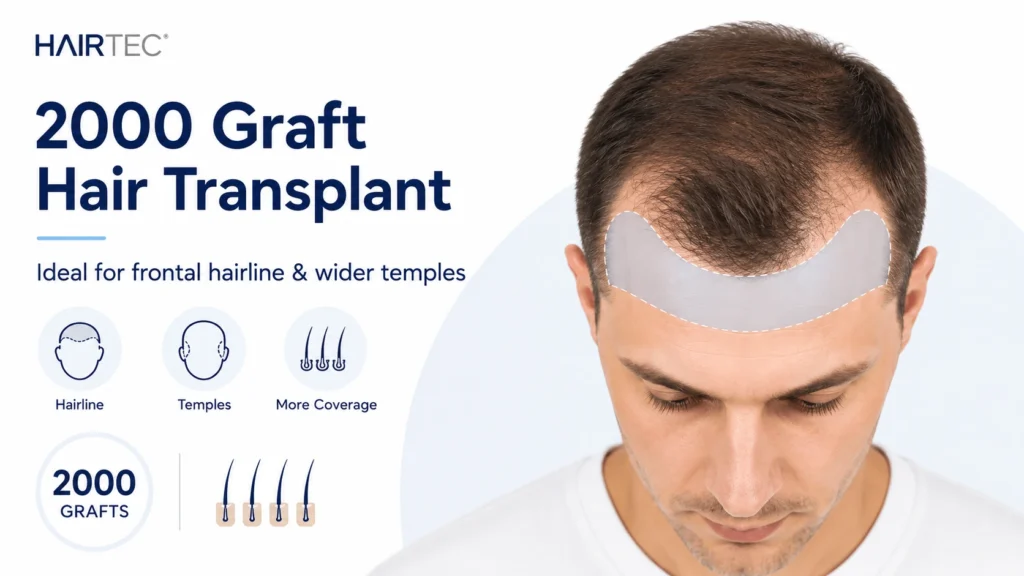
A 2000 graft hair transplant is the clinical standard for correcting moderate frontal hair loss and deep temporal recession. This specific volume provides enough density to rebuild a strong structural boundary without over harvesting the donor area at the back of the head. It represents a precise mathematical balance between achieving a significant aesthetic impact and preserving long term donor capacity for potential future use.
Executing a mid sized session requires strict clinical discipline and advanced architectural planning. The Hairtec medical team must map the recipient zone geometrically to distribute the follicles exactly where they provide the maximum visual coverage. When performed under strict Dutch medical protocols using direct implantation tools, this procedure reverses the visible signs of early stage genetic thinning and restores natural facial proportions permanently.
How Much Area Does a 2000 Grafts Hair Transplant Cover?
Patients frequently ask how much area a session of this size can actually restore. In clinical terms, a 2000 grafts hair transplant covers approximately forty to fifty square centimeters of bare scalp. This specific coverage relies on a high density packing of forty to fifty follicular units per square centimeter.
It is the ideal volume for patients sitting at a Stage 2 or Stage 3 on the Norwood scale of hair loss. However, the exact coverage area and the resulting visual density depend heavily on several distinct anatomical factors unique to the patient:
- Native Hair Caliber. The thickness of the individual hair shaft is measured in microns. Thicker hair shafts provide significantly better light blockage, allowing the grafts to cover a slightly larger area while appearing dense.
- Skin to Hair Contrast. High contrast between a pale scalp and dark hair requires tighter packing to eliminate the visibility of the scalp. Low contrast patients achieve the illusion of density with fewer grafts.
- Hair Texture. Wavy or curly hair naturally occupies more physical space, providing superior visual coverage compared to completely straight hair.
- Bone Structure. A wider forehead or a larger cranial circumference requires more follicles to rebuild the temporal boundaries accurately.
Restoring a Receding Hairline and Temporal Angles
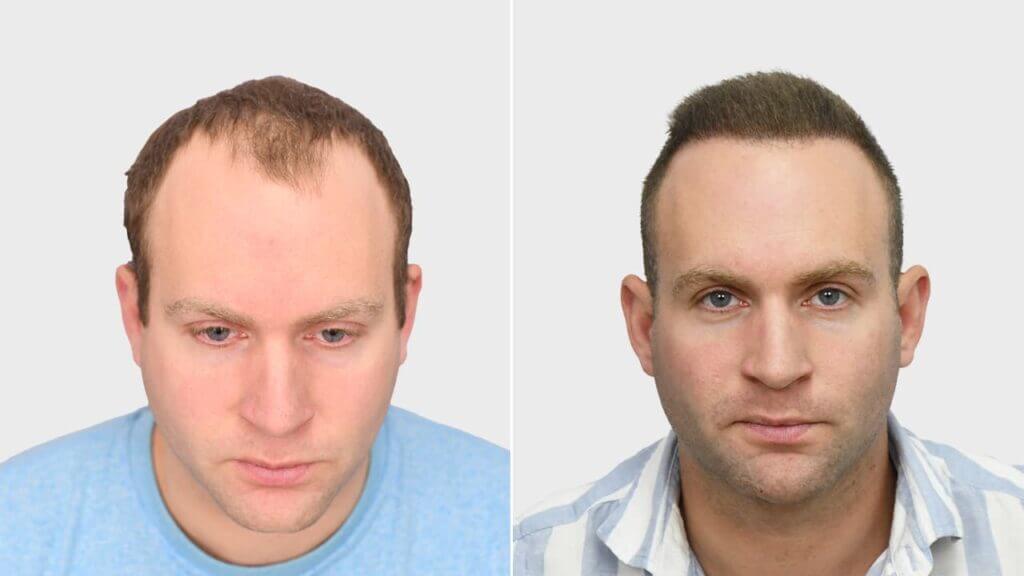
The most common application for this volume is rebuilding a receded hairline. As genetic hair loss progresses, the temporal peaks at the sides of the forehead push backward, creating a pronounced “M” shape. A 2000 graft hair transplant provides the exact amount of follicles needed to pull these temporal angles forward and frame the face correctly.
The Hairtec medical team divides the grafts strategically to prevent a pluggy, artificial appearance. This requires building the hairline in three distinct zones:
- The Transition Zone. Soft, single hair follicles extracted from the lower neck are used to create the very first few millimeters of the hairline. This creates a natural, slightly irregular edge.
- The Defined Zone. Moving backward from the transition zone, the surgeon places two hair follicular units to rapidly increase the visual density.
- The Frontal Tuft. Three and four hair units are packed tightly in the center behind the defined zone to build an impenetrable wall of structural volume.
- The Temporal Peaks. Grafts at the sides are angled completely flat against the skin to mimic the natural downward and backward sweep of the native temporal hair.
Increasing Mid Scalp and Frontal Density
For patients experiencing diffuse thinning across the frontal band, rather than total baldness, this procedure acts as a powerful density multiplier. The surgeon implants the 2000 grafts directly between the existing weakened native hairs.
This approach requires high powered optical magnification. The clinical objective is to avoid surgical transection, which is the accidental cutting of the hidden native roots beneath the skin.
| Area of Hair Loss | Graft Requirement (Approx.) | Clinical Objective |
|---|---|---|
| Frontal Hairline Only | 1000 to 1500 Grafts | Lowering an intact but high hairline |
| Deep Temporal Recession | 1500 to 2000 Grafts | Rebuilding receded temporal peaks |
| Frontal Band + Temples | 2000 to 2500 Grafts | Full anterior boundary reconstruction |
| Mid Scalp Density | 1500 to 2000 Grafts | Thickening existing diffuse native hair |
| Full Crown Area | 2500+ Grafts | High density packing for a bald vertex |
How Long Does a 2000 Graft Hair Transplant Take?
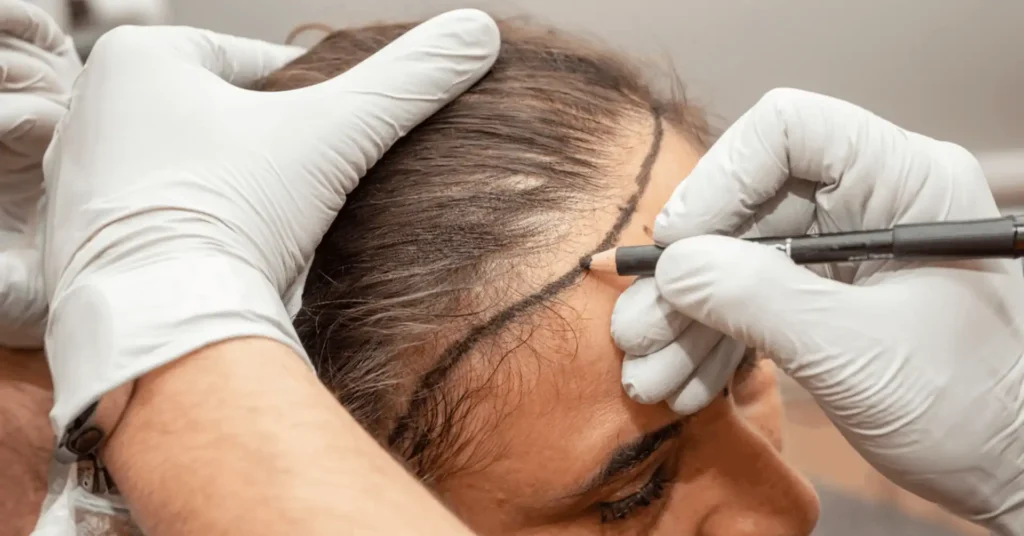
Patients planning their professional downtime often search for how long does a 2000 graft hair transplant take from start to finish. Because it is a moderate volume, the surgery is completed in a single day. A high quality clinical team takes between six and eight hours to complete the session.
Rushing a procedure of this size severely compromises the survival rate of the grafts. Follicles are microscopic organs that begin to degrade the moment they lose their blood supply. Operating at a steady, disciplined pace allows the medical team to manage graft viability, maintain patient comfort, and prevent the surgeon from experiencing visual fatigue.
Clinical Timelines for FUE Extraction and DHI Implantation
The surgical day is broken down into highly controlled and distinct medical phases. Each phase requires specific tools and specialized staff coordination:
- Morning Extraction (2 to 3 Hours). The surgeon uses a micro motor to harvest 2000 follicular units. The team utilizes ultra fine 0.7mm to 0.8mm titanium punches to prevent donor scarring and protect the surrounding follicles.
- Cold Storage Protocol. Extracted grafts are immediately sorted under a microscope and placed in specialized cooling solutions, such as HypoThermosol. This drops their metabolic rate and maintains cellular viability outside the body.
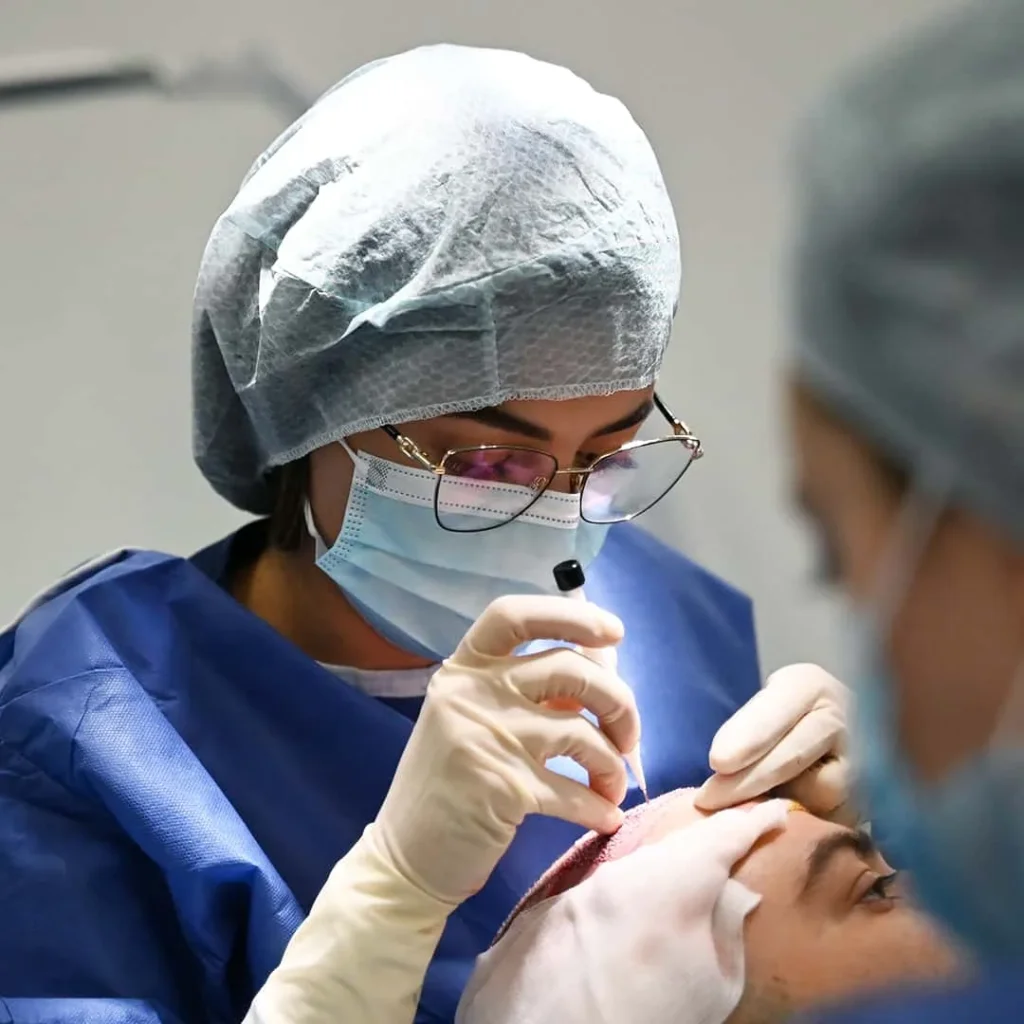
- Afternoon Implantation (3 to 4 Hours). The team loads the follicles into specialized DHI implanter pens. The surgeon implants them one by one into the recipient zone without the need to cut pre made channels.
- Biological Support. The clinical team administers Platelet Rich Plasma therapy simultaneously to accelerate tissue repair and stimulate angiogenesis.
Hairtec Medical Standards for 2000 Grafts in the Netherlands
Executing a flawless 2000 graft session requires a highly disciplined clinical environment. Hairtec operates under the stringent medical regulations of the Dutch healthcare system in Delft, Netherlands. This European framework prioritizes absolute patient safety, strict facility sterilization, and data driven aesthetic results.
The Hairtec medical team utilizes advanced DHI pens exclusively for the implantation phase. Traditional steel slit techniques require the surgeon to cut 2000 individual holes into the scalp before placing the hair, causing significant tissue trauma. The DHI pen eliminates this step. The sharp tip pierces the skin and places the follicle simultaneously. This provides absolute control over the depth, angle, and direction of every single hair.
For patients traveling from London and other UK cities, Hairtec provides a fully managed logistical pathway:
- Digital Diagnostics. Secure digital consultations for accurate graft calculation and donor capacity assessment before travel.
- VIP Logistics. Private airport transfers upon arrival in the Netherlands to verify a stress free experience.
- Clinical Accommodation. Premium private accommodation near the clinic to monitor the immediate recovery phase.
- Post Operative Care. Controlled medical washing and discharge protocols before returning to the UK.
Medical Protocols for a Hair Transplant 2000 Grafts Procedure
Executing a hair transplant 2000 grafts procedure successfully requires strict adherence to medical protocols that protect the health of the entire scalp. The extraction zone must be managed carefully to avoid a depleted look at the back of the head.
The Hairtec medical team operates strictly within the Safe Donor Area. This is the horseshoe shaped region at the back and sides of the head where follicles are genetically resistant to dihydrotestosterone. The team employs a geometric extraction pattern, taking only one out of every five available hairs in a specific micro zone. This leaves the donor area looking completely untouched once the hair grows out a few millimeters.
Unshaven Methods and PRP Biological Support
Because 2000 grafts is a moderate volume, it sits exactly on the borderline for Unshaven FUE protocols. For patients in corporate or public facing roles, shaving the entire head is a major psychological barrier.
If the patient has sufficient hair length, the clinical team executes a concealed extraction. They shave only a small horizontal window at the back of the head. The long hair resting above this window falls naturally over the extraction site, completely hiding the surgery. The recipient area at the front is not shaved at all, allowing professionals to return to work rapidly.
To support the rapid healing of these 2000 micro incisions, Platelet Rich Plasma is utilized. A blood sample is centrifuged to isolate the growth factors. This plasma is injected into the scalp to reduce post operative redness, minimize the risk of shock loss in existing hairs, and provide immediate nutrients to the new grafts.
How Much is a 2000 Graft Hair Transplant?
Financial planning is a core component of the clinical pathway. Patients researching the 2000 graft hair transplant cost notice significant variations depending on geographical location, facility standards, and the medical tools utilized. The cost is not just about the number of hairs; it reflects the surgical safety and the longevity of the results.
Pricing models generally fall into two distinct categories across Europe. Local clinics often charge per individual graft. This model inflates the final price rapidly when the surgeon realizes more grafts are needed mid surgery to perfect the density. Conversely, the medical tourism model typically offers comprehensive packages, providing a fixed rate for the entire clinical session.
2000 Grafts Hair Transplant Cost UK vs European Clinics
When individuals search for how much for 2000 grafts hair transplant uk fue, they often find premium rates in central London locations like Harley Street. These localized costs cover extremely high facility overheads. Furthermore, UK clinics often charge extra fees for essential biological treatments like PRP or the use of advanced DHI pens.
To access superior clinical technology without the inflated local premium, many UK patients choose regulated clinics in the Netherlands. This provides total financial transparency before the patient books their travel. European medical packages consolidate the surgical fee, biological therapies, and VIP logistics into a single, predictable investment.
Frequently Asked Questions About 2000 Graft Hair Transplant
Is 2000 grafts enough for a receding hairline?
It is typically the ideal volume for a moderate receding hairline. It provides enough follicular units to rebuild the temporal peaks and create a strong, dense frontal boundary without compromising the safe donor area at the back of the head.
How much for 2000 grafts hair transplant UK FUE?
Prices in the UK vary significantly depending on the clinic location and the surgeon expertise. London clinics often charge premium rates based on a per graft calculation. Regulated European clinics provide comprehensive packages that offer higher technical standards at a more structured and predictable price point.
Can I get a 2000 grafts hair transplant without shaving?
It is entirely possible if you have adequate length in your existing donor hair. The clinical team can shave a small concealed window at the lower back of the head. A digital consultation is required to confirm if your specific donor density supports an unshaven protocol for this specific volume.
How long does it take for 2000 grafts to grow completely?
The timeline follows standard biological hair growth cycles. The newly implanted hair sheds within the first month due to surgical shock. Permanent growth begins at month three. The hair reaches its final aesthetic density and structural maturity between twelve and fifteen months after the surgery.
Will a 2000 graft hair transplant look natural?
When performed by a highly skilled medical team using DHI pens, the result is entirely natural. The surgeon mimics the exact angle and downward sweep of your native hair, and uses fine single hairs at the very front boundary to avoid any artificial or pluggy appearance.
Does a 2000 graft procedure leave a visible scar?
The FUE extraction method uses microscopic titanium punches that leave tiny dot marks rather than a linear scar. These micro wounds heal rapidly and become completely invisible to the naked eye once your surrounding donor hair grows back a few millimeters.
What is the survival rate for a 2000 graft hair transplant?
Under strict clinical protocols utilizing DHI tools and proper cold storage solutions like HypoThermosol, the survival rate typically exceeds 90 to 95 percent. The integration of PRP biological therapy further supports high survival rates by rapidly increasing blood flow to the newly implanted area.
How much donor hair is required for 2000 grafts?
Your donor area at the back and sides of the head must have a healthy, stable density. The medical team extracts the grafts evenly across a wide safe zone to verify that your donor area does not look thin, patchy, or over harvested after the surgical recovery.
Is 2000 grafts considered a large hair transplant session?
It is considered a medium sized session. Small sessions for minor touch ups usually involve 500 to 1000 grafts. Large mega sessions for extensive baldness can involve 3500 to 4000 grafts. A 2000 graft session balances high visual impact with a rapid physiological recovery.
How long is the recovery time for 2000 grafts?
The physical healing of the micro incisions takes about seven to ten days. During this time, minor crusting and slight swelling are visible. Most patients can return to remote work within 48 hours and resume normal public and social activities within two weeks once the crusts naturally wash away.
How we reviewed this article:
Hairtec.co.uk has strict sourcing guidelines and relies on peer-reviewed studies, academic research institutions, and medical journals and associations. We only use quality, credible sources to ensure content accuracy and integrity. You can learn more about how we ensure our content is accurate and current by reading our editorial policy.
- Bernstein RM, Rassman WR (1997). The aesthetics of follicular transplantation. Dermatologic Surgery https://pubmed.ncbi.nlm.nih.gov/9311373/
- Nakatsui T, Wong J, Groot D (2008). Survival of densely packed follicular unit grafts using the lateral slit technique. Dermatologic Surgery https://pubmed.ncbi.nlm.nih.gov/18462426/
Our experts continually monitor the health and wellness space, and we update our articles when new information becomes available


