
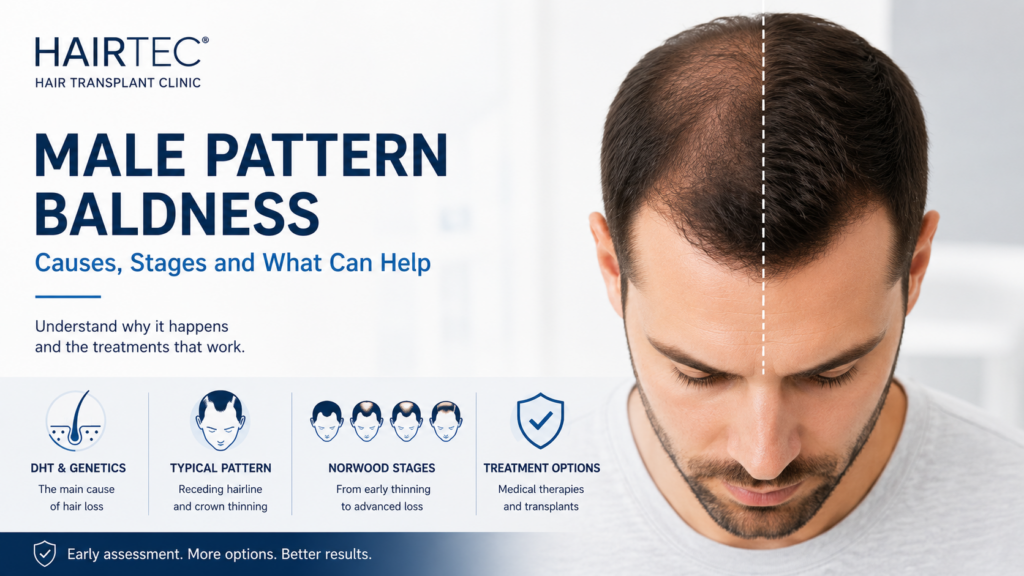
Male pattern baldness, known medically as androgenetic alopecia, is the most common cause of hair loss in men. Certain follicles are genetically sensitive to the hormone DHT, and over successive growth cycles they shrink, so the hair grows back finer and shorter until it eventually stops. The hairline and the crown are the first areas to show it. This is a slow condition. For most people it plays out over a decade or more, not overnight, which is partly why it is so easy to dismiss in the early stages.
What is male pattern baldness?
The condition is hereditary, with a hormonal trigger, and it runs in families across generations. It is also very common. The proportion of men affected rises steadily with age, and by around 50 about half show noticeable thinning. That share keeps climbing into the older decades.
There are a lot of misconceptions about it. Male pattern baldness is not brought on by poor hygiene, wearing hats or periods of stress. Genetics and hormones are what drive it. For the wider range of reasons hair thins or falls out, our overview of hair loss sets out the other causes.
What causes male pattern baldness?
The main factor is dihydrotestosterone, or DHT, a hormone the body produces from testosterone through an enzyme called 5-alpha-reductase. In men with an inherited sensitivity, the follicles across the top and front of the scalp react to it. Each hair cycle leaves the follicle a little smaller, and the new hair returns thinner and lighter. Clinicians call this miniaturisation. Given enough cycles, the follicle produces little or no visible hair at all.
Two factors have to combine for this to happen:
- Genetics. Sensitivity to DHT is inherited, and it can come down from either the mother’s or the father’s side.
- Hormones. DHT is the trigger, but it only acts on follicles that were genetically primed to react to it.
The same mechanism is why the hair at the back and sides tends to hold while the top thins. Those follicles barely respond to DHT and keep growing normally, and it is exactly this resistant band of hair that supplies the donor grafts in a transplant.
Common myths about the cause
Plenty of widely held beliefs are simply wrong. None of these cause male pattern baldness:
- Wearing hats or helmets.
- Frequent washing, or the shampoo you use.
- Blocked pores or an oily scalp.
- Stress or diet. Both can cause temporary shedding, which is a different thing, but neither is behind androgenetic alopecia.
How to recognise male pattern baldness
It follows a characteristic pattern, and that pattern is one of the clearest ways to identify it. Usually it starts in one or both of two places:
- The hairline. It recedes at the temples, often forming an M shape.
- The crown. The area at the top and back of the head thins and slowly widens.
Given time these areas can spread and, in some men, meet, while the hair around the sides and lower back stays put. The change is so gradual that many men only catch it in a photograph, or when a barber mentions it. In the clinic, that second-hand glimpse of the crown is often what prompts a first consultation, rather than the loss itself.
The table below sets the signs typical of male pattern baldness against those that are worth checking in case another condition is involved.
| Consistent with male pattern baldness | Worth checking for another cause |
| Gradual thinning at the temples and crown | Hair shedding suddenly or in handfuls |
| Similar hair loss elsewhere in the family | Round, patchy bald spots |
| A healthy scalp, no other symptoms | A red, sore, scaling or itchy scalp |
| Slow change over several years | Hair loss that arrives with other health changes |
The stages of male pattern baldness
Progression is measured on the Norwood scale, which runs from a full hairline through to advanced loss. Knowing the stage is not just academic. It is what decides whether medical treatment alone is realistic, or whether a transplant is the more sensible route. Our guide to the Norwood scale walks through each stage.
How is male pattern baldness diagnosed?
Most of the time the pattern of thinning and a person’s family history are enough to make the call. To be sure, a clinician might look at the scalp more closely with trichoscopy, and occasionally order blood tests to rule out other factors that pull hair down, such as thyroid problems or low iron.
The assessment earns its place because not every case is androgenetic. Sudden shedding, patchy bald spots or an inflamed, flaking scalp can mean something else that needs its own treatment. Where the loss ties into alopecia more broadly, our page on alopecia and hair transplants goes further.
Can hair grow back from male pattern baldness?
That comes down to how far things have gone. Follicles that have started to shrink but are still active can often respond to treatment, and starting early improves the odds of keeping what is there. Once a follicle has been dormant for years, it will not come back on its own. So an earlier look usually leaves more doors open.
Keep expectations grounded, though. There is no cure at present. What treatment can do is slow the loss and, for many men, win back some of the ground given up recently.
Treatment options for male pattern baldness
No single treatment suits everyone. The right route depends on the stage, general health, and what the person actually wants out of it. Here are the main options, and our guide to hair loss treatments looks at each in more depth.
| Option | What it is | Worth knowing |
| Topical minoxidil | A solution or foam worked into the scalp to slow loss and, for some men, thicken regrowth | No prescription needed, but it works only while it is used and results vary |
| Oral finasteride | A daily tablet that cuts the DHT reaching the follicles | Prescription only, carries possible side effects, not right for everyone, and used after medical advice |
| Low-level laser and PRP | Supportive treatments meant to give the scalp and existing hair a lift | Evidence is thinner here and outcomes are harder to predict |
| Hair transplant | Moves DHT-resistant follicles from the back and sides into the thin areas | Best for established loss; it does not stop loss elsewhere, so it forms part of a longer plan |
Every option comes with trade-offs, and an individual assessment is what separates a sensible plan from guesswork. One thing that often surprises people in a consultation is that a transplant does nothing to slow the original loss, so it usually sits alongside medical treatment rather than replacing it. If a transplant is on the table, our comparison of the DHI and Saffier FUE techniques explains how the modern methods differ.
When to seek professional advice
Because it only moves in one direction, an early assessment tends to give the widest set of options while there is still hair to protect. It is worth getting advice sooner rather than later if you notice any of these:
- Hair loss that is sudden or unusually fast.
- Bald patches instead of an even, gradual thinning.
- A scalp that is red, sore, flaking or itchy.
- Hair loss that shows up alongside other changes in how you feel.
Any of these can point to a different underlying cause that needs its own treatment.
The role of our doctors at Hairtec
Our team includes BIG-registered doctors, listed on the official Dutch medical register, working alongside experienced hair specialists. The doctors lead the consultation and the medical assessment, and they stay involved in the aftercare once treatment is done. In a consultation they read the pattern of loss, go through medical history and what the person is hoping for, then give a straight answer on which options are realistic. That medical oversight is what keeps the advice honest and matched to the person in the chair, not a one-size-fits-all pitch.
Frequently asked questions about male pattern baldness
What causes male pattern baldness?
An inherited sensitivity of the scalp follicles to DHT. The hormone slowly shrinks those follicles, so the hair they grow gets finer and shorter until it stops.
How is male pattern baldness treated?
There is no cure, but you can slow it down and sometimes recover recent loss. Treatments run from prescription and over-the-counter options, used with medical advice, through to a transplant once the loss is established. What fits depends on the stage and an individual assessment.
Can hair grow back from male pattern baldness?
Follicles that are shrinking but still active can often respond to treatment, especially early on. Ones that have sat dormant for years will not regrow by themselves, though a transplant can refill those areas with DHT-resistant follicles from the back and sides.
At what age does male pattern baldness start?
Any time after puberty. For a lot of men it shows up in their twenties or thirties, and it becomes more common with every decade that passes.
Is male pattern baldness inherited from the mother’s or father’s side?
Either side. The old idea that it only comes down through the mother is wrong.
How we reviewed this article:
Hairtec.co.uk has strict sourcing guidelines and relies on peer-reviewed studies, academic research institutions, and medical journals and associations. We only use quality, credible sources to ensure content accuracy and integrity. You can learn more about how we ensure our content is accurate and current by reading our editorial policy.
- Randall VA (2008). Androgens and hair growth. Dermatologic Therapy https://doi.org/10.1111/j.1529-8019.2008.00214.x
- Lolli F, Pallotti F, Rossi A et al. (2017). Androgenetic alopecia: a review. Endocrine https://doi.org/10.1007/s12020-017-1280-y
- Kaufman KD, Olsen EA, Whiting D et al. (1998). Finasteride in the treatment of men with androgenetic alopecia. Journal of the American Academy of Dermatology https://doi.org/10.1016/s0190-9622(98)70007-6
Our experts continually monitor the health and wellness space, and we update our articles when new information becomes available


