Hairtec Hair Transplant Clinic

Female pattern baldness is a highly prevalent genetic condition medically identified as female androgenetic alopecia. It affects millions of women globally and represents the leading cause of progressive hair loss in the female demographic. This condition triggers a gradual miniaturization of the hair follicles, leading to a permanent reduction in total scalp density.
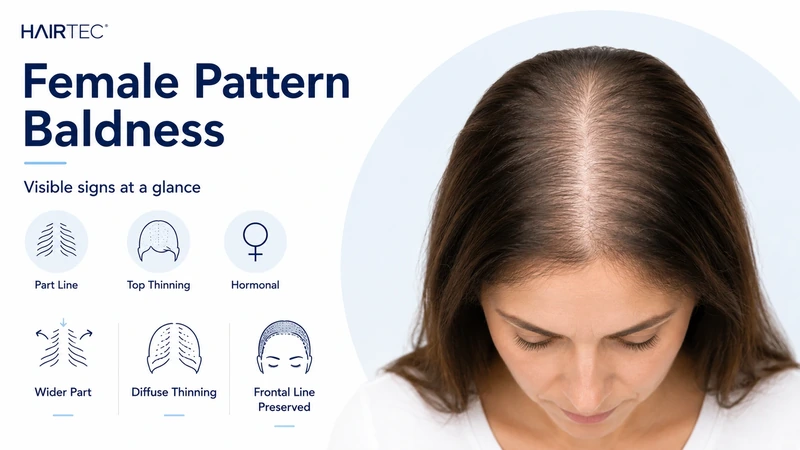
Unlike male hair loss, which typically presents as a distinct receding hairline or a bald patch on the crown, female pattern balding operates differently. The structural boundaries of the hairline usually remain intact, while the hair across the mid scalp thins diffusely. Addressing this condition requires early clinical intervention to stabilize the hormonal environment and protect the vulnerable follicles from permanent degradation.
Patients consistently ask dermatologists what causes female pattern baldness on a biological level. The condition is driven by a complex intersection of genetics, cellular aging, and endocrine system activity.
The human scalp contains thousands of hair follicles that operate on a continuous cycle of growth, rest, and shedding. In women with androgenetic alopecia, this biological cycle is permanently altered. The active growth phase becomes significantly shorter, while the resting phase is prolonged. This imbalance means hair falls out faster than the body can replace it, and the new hair that does grow is structurally weaker.
The primary physiological catalyst for hair loss female pattern baldness is an inherited sensitivity to androgens. Androgens are male sex hormones that are naturally present in the female body in smaller, highly regulated quantities.
A frequent clinical question is can females get male pattern baldness. While rare, women can exhibit the distinct Norwood scale hair loss patterns typically seen in men. This includes deep temporal recession, a noticeably receding anterior hairline, and vertex balding.
When a woman presents with these specific symptoms, medical professionals categorize it as a male pattern presentation of androgenetic alopecia. This clinical presentation always requires extensive blood panels to rule out underlying systemic disorders before any treatment protocol is established.
Understanding what causes male pattern baldness in females involves identifying severe endocrine disruptions. The primary medical trigger is a state of hyperandrogenism, where the female body produces an abnormally high concentration of male sex hormones.
This hormonal imbalance is most frequently associated with Polycystic Ovary Syndrome (PCOS). Women with PCOS experience elevated testosterone levels, which convert into Dihydrotestosterone. This potent hormone aggressively attacks the hair follicles at the temples and crown. Other medical causes include adrenal gland disorders, ovarian cysts, or specific thyroid imbalances that disrupt the entire endocrine system.
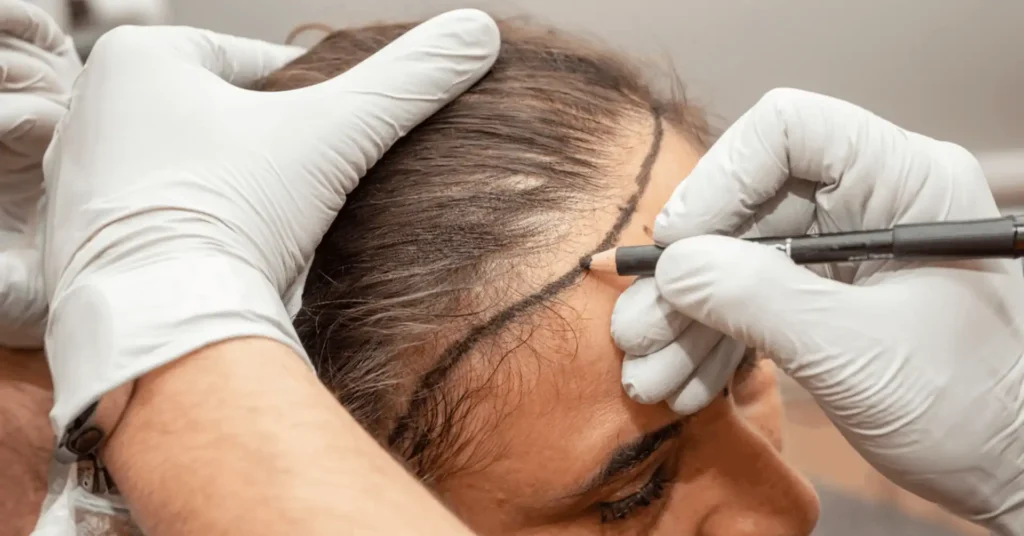
Identifying the condition early is the most critical factor in successful medical management. Patients often wonder how do you know if you have female pattern baldness versus a temporary shedding condition like telogen effluvium.
Female pattern balding is characterized by its gradual, insidious onset. It does not happen overnight. Medical professionals look for specific visual markers to confirm the diagnosis. The most obvious sign is a widening of the central parting. As the follicles along the top of the head miniaturize, the scalp becomes increasingly visible under normal lighting conditions.
| Clinical Symptom | Indicator of Female Pattern Baldness | Indicator of Temporary Shedding |
|---|---|---|
| Shedding Volume | Gradual, localized thinning over years | Sudden, massive daily hair fall |
| Affected Area | Primarily the top and crown of the head | Diffuse shedding across the entire scalp |
| Hairline Status | Frontal hairline usually remains intact | Hairline may feel uniformly thinner |
| Hair Texture | New hairs are finer, lighter, and weaker | Hair texture remains relatively unchanged |
While classic female androgenetic alopecia affects the mid scalp, some patients experience frontal female pattern baldness. This specific presentation requires careful dermatological differentiation.
If the hairline is actively receding and scarring is present, the diagnosis may shift to Frontal Fibrosing Alopecia. This is a distinct condition where the immune system attacks the hair follicles at the front of the scalp, destroying them permanently and replacing the tissue with a smooth scar. If no scarring is present, a receding hairline in women points directly to the hyperandrogenism factors mentioned previously.
While often associated with menopause, female pattern baldness in 20s is a documented clinical reality. When the genetic predisposition is strong, the biological triggers can activate shortly after puberty.
For young women, the onset is usually tied to early hormonal fluctuations, the initiation or cessation of oral contraceptives, or the early development of PCOS. Early warning signs include a noticeable decrease in ponytail volume, an inability to grow hair past a certain length without it looking stringy, and an increased visibility of the scalp when the hair is wet.

Patients actively researching a female pattern baldness treatment will find that clinical efficacy relies entirely on consistency. Because the condition is genetic, there is no permanent cure that alters the patient DNA. Treatment protocols are designed to manage the symptoms, halt the active shedding, and thicken the existing miniaturized hairs.
Dermatologists approach treatment through a combination of topical stimulation and internal hormonal regulation. The goal is to create a physiological environment where the hair follicle can survive and extend its active growth phase.
When asking what to do for female pattern baldness, the first step is consulting a medical professional to establish a baseline. From there, specific clinical therapies are deployed.
A primary concern for patients is whether the damage is permanent. Can female pattern baldness be reversed entirely? Medically, the genetic condition itself cannot be cured. However, the visible symptoms can be significantly reversed if clinical intervention begins early enough.
If a hair follicle is in the process of miniaturization, it can be rescued. Clinical treatments can force the weakened follicle to produce a thicker, darker, and longer hair shaft, effectively reversing the appearance of baldness. However, if the follicle has been dormant for several years and the skin has completely healed over, it is dead. No non surgical medical treatment can resurrect a dead hair follicle.
Patients constantly ask can hair grow back from female pattern baldness once treatment begins. Yes, regrowth is clinically possible, but expectations must be managed medically.
The human hair growth cycle is incredibly slow. When starting a clinical treatment protocol, the newly stimulated hair follicles require three to four months just to exit the resting phase. Visible new growth usually takes six to nine months to appear, and peak density results require twelve to fifteen months of continuous, uninterrupted treatment. If the patient stops the medical therapies, the newly grown hair will shed, and the baldness pattern will resume within six months.
Our hair loss treatments overview explains which options apply at each stage.
It is a genetic and hormonal condition characterized by the progressive shrinking of hair follicles. It typically presents as diffuse thinning across the top of the scalp and a widening of the central parting, leading to a permanent decrease in total hair volume.
The severity of this pattern is graded clinically using the Ludwig scale, which maps the progression from early diffuse thinning to advanced density loss.
Yes. While uncommon, women experiencing severe hormonal imbalances such as hyperandrogenism can develop a receding hairline and deep temporal bald spots. This is clinically referred to as a male pattern presentation of female hair loss.
The earliest indicator is a noticeable widening of your natural parting. You may also notice your ponytail feeling significantly thinner, increased scalp visibility under bright lighting, and a change in hair texture where new growth appears fine and transparent.
This specific presentation is almost always caused by an excess of male sex hormones, specifically testosterone and Dihydrotestosterone. Underlying endocrine disorders like Polycystic Ovary Syndrome are the most common triggers for this severe hormonal imbalance.
Hair can grow back if the follicle is still alive but miniaturized. Clinical therapies can stimulate these weakened roots to produce thick, healthy hair again. However, if the follicle has been completely dead for years, the hair will not grow back without a surgical transplant.
The immediate first step is to consult a dermatologist or a specialized trichologist for a formal diagnosis and blood work. Avoid wasting time on cosmetic shampoos. You need clinically proven topical solutions or oral medications to stop the biological progression.
The genetic code causing the condition cannot be reversed or cured. You can reverse the visible symptoms and restore density using continuous clinical treatments. If you stop the medical protocol, the baldness will immediately return.
When continuous medical therapy no longer restores visible density, a hair transplant for women offers a permanent surgical solution.
Early onset in young women is typically driven by a strong genetic predisposition combining with a hormonal catalyst. This catalyst is often the onset of an endocrine disorder, extreme physiological stress, or significant shifts in hormone levels from starting or stopping oral contraceptives.
If the frontal baldness is caused by a scarring condition like Frontal Fibrosing Alopecia, surgery is generally not recommended because the immune system will attack the transplanted hair. If it is caused by stable genetic factors, a hair transplant is a highly effective, permanent solution.
There is no single best treatment for everyone. The most effective clinical approach is a combined protocol utilizing daily topical vasodilators to stimulate local blood flow alongside oral anti androgen medications to block the hormonal triggers causing the damage.