Hairtec Hair Transplant Clinic

Answer 7 quick questions and find out in under two minutes whether Sapphire FUE surgery, medication or PRP fits your stage of hair loss, with an estimated graft range if you are a candidate.
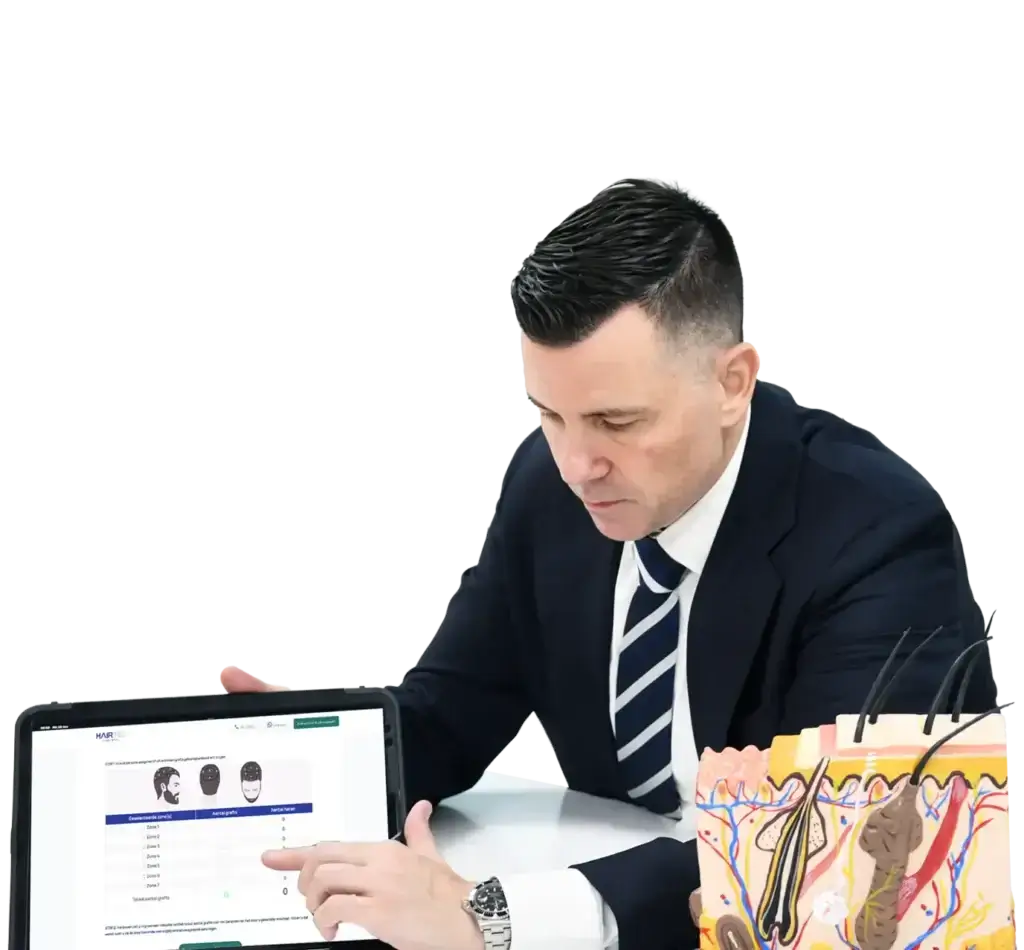
A suitability decision rests on three clinical factors, and the quiz screens all three before you speak to anyone.
Costs follow directly from the graft count, which you can check on our hair transplant costs page.
Good candidates share three things: a clear pattern of loss, a strong donor area at the back and sides, and hair loss that has stabilised. Age matters less than stability. A 45-year-old with steady Norwood 3 loss is usually a better candidate than a 22-year-old whose pattern is still changing.
When the quiz places you here it also names the technique that suits your pattern. We work with DHI, where an implanter pen places each graft directly between your existing hairs with full control over angle and density, and with Sapphire FUE, where sapphire blades open finer channels so a large area can be covered densely in one session. Larger cases are often planned as a combination of both.
Surgery is usually not recommended for diffuse unpatterned loss where donor hair is also thinning, active scalp conditions such as alopecia areata, very early loss that medication can still hold, or when the donor area cannot supply enough grafts for the goal. In these cases the quiz points you to PRP or medical treatment first, not a procedure that cannot deliver a lasting result.
Yes, but the assessment is different. Female hair loss is graded on the Ludwig scale rather than the Norwood scale, and diffuse thinning is more common, which makes donor stability the deciding factor. Women with a stable donor area and localised thinning, such as a widening parting or a hairline affected by traction, can achieve excellent FUE results. The quiz automatically switches to the female pathway and grades your answers on the Ludwig scale.
Not being a candidate today does not mean never. If the quiz points you away from surgery it recommends one of two routes: medication to stabilise active loss, or PRP therapy to strengthen thinning areas. Many patients return 12 to 18 months later with a stable pattern and become excellent transplant candidates, with a better long-term result than if they had rushed in. PRP is also used after surgery, so if you do go ahead later the same treatment supports your healing and the density of your grafts. You can see what a future procedure would cost on our hair transplant costs page.
Everything patients ask before finding out whether a hair transplant is right for them, from the right age and the Fox test to graft numbers and what happens if surgery is not the answer yet.
Not necessarily, but hair loss under 25 is often still progressing. Operating on an unstable pattern can leave transplanted hair isolated as native hair keeps receding. Our doctors usually stabilise loss with medication first, then confirm the right timing at a free assessment.
The most common reasons are an insufficient donor area, unstable or diffuse hair loss, active scalp conditions such as alopecia areata, certain uncontrolled medical conditions and unrealistic expectations. The quiz screens for the first three, and a photo assessment confirms the rest.
The FOX test is a small trial extraction in which a surgeon removes a few follicular units from the donor area to check how easily healthy grafts can be harvested by FUE. It helps confirm whether your donor hair is suitable before a full procedure is planned.
A mature hairline is an even recession of about 1–1.5 cm that stabilises and stays symmetrical. Balding shows progressive temple or crown loss, visible thinning and increased shedding. The Norwood-scale question in our quiz helps you tell the two apart.
In early stages minoxidil or finasteride can hold and partially regrow hair, so surgery may not be needed. Once an area is fully bald the follicles are gone and only transplanted grafts restore coverage. If the quiz places you at an early stage it recommends medication or PRP first, and many patients get the best result from a combination of both.
Age itself is rarely the limit, donor supply is. At advanced stages such as Norwood 6 and 7 there may not be enough donor hair for full coverage, so surgeons plan realistic partial coverage instead. A free assessment shows exactly what your donor area allows.
It is indicative, not diagnostic. The quiz uses the same first-line criteria our doctors check, meaning your pattern, its stability and your age, but it relies on what you report. That is why every result is followed by a free photo assessment before any recommendation is final.
It depends on your stage. Roughly 800 to 1,200 grafts at Norwood 2, 2,000 to 2,800 at Norwood 4 and 3,500 to 4,500 at Norwood 6. Women at Ludwig 2 usually need 1,500 to 2,500. Check your own zones with the hair graft calculator.
Every step toward a fuller head of hair starts with good advice. Schedule a free, no-obligation consultation and find out which treatment is right for you.
A personal consultation with our specialists to discuss your needs and options.
A detailed analysis of your scalp and hair follicles to determine the right approach.
The chosen hair transplant technique is carefully performed by our experienced team.
Professional support after your treatment to ensure optimal recovery and lasting results.