Hairtec Hair Transplant Clinic

Male pattern baldness is a highly common genetic condition medically classified as androgenetic alopecia. It is the leading cause of hair loss in adult men globally. This condition dictates a predictable sequence of follicular miniaturization, gradually transforming thick terminal hairs into thin, unpigmented vellus hairs before the follicles cease production entirely.
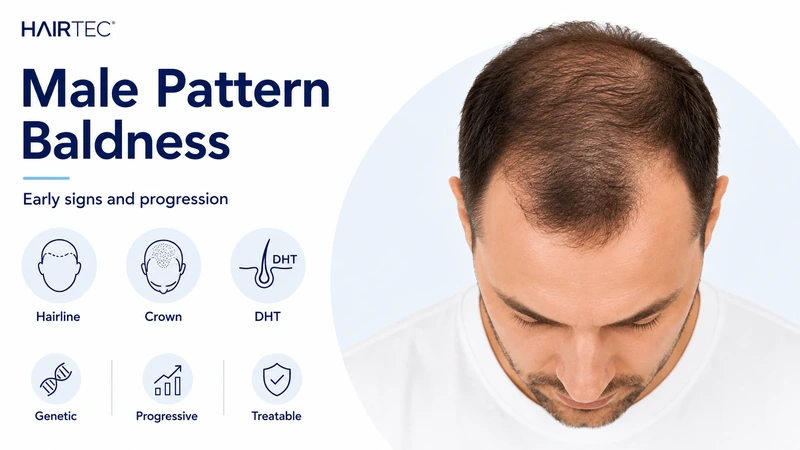
From a clinical perspective, this progressive condition is not a disease but a biological response to specific hormones. While it does not present any physical health risks, the aesthetic changes often prompt patients to seek medical intervention. Managing this condition requires a strict understanding of its genetic triggers and the exact stage of progression.
By analyzing the root causes, dermatologists and hair restoration specialists can map out effective clinical protocols. These protocols range from preventative therapies designed to halt active shedding to permanent surgical solutions that restore lost density.
Patients frequently ask what causes male pattern baldness at a biological level. The condition is triggered by a combination of genetic predisposition and the presence of specific male hormones called androgens. When these two factors align, the life cycle of the hair follicle is permanently altered.
The primary hormonal catalyst is Dihydrotestosterone. This is a highly potent androgen derived from free circulating testosterone. In patients with androgenetic alopecia, the hair follicles located at the front, top, and crown of the scalp possess a genetic sensitivity to this specific hormone.
The follicles at the back and sides of the head do not typically carry this genetic trait. This is why a male baldness pattern leaves a permanent horseshoe shape of hair, which surgeons utilize as a safe donor area during transplant procedures.
The interaction between genetics and Dihydrotestosterone dictates the speed and severity of the hair loss. When DHT binds to the androgen receptors on the susceptible hair follicles, it triggers a destructive biological process.

Determining when does male pattern baldness start depends entirely on the individual genetic code of the patient. There is no universal age of onset. The biological trigger can activate at any point after puberty once testosterone levels reach adult concentrations.
For a significant demographic, the initial signs of male pattern balding become visible in their late teens or early twenties. For others, the condition may remain dormant until their thirties or forties. Clinical statistics indicate that approximately twenty percent of men will experience noticeable recession by age twenty, and this percentage increases parallel to age.
Catching the condition early is the most critical factor in preserving native hair. Beginning male pattern baldness often presents subtle signs that are easily ignored until a significant volume of density is lost.
Medical professionals advise patients to monitor specific anatomical zones for early indicators. Recognizing these signs allows for prompt clinical intervention before the follicles die completely.
Clinical professionals do not evaluate hair loss through guesswork. They utilize a standardized visual metric to accurately diagnose the severity of the condition. Understanding the male pattern baldness stages is essential for determining which treatment pathway is mathematically viable for the patient.
The progression is highly predictable. It rarely involves random patches of baldness. Instead, the hairline retreats backward while the crown thins outward, eventually meeting in the middle of the scalp.
The Norwood scale is the international medical standard for classifying the stages of androgenetic alopecia. It divides the progression into seven distinct categories, providing a clear roadmap of the male hair baldness pattern.
| Norwood Stage | Clinical Presentation | Treatment Viability |
|---|---|---|
| Stage 1 | No significant hair loss or hairline recession. The baseline adolescent hairline remains intact. | Preventative monitoring only. |
| Stage 2 | Slight recession at the temporal angles creating a minor V shape. Often called a mature hairline. | Non surgical preventative therapies. |
| Stage 3 | Deep temporal recession forming a distinct M shape. This is the first stage considered clinical baldness. | Ideal stage for early surgical restoration and preventative care. |
| Stage 4 | Severe frontal recession and significant thinning at the crown vertex. A band of dense hair separates the two bald areas. | Moderate surgical intervention required for both zones. |
| Stage 5 | The band separating the front and crown becomes very narrow and sparse. Bald areas are highly prominent. | Large volume surgical mega sessions required. |
| Stage 6 | The separating band of hair disappears entirely. The front and crown merge into one large bald area. | High density coverage is difficult; conservative surgical planning needed. |
| Stage 7 | Only a narrow horseshoe band of hair remains at the back and sides. The top of the head is completely bald. | Surgical restoration options are severely limited by donor capacity. |

Patients actively researching a male pattern baldness treatment will encounter a massive medical and commercial market. Efficacy relies on selecting treatments backed by clinical data rather than cosmetic promises.
The clinical objective is divided into two distinct phases. The first goal is stabilizing the active shedding. The second goal is replacing the hair that has been permanently lost. A comprehensive approach often combines medical therapies to preserve native hair with surgical intervention to rebuild the damaged structural boundaries.
Learning how to stop male pattern baldness requires addressing the hormonal root cause. Clinical therapies focus on altering the environment of the scalp and protecting the vulnerable follicles from further androgen damage.
A frequent medical query is whether there is a definitive male pattern baldness cure. Biologically, there is no cure that alters a patient genetic code to eliminate the androgen sensitivity entirely. If preventative clinical therapies are stopped, the hair loss will immediately resume.
The only permanent solution for restoring lost density is a surgical hair transplant. Modern techniques like Direct Hair Implantation relocate genetically resistant follicles from the back of the head to the bald frontal zones. Because these donor hairs do not possess the DHT sensitive trait, they will continue to grow permanently in their new location, effectively bypassing the biological cause of the baldness.
Many patients express hesitation regarding clinical therapies and seek information on how to reverse male pattern baldness naturally. It is a strict medical fact that natural remedies cannot rewrite the genetic code or completely block systemic Dihydrotestosterone. Therefore, they cannot reverse advanced stages of genetic baldness.
However, optimizing scalp health and bodily wellness can slow the progression of early stage shedding and support the efficacy of clinical treatments. Natural approaches focus on minimizing environmental stressors and maximizing biological function.
Compare our hair loss treatments to understand which route suits your stage.
Clinically known as androgenetic alopecia, it is a genetic condition characterized by the progressive miniaturization of hair follicles. It is caused by an inherited sensitivity to Dihydrotestosterone, an androgen hormone that shrinks the follicles until they permanently cease hair production.
The genetics controlling hair loss are highly complex and polygenic. The traits responsible for androgen sensitivity can be inherited from either the maternal or paternal bloodlines. The belief that baldness is exclusively passed down through the mother side is a medical myth.
The condition is highly unpredictable and rarely stabilizes completely on its own. While the rate of shedding may fluctuate, the progression typically continues throughout the patient lifespan unless active clinical therapies are introduced to halt the miniaturization process.
Prevention requires early medical intervention. The most effective clinical protocols involve a combination of oral androgen blockers to lower systemic DHT levels and topical vasodilators to stimulate local blood flow and prolong the active growth phase of the follicles.
The speed of progression varies drastically between individuals based on their unique genetic code and the severity of their androgen sensitivity. Some men may progress from a Norwood Stage 2 to a Stage 5 in less than five years, while others may experience a slow, gradual thinning over several decades.
If a hair follicle has completely died and the scalp has become smooth and shiny, no non surgical treatment can bring it back to life. Clinical therapies can only thicken existing, weakened hairs and halt further loss. Permanent restoration of completely bald areas strictly requires surgical transplantation.
Yes. Severe physiological or emotional stress forces a massive number of hair follicles into a premature resting phase, causing a condition called telogen effluvium. When this rapid shedding occurs on top of existing genetic thinning, the overall rate of hair loss accelerates dramatically.
They are highly recommended by dermatologists. The earlier a patient begins preventative therapies, the more native hair they will preserve. Attempting to restore a massive area of baldness later in life is significantly more difficult and expensive than protecting the existing density early on.
No. Wearing hats, helmets, or caps does not cause genetic hair loss. The condition is driven entirely by internal hormones and genetics. However, consistently wearing extremely tight headgear can cause a separate physical condition known as traction alopecia due to constant friction and pulling.
For patients presenting at Norwood Stage 5 or higher, preventative therapies alone are insufficient to provide a cosmetic change. The primary clinical recommendation is a large volume hair transplant using advanced FUE or DHI methods to mathematically relocate resistant donor hair to the completely depleted zones.