
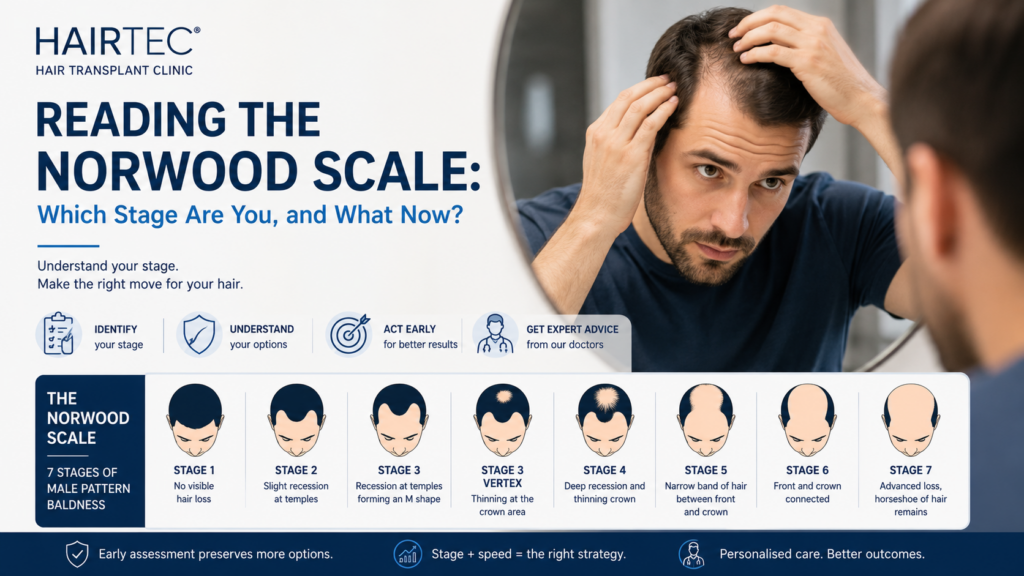
Most men meet the Norwood scale the same way. You are deep in a late-night search about a thinning crown, and up comes a row of seven little head diagrams, each balder than the last. Useful, but only halfway. Knowing the scale exists is one thing. Working out where you actually sit on it, and what that means for the next move, is the part nobody explains. This piece is that part. For the full breakdown of every stage with the diagrams, our main Norwood scale page has them laid out.
What the scale is, in one paragraph
The Norwood scale, sometimes called Hamilton-Norwood after the two doctors who developed and then refined it, is the standard map of male pattern hair loss. Seven stages. Stage 1 is a full head with no real recession. Stage 7 is the most advanced, a horseshoe of hair around the back and sides with the whole top bare. In between, the hairline retreats and the crown thins, sometimes separately, sometimes together. Clinicians reach for it constantly, because “you are around a Norwood 3” says more in four words than a paragraph of description ever could.
The seven stages, quickly
Before you place yourself, it helps to know what each stage actually looks like rather than just its number.
- Stage 1: no meaningful loss. The hairline is where it always was.
- Stage 2: slight recession at the temples. So mild that most people would not call it balding.
- Stage 3: the first stage counted as real loss. The temples cut back into deep Ms, and this is where most men first notice.
- Stage 3 vertex: hairline still roughly holding, but a bald patch opening at the crown.
- Stage 4: heavier recession at the front and a clear crown patch, with a band of hair still separating the two.
- Stage 5: that band narrows and thins as front and crown grow toward each other.
- Stage 6: the bridge is gone. Front and crown loss join into one bare area.
- Stage 7: the most advanced, only the horseshoe at the back and sides remains.
How to actually place yourself
Forget the diagrams for a second and check two zones. The hairline and the crown. They often move on different timelines, and where you land depends on what each is doing.
Start at the front. Stand at a mirror, push your hair back, and compare the shape of your hairline to how it looked at eighteen. A little recession at the corners is Norwood 2, and it is so common it barely counts as loss. When those corners cut deeper and leave a wedge of hair pointing forward in the middle, that is the classic Norwood 3, the stage where most men first admit something is happening.
Now the crown. Get a second mirror, or your phone camera on a timer, and look straight down at the top of your head. A thin patch at the crown while the hairline holds is Norwood 3 vertex, a slightly different flavour of the same stage. As the front and the crown both widen and start marching toward each other, you are into Norwood 4 and 5. When only a bridge of hair separates them, then finally nothing does, that is 6 and 7.
Two zones, two mirrors, five minutes. It will not be surgical-grade precise, and honestly it does not need to be. It gets you in the right neighbourhood, which is all you need before a proper assessment fills in the detail.
Why the stage changes the answer
Here is where the scale earns its keep. Your Norwood number is not a label, it is a filter on what is worth doing.
| Roughly this stage | What tends to make sense |
| Norwood 2 to early 3 | Medical treatment to hold the line; the follicles are mostly still there and worth protecting |
| Norwood 3 to 4 | Medical treatment first, and the point where a transplant starts to become a real conversation |
| Norwood 5 to 6 | A transplant plus medical treatment, with donor supply now the thing that limits what is possible |
| Norwood 7 | Coverage is capped by how little donor hair is left, so expectations have to be set carefully |
Notice the pattern. Early on, the game is defence, keeping what you have with treatments like minoxidil and finasteride. Our hair loss treatments page covers those in detail. Later, the game shifts to redistribution, moving surviving follicles into bare zones, which is what a transplant does. And the further up the scale you go, the more that donor area at the back and sides becomes the ceiling on what any surgeon can achieve, because you cannot transplant hair you no longer have. A man at Norwood 3 and a man at Norwood 6 are not two versions of the same decision. They are different decisions entirely.
Speed matters more than the number
The scale is a snapshot, not a forecast. It tells you where you are today. It does not tell you how fast you are moving, and speed is often the more important half of the story. A stable Norwood 4 in a man of fifty-five is a calm situation. A Norwood 3 that arrived by twenty-five and is still sliding is not, even though 3 sounds like the milder number.
So a single stage in isolation can mislead. What a clinician actually reads is the number plus the trajectory: your age, when it started, how the loss compares to a photo from a year ago, and what the older men in your family ended up with. Rapid early loss usually argues for starting medical treatment sooner, to protect ground while there is still ground to protect. Slow, late loss can sometimes just be watched. That combination, the stage and the momentum together, is what shapes a sensible plan, and it is the reason two men at the same Norwood number can walk out with very different advice.
When to actually do something about it
A common question is whether a given stage is the moment to act. The honest answer leans early. Because the scale only moves one way on its own, the follicles you still have at Norwood 2 or 3 are the ones most worth defending, and they are easier to keep than to win back later. Waiting until Norwood 5 to think about it does not make the problem simpler, it just removes options. None of that means rushing into surgery. It means getting a read on the trajectory early, so the timing of any treatment is a choice rather than a reaction.
Where the Norwood scale stops working
Two honest limits, because they come up a lot.
It is built for the male pattern, that front-and-crown retreat. Women usually lose hair differently, in a diffuse thinning across the top with the hairline mostly intact, which the Norwood stages do not capture. A separate scale, the Ludwig scale, exists for exactly that, and applying Norwood to female hair loss simply gives the wrong answer.
And it only describes the genetic male pattern. Hair that comes out in patches, or sheds suddenly across the whole scalp, or arrives with an itchy, flaking scalp, is not following the Norwood story at all. That points to a different cause, and it needs a diagnosis rather than a stage number. Forcing every kind of hair loss onto this one scale is a common mistake, and it sends people toward the wrong treatment.
The role of our doctors at Hairtec
Our team includes BIG-registered doctors, listed on the official Dutch medical register, alongside experienced hair specialists. Placing you on the scale is the easy bit, and you can get close on your own with two mirrors. The doctors do the part that matters more. They read the stage against your age, your history and the speed of the loss, rule out the causes that Norwood was never meant to describe, and tell you plainly what is realistic from here. Sometimes that means medical treatment, sometimes a transplant, and sometimes it simply means keeping an eye on things for a while before committing to anything.
Frequently asked questions about the Norwood scale
How do I know what Norwood stage I am?
Check two areas in the mirror, the hairline at the front and the crown on top, using a second mirror or your phone for the back. Corner recession sits around stage 2 to 3; a thinning crown with an intact hairline is stage 3 vertex; the front and crown widening toward each other is stage 4 to 6. A clinician can confirm it precisely and, more usefully, tell you how fast it is moving.
What is the most common Norwood stage?
Stage 3 is where a lot of men first recognise real loss, since it is the point the hairline recession becomes obvious rather than borderline. Plenty of men also spend years stable at stage 2 without progressing far, which is why 2 barely registers as balding.
Can you go back down the Norwood scale?
Not naturally. The scale only moves one way on its own. Medical treatment can slow or partly reverse recent thinning, and a transplant can make an area look like an earlier stage, but the underlying tendency does not reverse by itself, which is why ongoing treatment usually matters.
Does a higher Norwood stage mean I cannot have a transplant?
Not automatically, but it changes what is possible. The higher the stage, the more coverage you want and the less donor hair there is to provide it, so the donor area becomes the real limit. An assessment is the only way to know what your donor supply can realistically cover.
Is the Norwood scale used for women?
No. It is built for the male pattern of loss. Female hair loss usually follows a diffuse pattern that the Ludwig scale describes instead, and using Norwood for it gives a misleading picture.
How fast do people move through the Norwood stages?
There is no fixed speed. Some men drift from one stage to the next over decades, others move in a few years, and family history and the age it started are rough guides to which. That is why the rate of change, not just the current stage, is what a clinician pays closest attention to.
How we reviewed this article:
Hairtec.co.uk has strict sourcing guidelines and relies on peer-reviewed studies, academic research institutions, and medical journals and associations. We only use quality, credible sources to ensure content accuracy and integrity. You can learn more about how we ensure our content is accurate and current by reading our editorial policy.
- Norwood OT (1975). Male pattern baldness: classification and incidence. Southern Medical Journal https://doi.org/10.1097/00007611-197511000-00009
- Hamilton JB (1951). Patterned loss of hair in man; types and incidence. Annals of the New York Academy of Sciences https://doi.org/10.1111/j.1749-6632.1951.tb31971.x
- Wirya CT, Wu W, Wu K (2017). Classification of Male-pattern Hair Loss. International Journal of Trichology https://pmc.ncbi.nlm.nih.gov/articles/PMC5596658/
Our experts continually monitor the health and wellness space, and we update our articles when new information becomes available


