
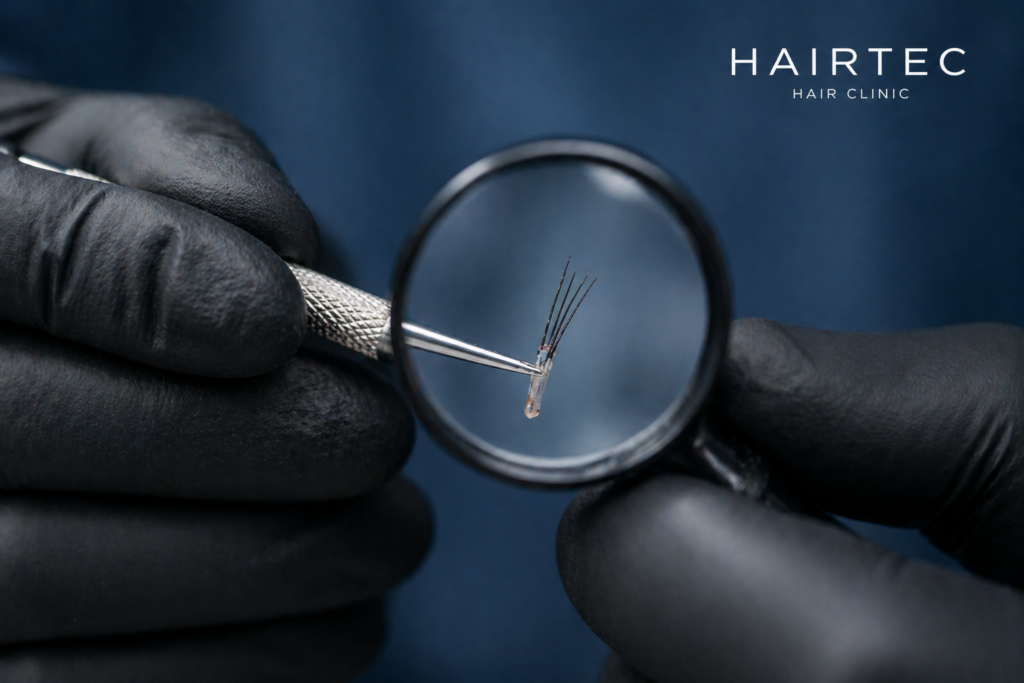
Formation of hair transplant scabs is a completely normal part of the physiological healing process. When a surgeon creates thousands of tiny incisions to place hair follicles, the body responds by forming small blood clots to seal the wounds. These clots eventually harden into scabs. While they might look concerning, they serve as a protective barrier against infection while the new grafts anchor into the scalp.
Managing these scabs correctly is vital for the survival of your new hair. If scabs remain on the scalp for too long, they can suffocate the follicles or increase the risk of inflammation. However, removing them too aggressively can pull out the grafts. For patients traveling from the UK to our clinic in Delft, we provide specific clinical protocols to make sure scabbing is handled safely.
Why Do Scabs Form After A Hair Restoration Procedure?
Scabs are the body’s way of protecting the surgical sites. During an FUE or DHI procedure, the skin is punctured to either extract or implant follicles. Each puncture is a tiny wound. The scabbing occurs when the blood and interstitial fluid dry up at the surface of these punctures.
The presence of scabs indicates that the healing process is moving forward. They keep bacteria out and keep the internal moisture in, which is necessary for the grafts to stabilize. In a boutique clinical setting like Hairtec, we use high-precision tools to keep these incisions as small as possible, which results in smaller, less noticeable scabbing compared to high-volume hair mills.
Hair Transplant Scabs Timeline Day By Day
Understanding the timeline helps you know what to expect during the first two weeks of recovery. Most patients find that the appearance of the scalp changes rapidly during this period.
| Recovery Phase | What To Expect | Graft Status |
|---|---|---|
| Days 1 to 3 | Scabs begin to form and may look like dark red or brown spots. | Very delicate and not yet anchored. |
| Days 4 to 7 | Scabs harden and the scalp might feel very itchy or tight. | Starting to anchor into the tissue. |
| Days 8 to 10 | Scabs begin to loosen and may start to flake off during washing. | Mostly secure but still require care. |
| Days 10 to 14 | This is the target window for complete scab removal. | Grafts are fysiologically anchored. |
If scabs are still present after day 14, it usually means the scalp is too dry or the washing technique is not thorough enough. Prolonged scabbing can lead to a crusting effect that is difficult to remove without professional help.
How To Safely Remove Hair Transplant Scabs
You should never pick at your scabs with your fingernails. The correct way to remove them involves softening the crusts so they slide off naturally during a wash. Most specialist clinics recommend starting this process around day 10.
- Step 1: Softening: Apply a medical grade lotion or pH-neutral foam to the recipient area. Let it sit for 30 to 45 minutes to soak into the scabs.
- Step 2: Rinsing: Use lukewarm water with very low pressure to rinse off the lotion. Do not use a high-pressure shower head directly on the grafts.
- Step 3: Gentle Massage: Use the pads of your fingers to make very light, circular motions over the scabs. Do not use any scrubbing or scratching motions.
- Step 4: Pat Dry: Use a clean paper towel or a soft cotton cloth to pat the area dry. Do not rub the scalp with a towel.
Repeating this process once or twice a day from day 10 to day 14 will usually result in a completely clean scalp. If a few stubborn scabs remain, do not force them. They will eventually fall off during the next wash.
What Happens If You Pick Your Scabs Too Early?
Picking at scabs before the 10 day mark is the most common cause of graft loss. Because the scabs are physically attached to the hair shaft and the underlying tissue, pulling a scab off prematurely can act like a hook, dragging the entire hair follicle out of its channel.
If you see bleeding after a scab comes off, it is a sign that the graft has likely been pulled out. This results in permanent bald spots in the transplanted area. The itching that occurs between day 4 and day 7 is often intense, but you must avoid scratching. Using a saline spray provided by your clinic can help soothe the irritation without risking the grafts.
Managing Post Operative Healing At Hairtec Delft
Patients traveling from the UK to Hairtec in Delft receive a personalized recovery plan that focuses on scab management and graft safety. We prioritize a boutique model where we treat only one or two patients per day, allowing our medical team to spend time explaining the aftercare in detail.
The journey from the UK to the Netherlands is short, which is a major benefit for your recovery. By flying into Amsterdam Schiphol and taking a quick 15 minute journey to Delft, you avoid the stress of long haul travel which can lead to increased swelling and harder scabbing. We provide every patient with a specialized aftercare kit containing the exact lotions and shampoos needed for safe scab removal.
Frequently Asked Questions About Hair Transplant Scabs
Is it normal for hair to fall out with the scabs?
Yes. This is known as “shock loss” or temporary shedding. The hair shaft often comes out with the scab, but the follicle remains safely anchored under the skin to grow new hair later.
What if my scabs are yellow or have a bad smell?
Yellow crusting can sometimes be normal, but if it is accompanied by a bad smell, pus, or excessive redness, it could be a sign of infection. You should contact your medical team immediately.
Can I use a comb to get the scabs off?
No. You should never use a comb, brush, or any sharp object on the recipient area for at least four weeks. Only use the pads of your fingers for gentle washing.
Why do some scabs look like white bumps?
When scabs get wet during a wash, they can absorb water and look like white, soft bumps. This is normal and actually means the scabs are softening and ready to be removed.
Does a hair transplant without scabs exist?
All transplants result in some scabbing because the skin must heal from the incisions. However, DHI techniques often result in smaller scabs that heal much faster than traditional methods.
How do I stop the itching during the scabbing phase?
Using a sterile saline spray every hour can keep the area hydrated and significantly reduce the urge to scratch. Avoid any topical creams that are not approved by your surgeon.
Will a hat make the scabbing worse?
Wearing a tight hat can trap sweat and bacteria, making scabs harder and increasing infection risk. Only wear a very loose hat after day 10 if absolutely necessary.
How we reviewed this article:
Hairtec.co.uk has strict sourcing guidelines and relies on peer-reviewed studies, academic research institutions, and medical journals and associations. We only use quality, credible sources to ensure content accuracy and integrity. You can learn more about how we ensure our content is accurate and current by reading our editorial policy.
- Bernstein RM, Rassman WR (2006). Graft anchoring in hair transplantation. Dermatologic Surgery https://doi.org/10.1111/j.1524-4725.2006.32033.x
- Vañó-Galván S, Bisanga CN, Bouhanna P et al. (2023). An international expert consensus statement focusing on pre and post hair transplantation care. Journal of Dermatological Treatment https://doi.org/10.1080/09546634.2023.2232065
Our experts continually monitor the health and wellness space, and we update our articles when new information becomes available


