
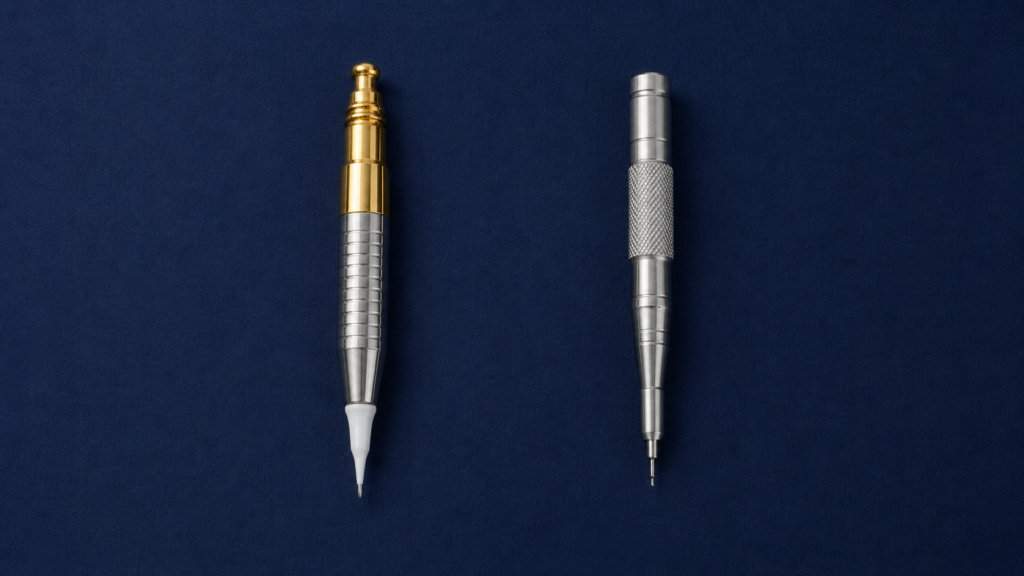
Choosing between a DHI and FUE hair transplant involves understanding the technical nuances of graft handling and implantation. Both methods utilize Follicular Unit Extraction to harvest hair from a donor zone. The way these follicles are integrated into the thinning areas differs significantly. Traditional FUE relies on a multi stage process of incision and manual placement. DHI utilizes specialized tools to combine these steps into a single motion.
The decision impacts the final density of the hairline and the speed of the physiological healing process. Many patients seeking high precision results for the front of the scalp look toward advanced implantation tools to protect the integrity of the hair follicles. At Hairtec in Delft, we analyze the specific scalp conditions of our UK patients to determine which surgical approach provides the most stable long term growth.
What Is The Main Difference Between DHI And FUE?
The primary technical distinction between DHI and traditional FUE is found in the implantation stage. In a standard FUE procedure, the surgeon creates microscopic incisions in the recipient area before any grafts are placed. This creates a delay between the extraction of the follicle and its final placement in the scalp.
To understand the mechanical differences, look at the surgical workflow for both methods:
- The FUE Workflow: Grafts are extracted, stored in a cooling solution, channels are manually cut into the scalp, and grafts are inserted using forceps.
- The DHI Workflow: Grafts are extracted and loaded directly into a Choi Implanter Pen. The pen pierces the scalp and deposits the graft simultaneously without pre cut channels.
By eliminating the manual channeling phase, the surgeon has more granular control over the depth and direction of every hair. This is a major factor in achieving a highly natural look.
How Does The Implantation Process Affect Your Scalp?
Both techniques use the same extraction philosophy. Individual follicular units are removed from the donor area at the back of the head using a micro punch tool. The difference starts once the grafts leave the scalp.
In traditional FUE, the surgeon uses a fine blade or a sapphire needle to open thousands of tiny holes in the skin. This two step process can cause more trauma to the skin tissue. The incisions are made independently of the graft size, which can lead to unnecessary tissue damage and longer bleeding times.
The DHI method uses the Choi Implanter Pen as a carrier for the follicle. Because the tool makes an opening that exactly matches the size of the graft, there is far less unnecessary damage to the surrounding scalp tissue. This precision is particularly beneficial when working between existing hairs to increase density without harming the native follicles.
Which Technique Provides Better Hair Graft Survival Rates?
Graft survival depends on how long a follicle stays outside the body and how much it is handled by the surgical team. In FUE, the grafts are often stored in a cooling solution for several hours while the surgeon opens channels. While this is a standard medical practice, the risk of graft desiccation increases the longer they remain outside their natural environment.
DHI allows for a faster transition from extraction to implantation. Because each graft can be loaded and placed immediately, the follicles spend less time in a dormant state. This direct transfer supports the physiological health of the hair bulb. The reduced handling of the follicle with the Choi pen also prevents accidental damage to the delicate root structure during insertion.
Is DHI Better Than FUE For Hairline Density?
Density is the most important factor for patients looking to restore a youthful appearance. Traditional FUE density is often limited by the size of the manual incisions. If channels are placed too close together, it can disrupt the blood flow to the skin. This negatively impacts the healing of the grafts.
DHI allows for a much tighter placement of follicles. The specialized pens enable the surgeon to place grafts with high frequency without compromising the health of the scalp tissue.
The specific advantages of DHI for density include:
- Exact control over the angle and direction of each hair.
- Ability to pack grafts tightly in the front hairline.
- Safe implantation between existing thinning hairs without causing shock loss.
- Complete customization of the hairline shape based on facial structure.
These factors make DHI the superior option for the front of the scalp, where a high concentration of hair is needed to create a thick, natural looking hairline.
Comparing Recovery Times And Scalp Trauma
Recovery from a hair transplant is tied to how much trauma the scalp receives during surgery. FUE involves thousands of individual incisions made before the grafts are placed. This often leads to more significant scabbing and swelling across the forehead and recipient area. Most FUE patients require about ten to fourteen days for the visible signs of the surgery to subside.
The DHI method is less invasive because it combines the incision and placement into one step. The punctures made by the Choi pen are smaller and close more quickly than manual channels.
What to expect during a DHI recovery:
- Less post operative bleeding on the day of the surgery.
- Smaller scabs that tend to fall off within seven to ten days.
- A faster reduction in scalp redness and inflammation.
- A quicker return to light daily activities.
Many patients find they can return to their daily routines in the UK sooner when choosing the DHI approach.
Technical Comparison Between DHI And FUE
The following data outlines the technical requirements and outcomes associated with each method.
| Technical Aspect | FUE Hair Transplant | DHI Hair Transplant |
|---|---|---|
| Implantation Method | Pre cut manual channels | Direct placement via Choi Pen |
| Graft Handling | High (Extraction, Sorting, Placement) | Lower (Direct loading and placement) |
| Follicle Survival | High | Very High due to direct transfer |
| Incision Size | Depends on blade width | Matches graft diameter exactly |
| Scalp Trauma | Moderate | Minimal |
| Ideal Candidate | Large bald areas and the crown | Hairlines and thinning areas |
| Shaving Required | Usually a full head shave | Often possible without shaving the top |
Cost Analysis Of DHI vs FUE Procedures
The cost of these procedures is influenced by the time required in the operating room and the medical tools used. FUE is generally more cost effective because it allows the surgeon to work faster during the implantation phase. It is often the preferred choice for patients who need more than 3,500 grafts to cover large areas of the scalp in a single day.
DHI is a more expensive option due to the specialized equipment and the slower, more meticulous nature of the work. Each Choi pen is a single use tool. A typical surgery may require several pens to handle different graft sizes. While the initial investment is higher, many patients choose DHI for the technical advantages it offers in terms of density and the quality of the final hairline.
DHI Surgery And Recovery At Our Delft Clinic
UK patients looking for a specialized medical experience often travel to our clinic in Delft, Netherlands. High volume clinics frequently prioritize speed, but Hairtec focuses exclusively on the clinical precision of DHI and FUE. We provide a surgeon led environment where the technical health of your donor area is protected at all times.
The journey from the UK to Amsterdam Schiphol is short and straightforward. This allows you to receive care in a strictly regulated Dutch medical environment and return home safely.
Our team analyzes your donor density and the thickness of your hair to determine the most effective surgical strategy. Whether you require a high volume FUE session or a high density DHI procedure, our goal is to provide a result that looks completely natural and remains stable.
Frequently Asked Questions About DHI And FUE Hair Restoration
Does DHI require shaving the head?
DHI is often the preferred method for unshaven transplants because the Choi pen can place grafts between existing long hairs without needing a full shave.
Which method is more painful during recovery?
Both procedures are performed under local anesthesia so you do not feel pain during surgery. DHI often has a slightly more comfortable recovery because it causes less trauma to the scalp tissue.
Can I get 4000 grafts with DHI in one day?
DHI is a slower process and usually limited to about 2,500 to 3,000 grafts per session. For larger counts FUE or a multi day DHI session is required. Read more about what a 4000 grafts procedure involves.
How soon can I fly back to the UK after my procedure?
Most patients are safe to fly the day after their surgery. We provide specific instructions to protect your grafts during travel and your flight home.
Is the growth speed different between DHI and FUE?
The growth timeline is identical for both methods. You will see the first signs of growth after four months and final results after twelve to eighteen months.
Can a botched FUE be fixed with DHI?
Yes DHI is an excellent tool for revision surgery because it allows the surgeon to place new grafts around old poorly placed hair with high precision.
What makes the Choi implanter pen so effective?
The pen protects the hair follicle during insertion and creates an opening that perfectly matches the graft size reducing tissue damage and improving healing.
How we reviewed this article:
Hairtec.co.uk has strict sourcing guidelines and relies on peer-reviewed studies, academic research institutions, and medical journals and associations. We only use quality, credible sources to ensure content accuracy and integrity. You can learn more about how we ensure our content is accurate and current by reading our editorial policy.
- Choi YC, Kim JC (1992). Single hair transplantation using the Choi hair transplanter. Journal of Dermatologic Surgery and Oncology https://pubmed.ncbi.nlm.nih.gov/1430550/
- Sethi P, Bansal A (2013). Direct hair transplantation: a modified follicular unit extraction technique. Journal of Cutaneous and Aesthetic Surgery https://pmc.ncbi.nlm.nih.gov/articles/PMC3764754/
- Park JH, Ho YH, Manonukul K (2023). A Practical Guide to Hair Graft Placement Using the Sharp Implanter Method. Clinical, Cosmetic and Investigational Dermatology https://pmc.ncbi.nlm.nih.gov/articles/PMC10349607/
- Rassman WR, Bernstein RM, McClellan R et al. (2002). Follicular unit extraction: minimally invasive surgery for hair transplantation. Dermatologic Surgery https://pubmed.ncbi.nlm.nih.gov/12174065/
Our experts continually monitor the health and wellness space, and we update our articles when new information becomes available


