
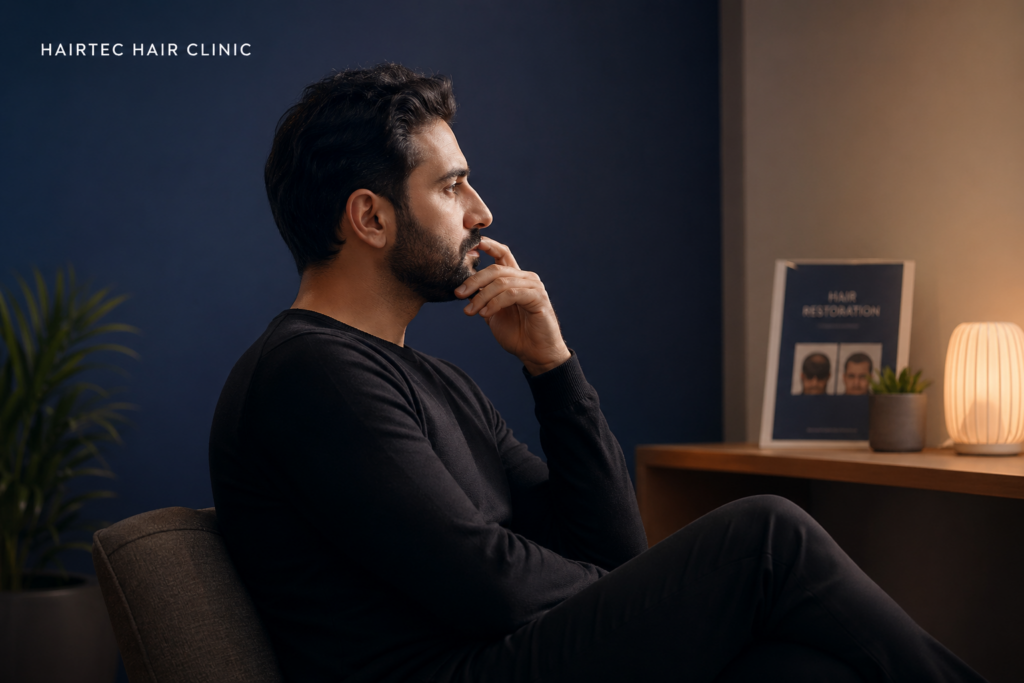
Hair loss affects millions of people globally. It causes severe drops in self-esteem. Muslim men and women facing this issue often want to seek a medical solution. But a massive question always stops them right at the beginning. Is hair transplant haram?
You need absolute clarity before booking any medical procedure. Islamic law has strict rules about modifying the human body. This post breaks down the exact religious rulings. It explains the difference between allowed treatments and forbidden clinical practices.
Why Do Muslims Ask if a Hair Transplant is Haram?
Practicing Muslims govern their lives through Islamic jurisprudence. Modifying the human body without a valid reason is strictly forbidden. The Quran specifically condemns altering natural creation just for vanity.
Because of this strict rule, many people assume that moving hair around the scalp is a sin. They worry that getting surgery means they are ungrateful for their physical appearance. This fear makes people hesitate. They search for fatwas and scholarly opinions online.
However, Islamic scholars make a massive distinction between unnecessary cosmetic vanity and treating a medical defect. You must know this distinction to find out if the procedure is permissible for you.
Hair Transplant is Halal or Haram?
Prominent Islamic scholars do not view severe hair loss as a normal state. They classify conditions like male pattern baldness or alopecia as physical defects or medical ailments.
Islam actively encourages all Muslims to seek medical treatment for illnesses. Prophet Muhammad instructed his followers to find cures for their medical problems. Fixing a physical defect to return your body to its natural state is universally allowed.
Therefore, the basic idea of treating hair loss is completely permissible. Restoring a lost body part is a biological restoration. It is not an act of deception. You are simply returning the body to its original, natural state. The religious debate lies entirely in the specific surgical method you choose.
When is Getting a Hair Transplant Haram?
There are absolute religious red lines in cosmetic medicine. Some clinical practices cross directly into forbidden territory. Is getting a hair transplant haram under certain clinical conditions? Yes. You must avoid the following prohibited methods at all costs.
Using Another Person’s Hair
You cannot attach another person’s biological hair to your own scalp. Islamic teachings strictly forbid this specific practice. The religious texts clearly condemn adding human hair extensions or wigs made from someone else. Scholars view this as a major form of deception. It is also considered a violation of the donor’s physical dignity.
Implanting Synthetic Hair Fibres
Artificial hair fibres also fall into the prohibited category. They do not heal a biological defect. They act as a permanent, artificial plastic cover over your scalp. Injecting foreign, synthetic materials into the skin simply to mask baldness is widely considered unacceptable by religious authorities. It also carries severe medical risks like chronic infections and tissue rejection.
Using Impure Animal Hair
Using biological material from animals considered impure (najis) is completely banned in Islamic jurisprudence. Pig bristles or other forbidden animal derivatives cannot be placed inside the human body for cosmetic reasons.
If a clinic offers you any of these artificial or third-party methods, you must walk away immediately. Those specific procedures are strictly haram.
Is a Hair Transplant Haram if You Use Your Own Hair?
Modern medical clinics do not use synthetic fibres. They rely entirely on your own living biology. This simple medical fact changes the religious ruling completely.
The surgeon takes healthy hair roots from the back of your head. They then move those exact living roots to your bald spots. You simply relocate your own living cells from one part of your scalp to another.
Is a hair transplant haram when doctors use your own hair? No.
Islamic scholars call this an autologous treatment. It restores what was lost. It does not alter the original creation of Allah in any forbidden way. Because the medical team uses your own native hair, the procedure is totally halal. Moving a hair follicle does not change its DNA. It remains your natural, God-given hair.
Is FUE and DHI Hair Transplant Halal?
Patients often get confused by the medical acronyms. They search to see if specific techniques break Islamic law. The two most common modern techniques are Follicular Unit Extraction (FUE) and Direct Hair Implantation (DHI).
Both of these methods are fully halal. They are simply different medical tools used to extract and implant your own native hair.
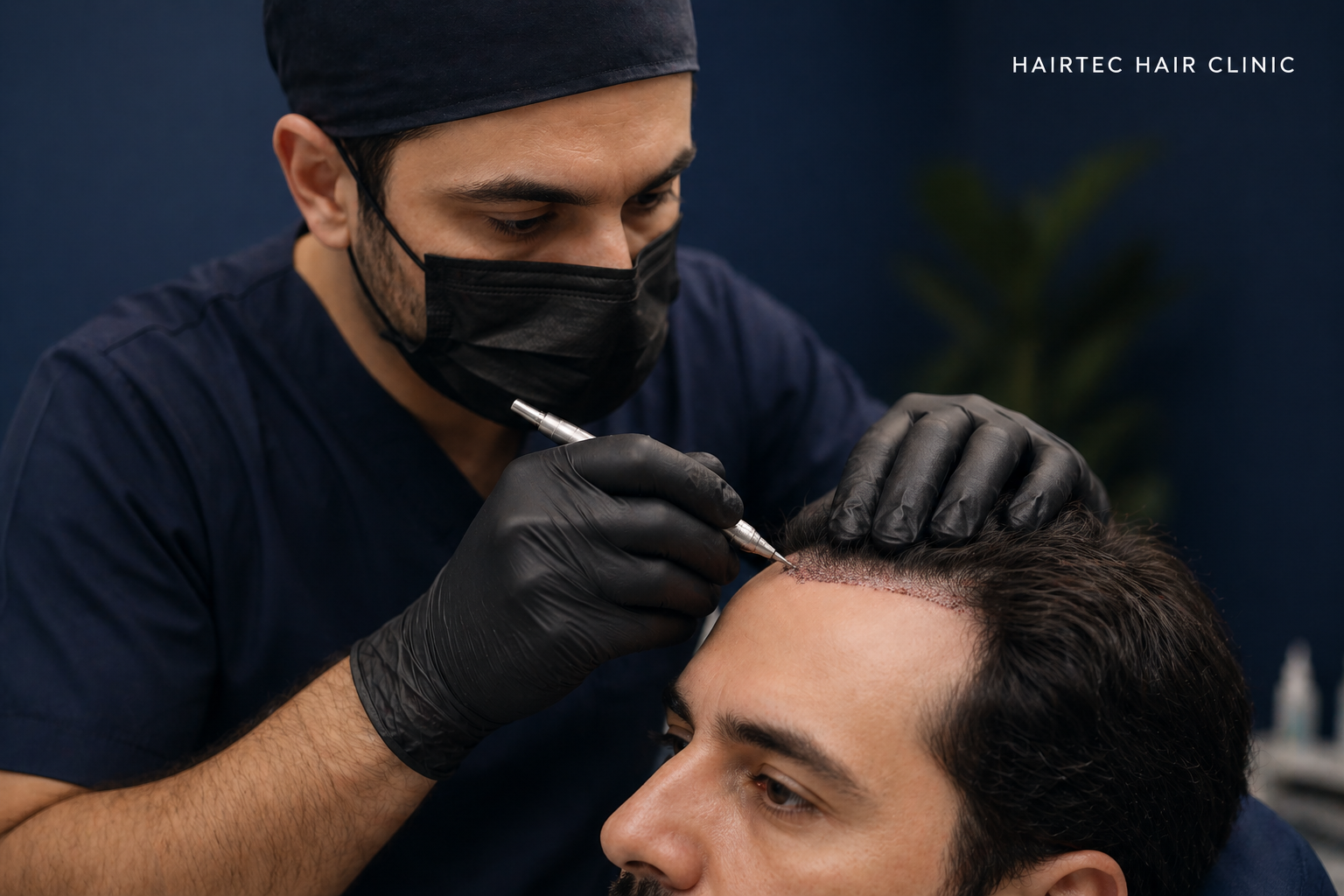
FUE uses a small punch tool to remove the follicle. The doctor then creates a tiny channel in the bald area to place it. DHI uses a pen-like tool to implant the follicle directly without making a separate channel first.
Neither method uses haram substances. Neither method uses someone else’s hair. They are purely autologous surgical procedures. The International Islamic Fiqh Academy officially stated that treating hair loss to restore a person’s natural appearance using these methods is completely permissible.
Is Hair Transplantation Haram for Women?
Women suffer from severe hair loss too. Conditions like female pattern baldness, traction alopecia, or postpartum shedding cause immense psychological stress. The religious rules apply equally to both genders.
Is hair transplantation haram for female patients? No. It is entirely permissible for women to use their own native hair to restore thinning areas or a widening parting. It is a valid, halal medical treatment.
Modesty (Awrah) is the main religious concern for female patients. Seeking a clinic that respects your privacy is crucial. Many modern clinics provide enclosed, private surgical suites. This allows female patients to remove their hijab safely during the procedure. Female medical assistants are also frequently available to maintain total comfort and strict religious compliance.
The Role of Pure Intentions (Niyyah) in Surgery
Actions in Islam are always judged by their intentions. Why do you want to undergo this surgery?
If hair loss causes you severe psychological pain, fixing it is a noble intention. Protecting your mental health is highly valued in Islam. If baldness causes depression or intense social anxiety, surgery brings necessary medical relief.
However, intention matters deeply in social contracts like marriage. Deceiving a potential spouse about a severe medical condition or extensive baldness is strictly prohibited. Honesty must always come first. Your primary goal for surgery should be personal healing and regaining your natural physical state.
Can I Perform Wudu (Ablution) After a Hair Transplant?
Patients usually have specific, practical worries regarding the recovery process. A major concern is the performance of daily prayers. Muslims must perform ablution (Wudu) five times a day. Can you wash your head after surgery?
Newly implanted grafts are extremely fragile during the first fourteen days. Aggressive washing or rubbing will rip them out. This ruins the surgery permanently.
Islam is a highly practical religion. It provides clear accommodations for medical necessity. During the initial healing phase, you do not need to scrub or heavily wash your scalp. You can perform Tayammum (dry ablution) if water causes medical harm. Alternatively, you can simply wipe very gently over the non-surgical areas of your head.
Clinical staff always provide exact instructions on how to clean the head safely. Once the grafts anchor securely after a few weeks, you return to your normal ablution practices without any issues.
Is Local Anaesthesia and Medical Alcohol Halal?
Surgery involves various chemicals and medications. Are these medical substances allowed under Islamic law? Yes.
You will receive local anaesthesia to numb the scalp before extraction begins. Relieving physical pain during a medical procedure is fully permissible. The numbing medication is a strict medical necessity. It does not intoxicate the mind. It only blocks the pain receptors in the skin.
The medical staff will also use alcohol-based solutions to sterilize your skin before the incisions. This vital step prevents deadly infections. Islamic scholars universally agree that using alcohol for external medical sterilization is completely halal. It is used purely as a clinical disinfectant. It is not consumed as a prohibited intoxicant.
Psychological Distress and Finding a Safe Clinic
Hair loss is often dismissed as a purely cosmetic issue. This perspective ignores the severe mental health impact on the Muslim community.
Many young men experience premature balding in their early twenties. This causes severe social anxiety. They struggle with self-esteem during marriage processes. Islam does not require a person to suffer mentally when a safe, halal medical cure exists. Restoring hair restores confidence. It allows individuals to participate fully in their communities.
You must pick the right medical method to ensure your procedure remains halal. Avoid unregulated, low-cost clinics. Some untrustworthy places might cut corners. They might illegally mix synthetic fibres into your scalp if your native donor hair is weak.
You must demand absolute clinical transparency. Many UK patients now use secure digital consultations. You send photos of your scalp to specialists online. They check your donor capacity mathematically. If you do not have enough hair for a halal, autologous transplant, you must accept the medical reality. Do not resort to haram alternatives just to achieve a specific look.
Frequently Asked Questions About Islam and Hair Restoration
Is getting a hair transplant haram?
No. It is fully permissible if the doctor uses your own native hair to treat baldness. Adding someone else’s hair is the only action that makes it prohibited.
Is using beard hair for a scalp transplant halal?
Yes. Many men do not have enough donor hair on the back of their head. Surgeons often extract hair from the beard or chest to place on the scalp. Because this hair belongs to your own body, moving it is completely halal.
Is scalp micropigmentation (SMP) halal?
Scalp micropigmentation involves injecting ink into the skin to create the illusion of hair follicles. This is functionally a tattoo. Islamic law strictly prohibits tattooing. Therefore, covering baldness with SMP is haram. You must rely on autologous hair relocation instead.
Do all Islamic scholars agree on this ruling?
Major institutions like the International Islamic Fiqh Academy officially agree on this. Treating a medical defect like severe baldness is allowed. You are restoring your original appearance, not altering natural creation out of vanity.
Does a hair transplant change Allah’s creation?
No. Moving a hair follicle does not change its fundamental DNA. It remains your natural, God-given hair. You are just relocating it to a bald spot to restore your original, natural physical state.
How we reviewed this article:
Hairtec.co.uk has strict sourcing guidelines and relies on peer-reviewed studies, academic research institutions, and medical journals and associations. We only use quality, credible sources to ensure content accuracy and integrity. You can learn more about how we ensure our content is accurate and current by reading our editorial policy.
- Atiyeh BS, Kadry M, Hayek SN, Musharafieh RS (2008). Aesthetic Surgery and Religion: Islamic Law Perspective. Aesthetic Plastic Surgery https://doi.org/10.1007/s00266-007-9040-7
- Okur H (2025). The Legitimacy of Aesthetic Surgery in Islamic Law: A Normative and Jurisprudential Assessment. IIUM Law Journal https://journals.iium.edu.my/iiumlj/index.php/iiumlj/article/view/1069
- Chamsi-Pasha H, Chamsi-Pasha M, Albar MA (2020). Plastic Surgery in daily practice: Islamic Perspective. Journal of the British Islamic Medical Association https://jbima.com/wp-content/uploads/2020/04/2.4.pdf
Our experts continually monitor the health and wellness space, and we update our articles when new information becomes available


