
Every centre calls itself the best. That word tells you nothing, and it is not meant to.
What you actually need is not a ranking somebody else wrote, but a way to compare centres yourself, on the things that decide whether your result is good. So this is not a list of names. It is a checklist, the questions and criteria to run each centre through before you hand over any money, so the choice is yours and grounded rather than borrowed from an advert.
Work through it and the differences between centres stop being about marketing and start being about substance.
The one idea to hold onto first
There is no single best centre in the abstract, and chasing one is the wrong game.
The best centre is the one that is best for your case, your stage of loss, your donor area and your expectations. A centre that is excellent for a stable, moderate case can be the wrong choice for early, aggressive loss, and vice versa. So every item below is really asking the same underlying question. Is this centre set up to get my result right, specifically.
The assessment, and whether it is real
Start here, because it separates a serious centre from a sales operation faster than anything else.
A proper centre puts a genuine assessment before any quote. It examines your loss, checks the donor area, takes a medical history, and is willing to tell you no or not yet if that is the honest answer. A centre that skips straight to a price and a date has told you where its priorities sit. Ask directly whether the first appointment is a medical assessment or a sales meeting, and listen carefully to how they answer.
The medical side of what a thorough assessment covers is set out on our male pattern baldness page.
The team, and who actually does the work
This is the factor that moves the result more than any other, and the one centres are often vaguest about.
You want to know who leads the medical assessment and what their credentials are, who physically carries out each stage of the procedure, and how experienced that team is with cases like yours. Vagueness here is itself an answer. A centre proud of its team makes the team easy to find, which is why it is worth looking at who would be involved before you commit. Ours are listed on our team page, as a sense of what that transparency looks like.
A checklist you can actually use
Here is the comparison boiled down. Run each centre you are considering against these, and score them honestly rather than on how slick the website is.
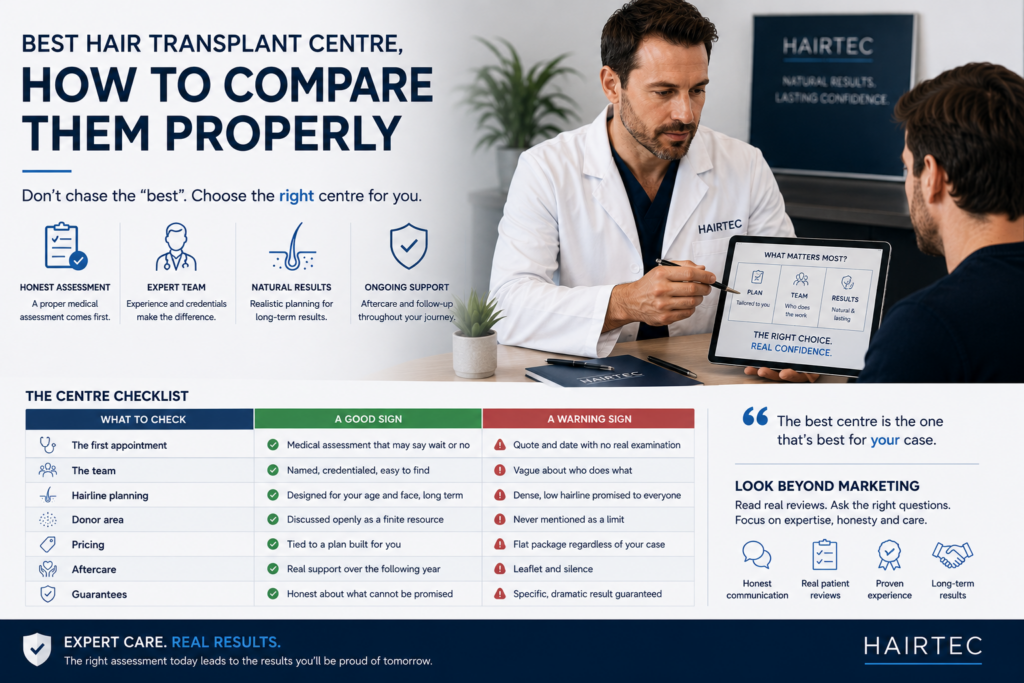
| What to check | A good sign | A warning sign |
| The first appointment | A medical assessment that may say wait or no | A quote and a date with no real examination |
| The team | Named, credentialed, easy to find | Vague about who does what |
| Hairline planning | Designed for your age and face, long term | A dense low hairline promised to everyone |
| Donor area | Discussed openly as a finite resource | Never mentioned as a limit |
| Pricing | Tied to a plan built for you | A flat package regardless of your case |
| Aftercare | Real support over the following year | A leaflet and silence |
| Guarantees | Honest about what cannot be promised | A specific, dramatic result guaranteed |
If a centre lands on the right-hand column more than once, that is not a detail to overlook. It is the centre telling you what to expect.
One more thing that does not fit neatly in a column, reviews. Read past the five-star average and look at what people actually say. Genuine reviews mention the awkward middle months, the shock loss, the year-long wait, the honest conversation about expectations. A wall of identical, glowing, detail-free praise is less reassuring than a handful of balanced accounts that sound like real recoveries. And a centre that shows its own before-and-after work with realistic timelines, rather than only miracle transformations, is quietly telling you it trusts its results to stand up.
Price, and why cheapest is a trap
Cost belongs on the checklist, but not at the top, and here is why.
A very low headline price usually means volume, many patients moved through quickly, with the careful, unhurried work traded away to hit the number. The true cost of a result that ages badly or fails is a second corrective procedure, which is harder, dearer, and limited by the donor hair the first attempt already spent. Judge a centre on the plan and the people, not the sticker. Cheap only counts as cheap if it works the first time.
What a good centre will never do
A short, blunt list, because these are the deal-breakers.
No honest centre guarantees a specific dramatic outcome, pressures you to sign today, skips the medical assessment, or sells one identical package to everyone regardless of their donor area or stage of loss. Spot any of those and slow down. Spot several and walk. None of them is a quirk of style, they are all signs of a place optimising for bookings rather than results.
The role of our doctors at Hairtec
Our team includes BIG-registered doctors, listed on the official Dutch medical register, working alongside experienced hair specialists.
Rather than claim the title of best, we would point you at the checklist above and invite you to hold us to it. In practice the doctors lead the consultation and the medical assessment before grafts or dates are discussed, weighing up whether your loss is stable enough for surgery to hold, what the donor area can realistically supply, and whether medical treatment should come first or run alongside.
They stay involved through the aftercare too, and when the honest answer is that now is not the time, that is what you will hear. If you want to see how that first step works, our free consultation page lays it out.
Frequently asked questions about choosing a hair transplant centre
What makes the best hair transplant centre?
There is no single best centre for everyone. The best one for you assesses you properly, has an experienced and transparent team, plans realistically around your donor area, and provides genuine aftercare. A centre that examines you honestly is worth more than one that simply calls itself the best.
How do I compare hair transplant centres?
Run each through the same criteria, the quality of the assessment, who does the work, how the hairline and donor area are planned, the pricing approach and the aftercare. Score them on substance rather than on how polished the marketing looks.
Is the cheapest hair transplant centre a bad idea?
Not automatically, but a very low price often signals high-volume, low-attention work, and a poor result is expensive to correct later. Value comes from the plan and the team, not the headline figure.
Which country has the best hair transplant centres?
No single country holds the title, because quality varies enormously within every destination. The specific centre, team and plan matter far more than location, so judge the centre itself rather than the country it sits in.
What questions should I ask a hair transplant centre?
Ask who carries out each stage and their experience, whether your loss is stable enough for surgery, what your donor area realistically allows, what aftercare is included, and what happens if the result falls short of the plan. How they answer is as revealing as the answers themselves.
How we reviewed this article:
Hairtec.co.uk has strict sourcing guidelines and relies on peer-reviewed studies, academic research institutions, and medical journals and associations. We only use quality, credible sources to ensure content accuracy and integrity. You can learn more about how we ensure our content is accurate and current by reading our editorial policy.
Our experts continually monitor the health and wellness space, and we update our articles when new information becomes available


