
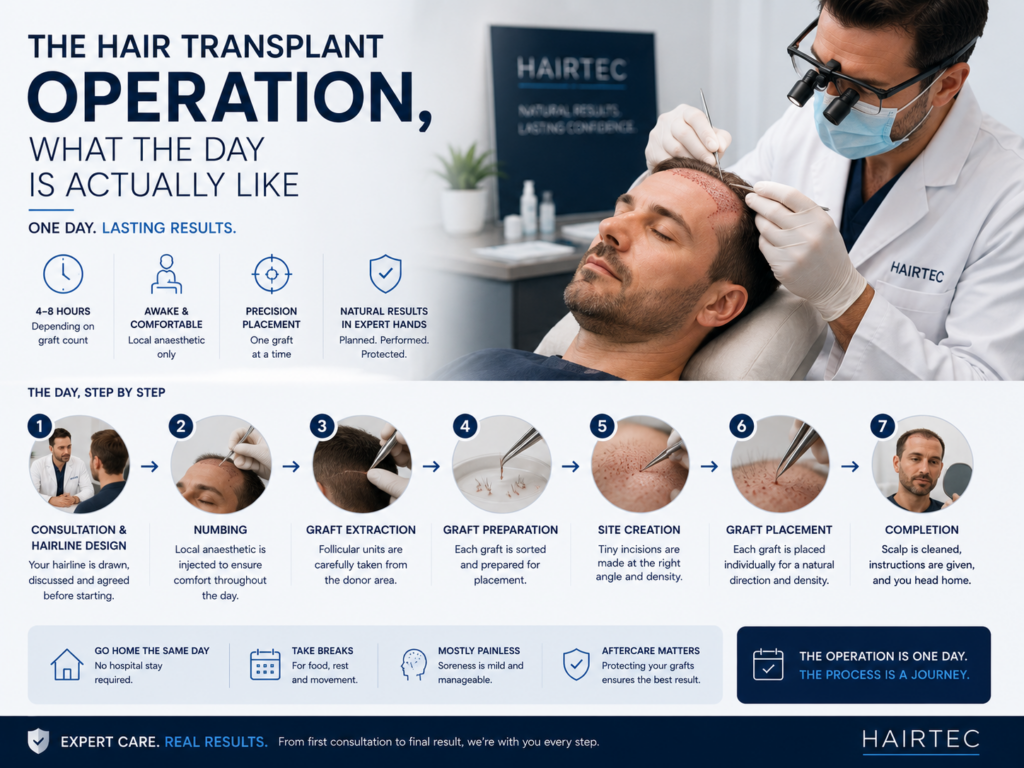
Ask a man what worries him about a hair transplant and he rarely names the result. He names the operation. The chair. The needles. The long hours in between, and the not knowing what any of it will feel like.
Fair enough, so let us take the day itself apart, described the way you would actually live through it, from the walk in to the walk out. Not the biology. Not the recovery. Just the hours in the chair.
The short version surprises most people. It is long, it is oddly boring, and it is nothing like the word “operation” makes it sound. Here is the longer version.
Is a hair transplant actually surgery?
It is, though not the sort your imagination reaches for.
Think minor surgery under local anaesthetic, not a hospital ward. Nobody puts you to sleep. There is no general anaesthetic, no gown, no recovery bay. You sit awake and comfortable in a clinic chair, the same day out, the same day home. Honestly it has more in common with a long dental appointment than with anything you would call an operation, and just knowing that quietly defuses half the fear people arrive with.
How long the hair transplant operation takes
Longer than you would guess. And that is a good sign, not a worrying one.
A session usually runs four to eight hours, set by the number of grafts being moved. A small hairline touch-up finishes at the short end. A big restoration eats most of the day. Nobody is dawdling. Placing thousands of grafts at natural angles, one at a time, is slow work by design, and rushing it is exactly how a result ends up looking obvious.
The hours are broken up. There are pauses for the loo, for food, for a stretch and a walk about. Bring headphones. Plenty of people put on a film, work through a playlist, or simply nod off partway through.
Graft numbers are the figure everyone latches onto, so a word on them. A modest hairline might take a couple of thousand. A wider area, more. Each one gets placed by hand, which is where the day goes, and more is not better, because every graft comes out of a donor area that never refills. A sensible plan moves what the day needs and leaves the rest in reserve.
Walking through the operation
The day runs in a clear order, and having that order in your head beforehand takes most of the nerves out of it.
It opens with the hairline. Before a single graft is touched, the new shape is drawn on your scalp and agreed with you, and this stage is given real time because it decides whether the finished result reads as natural or obvious. Then comes the numbing, which is the one genuinely uncomfortable stretch of the whole day, a sharp sting as the local anaesthetic goes into the donor and recipient areas, gone within minutes. After that you feel almost nothing. The follicles are taken from the back and sides, which registers as pressure and movement rather than pain, and then the long, meticulous part begins, each graft set into the thinning area one by one. When it is done the scalp is cleaned, you are handed your aftercare, and you leave.
For a fuller walk-through with the practical detail, our treatment day page covers it stage by stage.
Does the operation hurt?
Straight answer. The anaesthetic stings, and after that, barely anything does.
Those first injections to numb the scalp are the sorest few minutes of the day, and they are over quickly. Once you are numb, extraction and placement come through as tugging and pressure, not pain. What catches people off guard is how little they feel, and how much of the day is just sitting there. Our blog on whether a hair transplant is painful digs into this properly.
Some soreness and tightness does arrive over the next few days, once the anaesthetic fades, but it is mild and easily handled. The operation itself is simply not the ordeal people steel themselves for.
What to expect straight after
You walk out visibly having had something done, and that is exactly as it should be.
The treated area sits red, a touch swollen, freshly dotted with grafts. Someone will run you through how to sleep, what to leave well alone, and when your hair can be washed again. Most people lie low for a few days while the swelling and redness fade, then slide back into normal life inside a fortnight. Everything past that point, the shedding and the slow regrowth, lives on our hair transplant surgery recovery page.
How to prepare for the operation
A little groundwork makes the day run easier, and your clinic will give you the exact list. In broad strokes it comes down to a few sensible habits.
Ease off alcohol and smoking for a stretch beforehand, since both drag on healing. Pause any medications or supplements your clinic flags. Turn up with clean hair and loose clothing you do not have to haul over your head. And clear the following day or two of anything strenuous rather than booking yourself straight back into the gym.
None of that is dramatic, yet it feeds directly into how well the grafts take, so it earns following. Which technique your operation uses colours the day a little too, and our page on Sapphire FUE explains how the modern approaches differ in practice.
The role of our doctors at Hairtec
Our team includes BIG-registered doctors, listed on the official Dutch medical register, working alongside experienced hair specialists.
Because it is a medical procedure, the operation is planned and overseen medically rather than simply performed. Well before the day, the doctors lead the consultation and the assessment, judging whether the operation suits you at all, what your donor area can support, and how the plan should be shaped around both.
They stay in it through the aftercare as well. So the day in the chair is really just the calm, well-rehearsed middle of something that was thought through long before you sat down, and looked after long after you stood up.
Frequently asked questions about the hair transplant operation
How long does a hair transplant operation take?
Most sessions run between four and eight hours, depending on how many grafts are being moved. Smaller cases finish sooner, while larger restorations can take most of a day, with breaks throughout.
Is a hair transplant operation painful?
The anaesthetic injections sting for a few minutes, and that is the sorest part. Once numb, the procedure itself is largely painless, felt as pressure rather than pain, with some mild soreness in the days afterwards.
Are you awake during a hair transplant?
Yes. A hair transplant is done under local anaesthetic, so you stay awake and comfortable throughout. There is no general anaesthetic, and most people read, listen to music or doze during the longer stretches.
Do you stay overnight after a hair transplant operation?
In most cases, no. It is a day procedure, and you go home the same day with aftercare instructions. There is no need for a hospital stay under local anaesthetic.
How should I prepare for a hair transplant operation?
Your clinic will give a specific list, but it usually involves avoiding alcohol and smoking beforehand, pausing certain medications if advised, arriving with clean hair and loose clothing, and keeping the following day or two clear of strenuous activity.
How we reviewed this article:
Hairtec.co.uk has strict sourcing guidelines and relies on peer-reviewed studies, academic research institutions, and medical journals and associations. We only use quality, credible sources to ensure content accuracy and integrity. You can learn more about how we ensure our content is accurate and current by reading our editorial policy.
Our experts continually monitor the health and wellness space, and we update our articles when new information becomes available


