
Type “hair treatment” into a search bar and you get a mess. Salon masks sit next to prescription drugs, and a 12 pound bottle of shampoo shares the page with a surgical procedure that runs into thousands. This article draws a line around one part of that mess: the treatments that actually do something about hair you are losing, rather than the ones that just make what is left feel softer. If your loss is the ordinary inherited type, the deep dive lives on our male pattern baldness page.
Start with the cause, not the cure
Hair thins for a dozen reasons and they do not share a fix. Genetics. A crash diet. Low ferritin. An underactive thyroid. Three years of tight braids pulling at the hairline. Each of these leaves the scalp differently and answers to a different treatment, and pouring minoxidil on hair that fell out because of an iron deficiency is money down the drain.
So the first spend should not be a product at all. It should be twenty minutes with someone who can tell you what is happening up there. Get that wrong and everything after it is guesswork. Our overview of hair loss runs through the usual suspects if you have no idea which one is yours.
The hair cycle, briefly, because it explains everything
Here is the part most people skip, and it is the reason treatments take a season to prove themselves.
Each follicle cycles. It grows a hair for two to six years, rests for a few months, drops it, then starts over. On a normal scalp roughly nine in ten follicles are growing at any given time and the rest are dozing. Treatments do one of two things: they coax more follicles back into the growth phase, or they shield the ones sliding out of it. Either way you are working with the clock of the cycle, not against it, which is why nothing here delivers in a fortnight. It also explains a nasty surprise on some treatments, a wave of shedding in the first weeks. That is old resting hair getting shoved out by new growth pushing up underneath. Counterintuitive, but usually the good kind of shedding.
The options, side by side
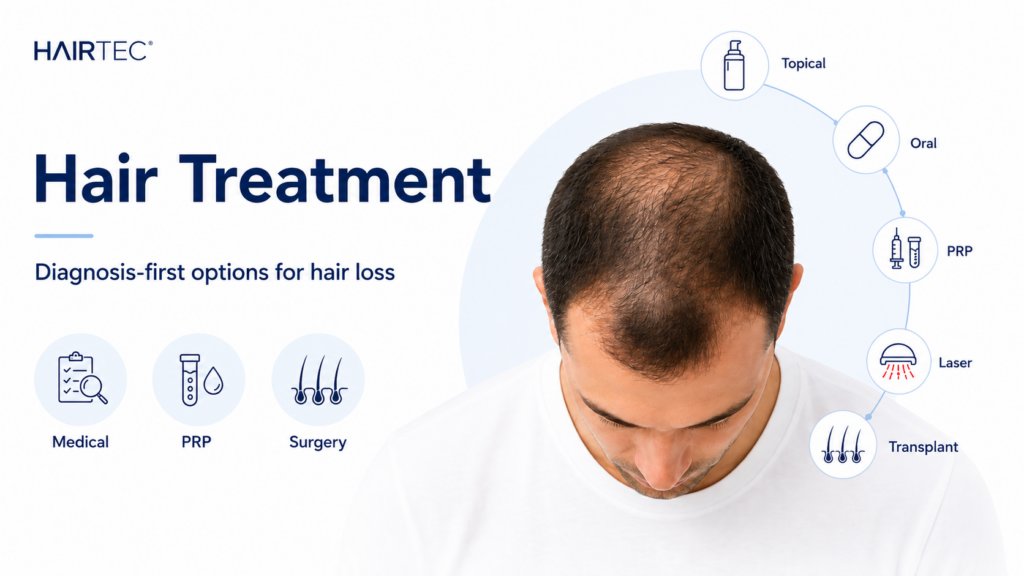
Five treatments cover most of what a clinic will actually recommend. The table is the quick version; the detail sits underneath and in our guide to hair loss treatments.
| Treatment | Best suited to | Worth knowing |
| Topical minoxidil | Early to moderate thinning | Over the counter at 2% or 5%; only works while used, and it takes 3 to 6 months to judge |
| Oral finasteride | Male pattern hair loss | Prescription, taken after medical advice; a small share of men report side effects |
| PRP | Thinning where follicles still live | Made from your own blood; evidence is mixed, and a course is usually three sessions plus top-ups |
| Low-level laser | Mild thinning, as a support | Easy and low-risk, effect is modest, best bolted onto something else |
| Hair transplant | Established, stable loss | Moves resistant follicles for good, but does nothing to stop future loss |
Minoxidil
You rub it in once or twice a day, a liquid or a foam, at 2% or 5%. It stretches out the growth phase and lifts blood supply to the follicle, and for a good number of people that buys slower loss and a bit of thickening. Cheap, no prescription, easy to start.
The catch is two-fold and worth being honest about. Give it three to six months before you decide anything, because early on it can look like it is making things worse. And once you stop, the hair it was holding onto tends to leave within a few months, back to where the genetics were always heading. Minoxidil rents you hair. It does not buy it.
Finasteride
Different mechanism entirely. Finasteride goes after the driver of male pattern loss, a hormone called DHT, by blocking the enzyme 5-alpha-reductase that makes it. Less DHT reaching the follicle means less shrinkage, so the thinning slows and often stalls. Of everything on the list, this has the strongest evidence for hormonal loss, and plenty of men keep their hairline on it for years.
It is prescription-only, and that is not red tape. A minority of men, in the low single digits in most trials, report effects on libido or mood, and it is off the table for some people entirely. Which is the whole argument for it starting in a consultation rather than a shopping cart.
PRP and the scalp-support crowd
PRP means platelet-rich plasma. A nurse draws a little of your blood, spins it in a centrifuge to concentrate the platelets, and injects that back across the scalp. Those platelets carry growth factors, and the theory is they wake up follicles that are struggling but not dead. The research is honestly all over the place. For the right candidate, someone whose follicles are shrinking rather than gone, it can add something to a broader plan, usually over three sessions with maintenance later. Laser caps and combs live in the same drawer: harmless, convenient, gently useful, never the main event. Our PRP hair treatment page spells out what a course involves.
Where a transplant fits
At some point the follicles in a bald patch are not shrinking, they are simply gone. No foam or injection resurrects them. That is the line where surgery stops being premature and starts making sense.
A transplant relocates follicles from the back and sides, the band of hair that shrugs off DHT, into the thin zones up top. Because those follicles keep their resistance after the move, the transplanted hair sticks around. Here is the part that catches people off guard in a consultation: the operation does nothing to the hair you did not transplant. Your original loss carries on to its own schedule, and if you ignore that, you can end up with an island of grafts and a receding sea around them three years later. Good clinics plan around it, pairing surgery with medical treatment, and sometimes telling you to wait or to try the tablets first. Weighing it up? Our comparison of the DHI and Sapphire FUE techniques breaks down how the modern methods differ.
And the shampoos and serums on the shelf?
Fair question, since it is where nearly everyone starts. Some of these are decent. A good scalp shampoo can cut breakage, calm irritation, and leave the hair you have looking fuller, and none of that is nothing. But a bottle cannot rewrite how a follicle answers to DHT. Think scalp care, not cure. Lean on a serum to reverse a receding hairline and the only thing you lose, besides the money, is the months that early medical treatment could have put to work.
How to actually choose
Nobody picks a treatment in a vacuum. You pick once you know the cause and the stage. Roughly:
- Recent loss, follicles still alive: medical treatment first, PRP sometimes alongside.
- Years of loss, skin showing through: a transplant is the likelier answer, with medical treatment to guard the rest.
- Sudden, patchy, or an itchy sore scalp: that is a different problem, and it needs a diagnosis before anything else.
- No clue what is going on: book the assessment. Cheapest step on the list, saves the most.
The thread through all of it is dull but true. A treatment is only as good as the diagnosis it sits on. Nail that, and the rest is a decision instead of a bet.
The role of our doctors at Hairtec
Our team includes BIG-registered doctors, listed on the official Dutch medical register, alongside experienced hair specialists. The doctors run the consultation and the medical assessment, and they stay in the loop for the aftercare. In practice that means reading the pattern and history of your loss, ruling out the other causes where it matters, and telling you plainly which treatments are realistic for you, up to and including the answer nobody selling hair likes to give, which is sometimes wait, or try the medicine before the theatre. That oversight is what keeps the advice fitted to the person rather than the product.
Frequently asked questions about hair treatment
What is the best treatment for hair loss?
No single winner. It hangs on why the hair is going and how far it has gone. Early, active loss usually points to medical treatment; established loss points to a transplant; and the two get combined more often than not, each covering what the other cannot.
Can hair treatments regrow lost hair?
Depends entirely on the follicle. Ones that are shrinking but still alive often respond to minoxidil, finasteride or PRP. Ones that have been gone for years will not come back on their own, though a transplant can carry healthy hair into those patches.
Do I need a prescription for hair treatment?
For some. Finasteride, yes, and only after medical advice. Minoxidil you can buy off the shelf. PRP and transplants are procedures, so they open with a consultation rather than a checkout.
How long before hair treatment shows results?
Medical treatments need three to six months minimum, and they only hold while you keep using them. A transplant takes the best part of a year for the moved hair to fully grow through. Anything promising a transformation in a fortnight is a warning, not a selling point.
Is hair treatment permanent?
Medicines last exactly as long as you keep taking them. A transplant permanently moves the hair, but it will not freeze the original loss, so some ongoing care usually still earns its keep.
Can I combine different hair treatments?
Usually, and it is often the smart move. Finasteride plus a transplant, for example, protects the hair you were born with while the grafts bed in. Run any combination past a clinician first so the treatments pull together instead of against each other.
How we reviewed this article:
Hairtec.co.uk has strict sourcing guidelines and relies on peer-reviewed studies, academic research institutions, and medical journals and associations. We only use quality, credible sources to ensure content accuracy and integrity. You can learn more about how we ensure our content is accurate and current by reading our editorial policy.
- Adil A, Godwin M (2017). The effectiveness of treatments for androgenetic alopecia: A systematic review and meta-analysis. Journal of the American Academy of Dermatology https://doi.org/10.1016/j.jaad.2017.02.054
- Kanti V, Messenger A, Dobos G et al. (2018). Evidence-based (S3) guideline for the treatment of androgenetic alopecia in women and in men. Journal of the European Academy of Dermatology and Venereology https://doi.org/10.1111/jdv.14624
- Evans AG, Mwangi JM, Pope RW et al. (2022). Platelet-rich plasma as a therapy for androgenic alopecia: a systematic review and meta-analysis. Journal of Dermatological Treatment https://doi.org/10.1080/09546634.2020.1770171
- Liu KH, Liu D, Chen YT, Chin SY (2019). Comparative effectiveness of low-level laser therapy for adult androgenic alopecia: a system review and meta-analysis of randomized controlled trials. Lasers in Medical Science https://doi.org/10.1007/s10103-019-02723-6
Our experts continually monitor the health and wellness space, and we update our articles when new information becomes available


