
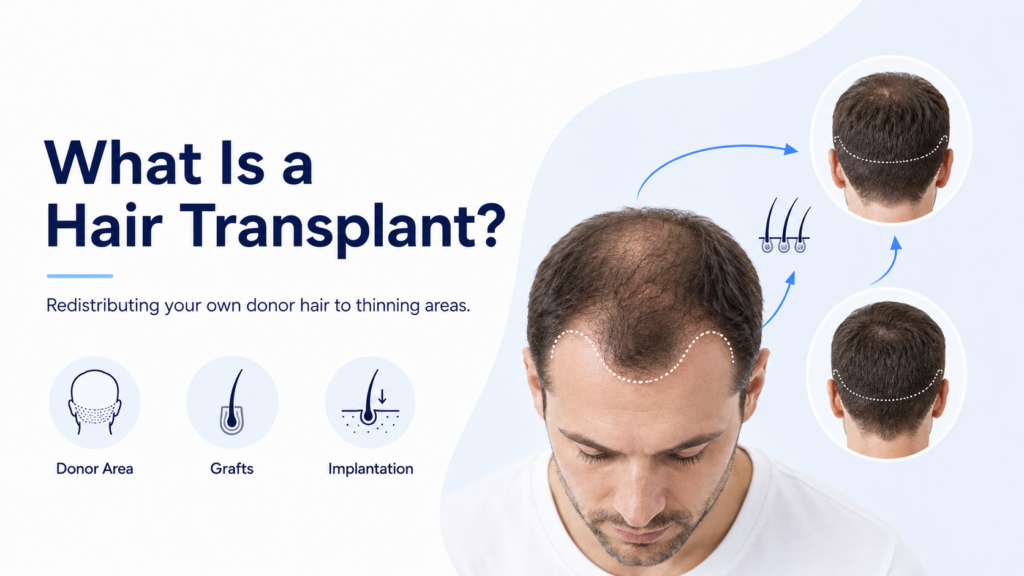
Take hair from where you have plenty. Put it where you have none. That, stripped of every brochure, is a hair transplant.
The hair ringing the back and sides of your head resists the hormone that thins the top. A surgeon borrows from that hardy reserve and moves it into the balding areas, where it settles in and keeps growing. Because the moved follicles carry their resistance with them, they do not thin out later. The result stays.
The rest, the technique names, the graft counts, the year-long wait, is scaffolding around that one idea. Here is the plain-English version: what a transplant is, what it will and will not do, and who it actually suits.
What a hair transplant actually involves
At heart it is a redistribution, not a reinvention.
A surgeon lifts tiny natural clusters of hair, called follicular units, from a donor area at the back and sides. Each cluster holds one to four hairs. Those units then go, one at a time, into the thinning zones at the front or crown, angled to fall the way real hair does.
You stay awake under local anaesthetic throughout. A session runs anywhere from four to eight hours, set by the number of grafts, with no big incisions and, in most cases, no overnight stay. For the full hour-by-hour, our treatment day page walks through it.
A word on graft numbers, since it is the figure everyone fixates on. A modest hairline might take a couple of thousand. Bigger areas take more. But more is not better, because every graft you move is spent from a reserve that never refills. The best plans use the fewest grafts that still look natural, and keep something back for the years ahead.
Why a hair transplant works: the one bit of biology that matters
Everything rests on a single quirk of male pattern loss.
Up top, the follicles are sensitive to a hormone called DHT. It shrinks them, cycle by cycle, until they stop growing visible hair. Down at the back and sides, the follicles ignore DHT entirely, which is why that band survives even when the crown is bare.
Now move one of those stubborn follicles into a bald patch. It does not change its nature. It keeps ignoring DHT and keeps growing, exactly as it did before. That single fact is why a transplant lasts, and why the donor hair only ever comes from that particular ring. The condition driving all of it sits on our male pattern baldness page.
What a hair transplant is not
This half causes most of the disappointment, so read it twice.
It is not new hair. Nobody grows extra follicles; a transplant only shuffles the ones you already own, and your donor supply is the hard limit on the whole thing.
It is not a cure. Your original loss carries on regardless, and the native hair around the grafts can keep thinning, which is why surgery is so often paired with medical treatment.
It is not fast. The transplanted hairs shed within a few weeks, sit quiet for a couple of months, then grow through over the best part of a year.
And it is not one plan for everyone. What suits settled, moderate loss is the wrong move for early, galloping loss. Same procedure, very different decision.
Hold those four in mind and it all clicks. Skip them and you have set yourself up to be let down.
The main types of hair transplant
You will meet a few names, and mostly they describe how the grafts are handled, not radically different operations.
- FUE-based techniques. Units are taken out individually from the donor area. Our Sapphire FUE page covers one modern take on it.
- DHI. Extraction and placement combined through a specific implanting tool, explained on our DHI page.
Here is the unglamorous truth. Both move the same follicular units, both produce natural results in good hands, and the acronym matters far less than the person holding the instrument. Skill beats branding, every time.
What can a hair transplant treat?
The scalp is the famous one, but the same principle travels across the face and head.
- Hairline and temples, by far the most common ask, rebuilding a receding front.
- Crown, the thinning patch up top and towards the back.
- Beard, filling sparse or patchy growth, covered on our beard hair transplant page.
- Eyebrows, restoring thin or over-plucked brows.
Women can be candidates as well, though the assessment runs differently, because female loss tends to be more diffuse. Our hair transplant for women page gets into why.
Who is a hair transplant for?
Not everyone. A clinic worth its name will say so plainly.
The good candidate usually has loss that has settled, or is being held steady with medical treatment, plus a healthy donor area to draw on. Expectations count for as much as biology here, because the donor supply is finite and quietly caps what any surgeon can build.
Early, fast-moving loss is the textbook reason to wait rather than operate. Go in too soon and the transplanted hair can end up marooned while the hair around it keeps receding. Timing, in other words, is a medical call, not a scheduling one.
Cost is usually the next question, and it tracks the graft count your plan needs. Since that count depends on your exact pattern of loss, a real number comes out of an assessment rather than a price list, which our hair transplant costs page explains honestly.
The role of our doctors at Hairtec
Our team includes BIG-registered doctors, listed on the official Dutch medical register, working alongside experienced hair specialists.
A transplant is a medical decision before it is a cosmetic one, so the doctors lead the consultation and the assessment before grafts or dates come up at all. They judge whether your loss is stable, what your donor area can realistically give, and whether medical treatment belongs first or alongside.
They stay in it through the aftercare too. And if the honest answer is that a transplant is not right for you yet, that is the answer you will get. To see what that first step looks like, our free consultation page lays it out.
Frequently asked questions about what a hair transplant is
What exactly is done in a hair transplant?
Natural clusters of one to four hairs, the follicular units, are taken from a donor area at the back and sides and placed into the thinning zones at the front or crown. It happens under local anaesthetic, with you awake, usually across several hours.
Is a hair transplant safe?
Done properly by an experienced team, it is generally a low-risk procedure, since it uses your own hair and local anaesthetic. Every procedure carries some risk, which is exactly why the medical assessment beforehand matters.
Are hair transplants painful?
More uncomfortable than painful for most people. The anaesthetic stings going in, then the scalp is numb and the rest is largely painless, with some mild soreness in the days that follow.
How long does a hair transplant last?
The moved follicles come from the DHT-resistant donor band, so they tend to keep growing for life. What a transplant cannot do is stop your other hair thinning, which is why some ongoing care around the grafts usually still matters.
Does a hair transplant use your own hair?
Yes, entirely. It relocates your own follicles from your donor area into the thinning areas, never anyone else’s hair, which is part of why the body tolerates it so well.
How we reviewed this article:
Hairtec.co.uk has strict sourcing guidelines and relies on peer-reviewed studies, academic research institutions, and medical journals and associations. We only use quality, credible sources to ensure content accuracy and integrity. You can learn more about how we ensure our content is accurate and current by reading our editorial policy.
- Orentreich N (1959). Autografts in alopecias and other selected dermatological conditions. Annals of the New York Academy of Sciences https://pubmed.ncbi.nlm.nih.gov/14429008/
- Jimenez F, Alam M, Vogel JE, Avram M (2021). Hair transplantation: Basic overview. Journal of the American Academy of Dermatology https://pubmed.ncbi.nlm.nih.gov/33905785/
- Shiell RC (2008). A review of modern surgical hair restoration techniques. Journal of Cutaneous and Aesthetic Surgery https://pmc.ncbi.nlm.nih.gov/articles/PMC2840892/
Our experts continually monitor the health and wellness space, and we update our articles when new information becomes available


