
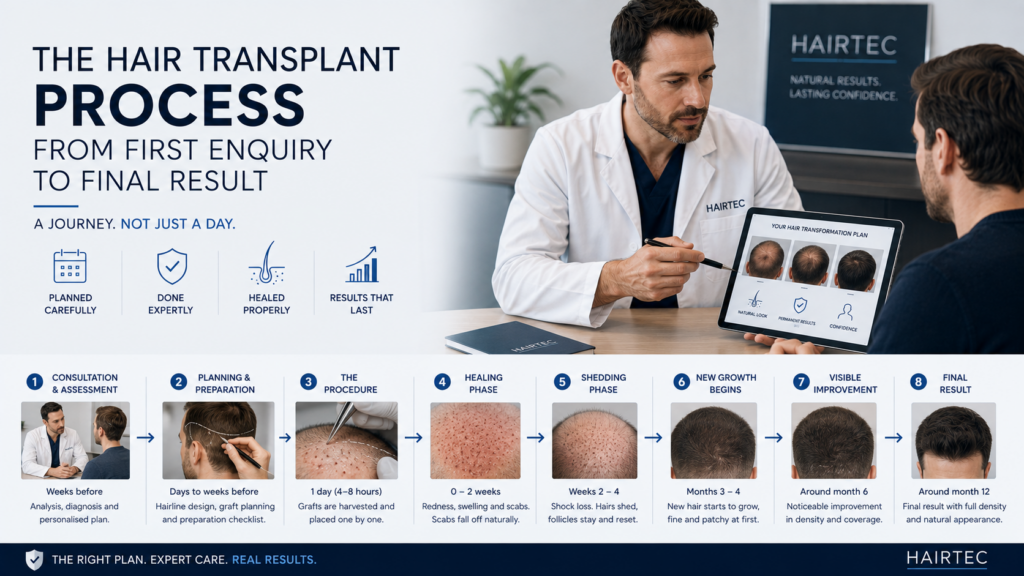
Most people picture a hair transplant as one day. You turn up, you sit in a chair, you leave with hair.
If only. That day is a single chapter, and not even the longest one. The story actually opens weeks earlier at a consultation, and it does not close until nearly a year later, when the last of the transplanted hair has finally grown in. Mistake the day for the whole thing and your expectations land in the wrong place from the start.
What follows is the full arc, chapter by chapter, with a rough sense of how long you spend in each.
Stage one, the consultation and assessment
Everything good starts here, weeks before a scalpel comes anywhere near you.
The opening move should be an honest assessment rather than a sales pitch. A clinician reads your pattern of loss, checks the donor area, goes through your medical history, and asks what you actually want. Then they tell you whether a transplant is even the right call. Often it is. Sometimes the right answer is to wait, or to hold the loss with medical treatment first, and a clinic willing to say that out loud has just told you something valuable about itself.
The plan gets set at this stage too. Graft numbers, placement, and the honest ceiling of what your donor area can spare. Our free consultation page covers what that first appointment actually involves.
And here is the uncomfortable truth about chapter one. Get it right and everything downstream tends to fall into place. Rush it, take a quote instead of a diagnosis, and no brilliance on the day fully undoes the mistake. Nearly every regretted transplant was lost here, in a decision made or skipped weeks before the operation, not on the table.
Stage two, planning and preparation
Between the yes and the procedure sits a stretch of quiet groundwork.
The hairline design is refined. The graft count is confirmed. You get a short list of dos and don’ts for the run-up, easing off alcohol and cigarettes, pausing certain medications if you are told to, keeping a couple of calm days free afterwards. Undramatic, all of it. Also directly tied to how smoothly the day runs and how well the grafts take.
The takeaway is simply that a transplant is planned, not improvised.
Stage three, the procedure
Now the chapter everyone pictures first, and it swallows most of a day.
Four to eight hours, awake, under local anaesthetic. Follicles come out of the donor area at the back and sides, then go in one by one across the thinning zones. Once the numbing is done it is more boring than sore, honestly, hours of careful, repetitive placement. Our treatment day page runs through the hour-by-hour if you want the detail.
Same evening you are home, and the longest chapter quietly begins.
Stage four, healing
Two weeks. That is the only physically delicate stretch of the whole process, and it goes fast.
The early days bring redness, a bit of swelling, and small scabs ringing each graft. Come the end of week two those scabs have shed, the redness is on its way out, and the scalp has mostly healed over. Plenty of people are back at work and out in public by then, even though, as far as visible hair goes, nothing has really happened yet.
Healing is the quick part. Growth is the patient part, and it is up next.
Stage five, shedding and regrowth
Brace for this one, because it blindsides people who were not warned.
Somewhere in weeks two to four, most of the transplanted hair falls out. It looks exactly like failure. It is nothing of the kind. The follicles stay anchored under the skin and reset, and fresh growth pushes through at three to four months, wispy and uneven to begin with before it fills in. By six months the change is obvious, and by roughly twelve months the result has settled into its final shape. The whole slow journey is mapped on our hair transplant surgery recovery page.
The whole process at a glance
End to end, the timeline sits like this.
| Stage | Roughly when |
| Consultation and assessment | Weeks before the procedure |
| Planning and preparation | The run-up to the day |
| The procedure | One day, four to eight hours |
| Healing | About two weeks |
| Shock loss | Weeks two to four |
| New growth begins | Months three to four |
| Visible improvement | Around month six |
| Final result | Around month twelve |
One word sums that table up. Patience. The procedure is a day. The process is close to a year, and the people who go in knowing that come out happier than the ones expecting a transformation by next weekend.
Where technique fits into the process
Two method names will come up along the way, and they belong to the procedure chapter, not the journey as a whole.
Both modern approaches move the same follicular units, and both look natural in capable hands, so which one you have is a footnote within the process rather than the plot. Our Sapphire FUE page sets out where one of them fits.
Keep it in proportion. People burn hours weighing up which acronym to choose and barely a minute on whether their loss is even settled enough to operate on, when that second question shapes the outcome far more than the first ever will. The technique is a tool. The plan and the timing are the process, and that is where a result is genuinely won or lost.
The role of our doctors at Hairtec
Our team includes BIG-registered doctors, listed on the official Dutch medical register, working alongside experienced hair specialists.
There is a reason the whole thing is framed as medical from the very first appointment. A good outcome leans far more on the stages wrapped around the procedure than on the hours in the chair. The doctors run the consultation and the assessment, judge whether and when surgery makes sense, and stay in it through the long healing and growth stretch.
That continuity is the quiet advantage. When the shed hits at week three and looks like a disaster, or the growth seems patchy at month four, having a team that assessed you and can say plainly that it is all on schedule is worth more than most people realise before they are living it.
Frequently asked questions about the hair transplant process
What are the steps of a hair transplant?
The process runs through consultation and assessment, planning and preparation, the procedure itself, then healing, shedding and regrowth. The surgery is one day, but the full process from first appointment to final result takes close to a year.
How long does the whole hair transplant process take?
The procedure is a single day of four to eight hours, but the complete process spans around twelve months. The scalp heals in about two weeks, while the transplanted hair sheds and then regrows to its final look over the following year.
Is the hair transplant process painful?
The only genuinely uncomfortable part is the anaesthetic injections at the start of the procedure, which sting briefly. After that the day is largely painless, and the healing stage brings mild soreness that is easily managed.
How long do 3,000 grafts take?
A session of that size typically falls within the usual four to eight hour range, often towards the middle or upper end, since each graft is placed individually. The exact time depends on the case and the team.
When will I see the final result?
New growth begins around three to four months, with clear improvement by six months and the final, settled result at roughly twelve months. The crown can take a little longer than the front.
How we reviewed this article:
Hairtec.co.uk has strict sourcing guidelines and relies on peer-reviewed studies, academic research institutions, and medical journals and associations. We only use quality, credible sources to ensure content accuracy and integrity. You can learn more about how we ensure our content is accurate and current by reading our editorial policy.
- Bernstein RM, Rassman WR (1997). Follicular transplantation: patient evaluation and surgical planning. Dermatologic Surgery https://pubmed.ncbi.nlm.nih.gov/9311372/
- Patwardhan N, Mysore V (2008). Hair transplantation: standard guidelines of care. Indian Journal of Dermatology, Venereology and Leprology https://ijdvl.com/hair-transplantation-standard-guidelines-of-care/
Our experts continually monitor the health and wellness space, and we update our articles when new information becomes available


