
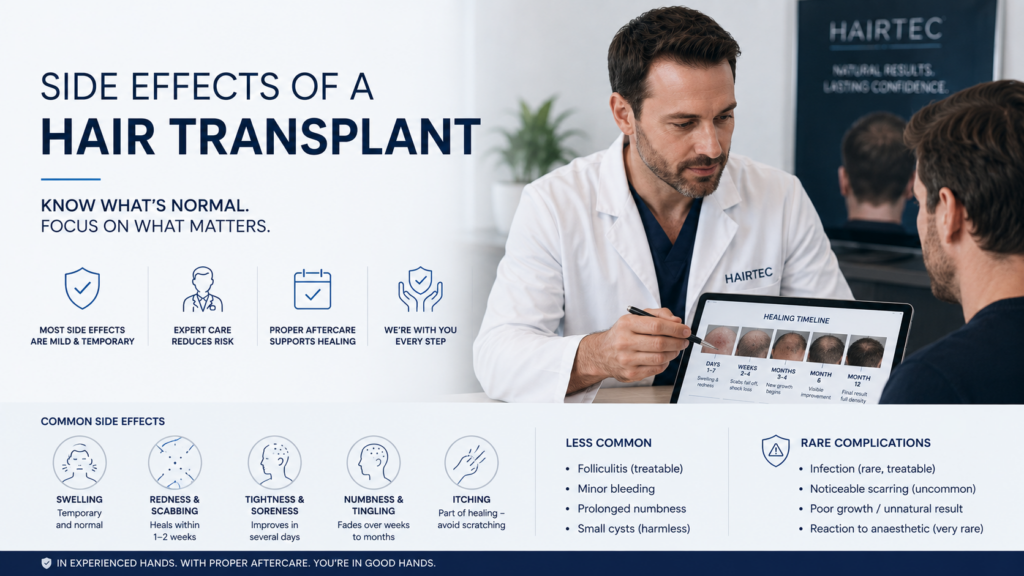
Every procedure has side effects. A hair transplant is no exception, and any clinic that tells you otherwise has just given you a reason to be wary of it.
The real picture is more reassuring than the word “side effects” sounds. Most of what you will experience is mild, short-lived, and simply part of healing rather than a sign that anything has gone wrong. Serious complications do exist. They are also uncommon when the work is done well and you look after the grafts afterwards.
What follows is a straight account, sorted from the routine to the rare, so you can tell which is which instead of fearing all of it equally.
The common, temporary side effects
Almost everyone gets some of these, and almost all of them clear up within days or a couple of weeks.
Swelling is the usual first one, often around the forehead and eyes for a few days before it drains away. The treated areas stay pink or red for a week or two while they heal. Small scabs form around each graft, then flake off by themselves toward the end of week two. Both the donor and recipient zones can feel tight and tender for several days, and a patch of numbness or tingling on the scalp is common, fading over weeks to months. As things heal, expect some itching, and resist scratching it, because that is exactly when you put grafts at risk.
None of this means a thing has gone wrong. It is your scalp doing its job. Our hair transplant aftercare guidance covers how to manage each of these as they come.
Shock loss, the side effect that scares people most
One side effect earns its own heading, because it looks like a catastrophe and is nothing of the sort.
Somewhere between week two and week four, most of the transplanted hairs fall out. Sometimes a little of the surrounding native hair goes with them. Every instinct says the transplant has failed.
It has not. The follicles are still there, sitting safely under the skin. Only the visible hairs shed, and they come back on a fresh growth cycle over the following months. Shock loss is a stage of recovery, not a complication, but it catches people off guard hard enough that it is worth bracing for in advance.
The less common side effects
A minority of people run into these, and most are minor and manageable, though a few are worth a call to your clinic.
Folliculitis, small inflamed spots around the grafts as hair regrows, is usually mild and treatable. A little bleeding can happen early on and normally settles with gentle pressure. Occasionally the numbness lingers longer than expected before it resolves. And now and then small, generally harmless cysts form where grafts were placed, then clear on their own.
The reason to know these is not to worry about them. It is so you can tell what is worth mentioning to your clinic rather than quietly sitting on.
The rare, serious complications
Uncommon, but honesty means naming them anyway. All of these are far less likely with an experienced team and good aftercare, and none of them should be dressed up as impossible.
Infection is rare with proper sterile technique, and treatable if it does occur. Noticeable scarring is uncommon with modern methods, though every procedure leaves some mark. Poor growth or an unnatural-looking result is usually a consequence of a bad plan rather than a medical event, which is exactly why the assessment carries so much weight. A reaction to the anaesthetic is very rare, and screened for beforehand.
Look at that list and a pattern emerges. The serious problems track back to who did the work and how carefully you were assessed, not to the operation itself. Our free consultation page explains what that screening actually checks.
A word on the donor area
The recipient area gets the attention. The donor area at the back and sides carries its own small set of considerations, and they are worth knowing.
It feels tight and mildly sore for the first several days, sometimes with a little temporary numbness. The concern to understand here is overharvesting. Take too many grafts from one stretch and the donor zone itself can end up looking thin, and unlike the transplanted area, it does not get refilled. That is a planning decision, not bad luck, which is one more reason an honest read of what your donor area can spare matters as much as the surgery that follows.
Do the side effects differ for women?
Broadly, no. The procedure is the same, so the healing is too. The real difference sits earlier, in the assessment.
Female hair loss is more often diffuse, and that affects whether the donor area is dependable and whether a transplant is even the right move. So the pre-procedure assessment matters more, not less, for women. Our hair transplant for women page goes into why.
How to lower your risk of side effects
You influence how smoothly this goes more than you might expect, and the steps are not complicated.
Choose an experienced, transparent team first, since that decision does more to keep you off the serious end of the list than anything else. Be fully honest at your assessment, because medical history, medications and health conditions all shape a safe plan. Then follow the aftercare closely, as most avoidable problems trace straight back to those vulnerable early days. And if something looks off, spreading redness, rising pain, signs of infection, call rather than wait it out.
Done sensibly, a hair transplant is generally regarded as a low-risk procedure. The routine side effects are the price of admission. The serious ones are, for the most part, avoidable.
The role of our doctors at Hairtec
Our team includes BIG-registered doctors, listed on the official Dutch medical register, working alongside experienced hair specialists.
Side effects are the whole reason a transplant is handled as a medical procedure first. Before a date is set, the doctors lead the consultation and the assessment, reviewing your health, your medications and anything that might raise your risk, so the plan is built around a safe result rather than only a cosmetic one.
They stay involved through the aftercare too, which is where most avoidable side effects are either prevented or caught early. If something does not look right, a medical team already familiar with your case can sort it out far faster than a search bar can.
Frequently asked questions about hair transplant side effects
What are the side effects of a hair transplant?
Most are mild and temporary, including swelling, redness, scabbing, tightness, itching and temporary numbness, plus shock loss where the transplanted hair sheds before regrowing. Less common effects and rare serious complications exist but are far less likely with proper care.
Is a hair transplant safe?
It is generally considered a low-risk procedure when carried out by an experienced team with proper aftercare, since it uses your own hair and local anaesthetic. As with any procedure there are risks, which is why a thorough medical assessment beforehand matters.
What are the worst days after a hair transplant?
The first three to four days are usually the least comfortable, with the most swelling, tightness and redness. Things improve steadily from there, and by around two weeks the scalp has largely healed.
Does a hair transplant leave scars?
All procedures leave some mark, but with modern techniques and a skilled team noticeable scarring is uncommon. Any small marks in the donor area are usually well hidden by surrounding hair.
Are the side effects of a hair transplant permanent?
Almost always no. The common side effects are temporary parts of healing that resolve within days or weeks. Rare complications can be more lasting, which is another reason the choice of clinic and careful aftercare matter.
How we reviewed this article:
Hairtec.co.uk has strict sourcing guidelines and relies on peer-reviewed studies, academic research institutions, and medical journals and associations. We only use quality, credible sources to ensure content accuracy and integrity. You can learn more about how we ensure our content is accurate and current by reading our editorial policy.
- Kerure AS, Patwardhan N (2018). Complications in Hair Transplantation. Journal of Cutaneous and Aesthetic Surgery https://pmc.ncbi.nlm.nih.gov/articles/PMC6371733/
- Salanitri S, Gonçalves AJ, Helene A Jr, Lopes FH (2009). Surgical complications in hair transplantation: a series of 533 procedures. Aesthetic Surgery Journal https://doi.org/10.1016/j.asj.2008.11.005
- Liu RH, Xu LJ, McCarty JC et al. (2025). A Scoping Review on Complications in Modern Hair Transplantation: More than Just Splitting Hairs. Aesthetic Plastic Surgery https://doi.org/10.1007/s00266-024-04316-3
Our experts continually monitor the health and wellness space, and we update our articles when new information becomes available


