
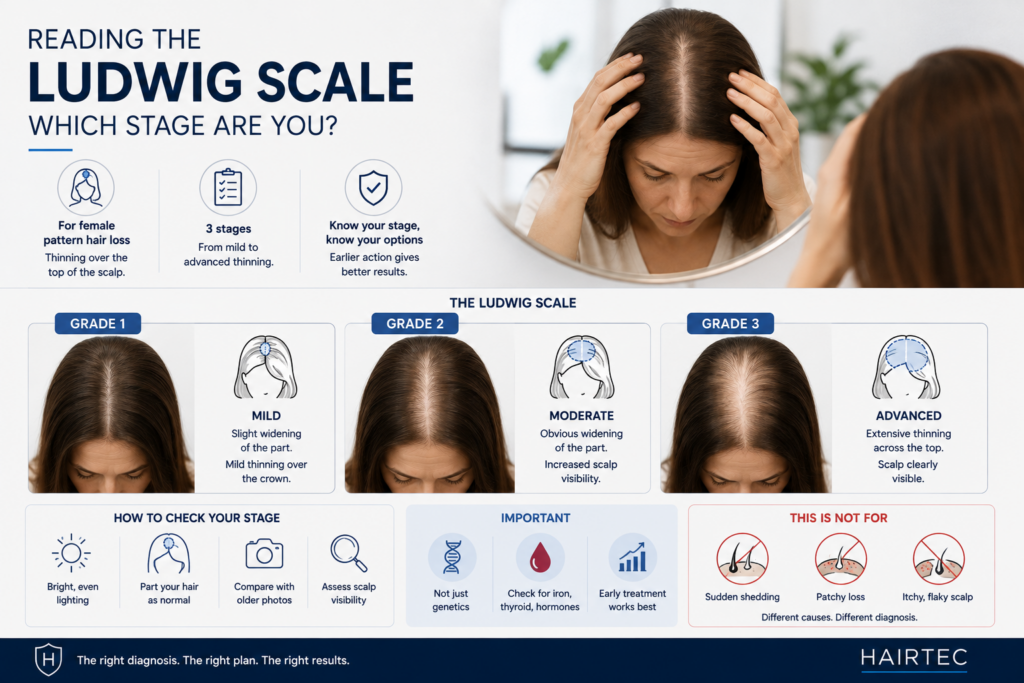
If you have started noticing more scalp through your parting, someone has probably pointed you at the Ludwig scale. Three little diagrams, three grades, and not much guidance on which one is you.
That is the gap this fills. Knowing the scale exists is easy. Working out where you sit on it, and what that actually means for what to do next, is the part that gets skipped. So here is how to read your own stage, and why it matters more than the number itself.
For the full definition of the scale and its grades, our main Ludwig scale page lays them out.
What the Ludwig scale is, quickly
The Ludwig scale is the standard way of grading female pattern hair loss, the female version of the male Norwood scale.
The key difference is where the hair goes. Women rarely recede at the hairline the way men do. Instead the thinning spreads across the top of the scalp while the front hairline usually holds, and the Ludwig scale captures exactly that, three grades of increasing thinning over the crown. It is why doctors reach for it rather than the Norwood scale for women, a distinction our female pattern baldness page goes into.
The three stages, in plain terms
Three grades, and telling them apart is more about the parting than anything else.
Grade one is mild. The thinning has begun, and the clearest sign is a parting that looks a little wider than it used to, with some diffuse loss over the crown. Easy to miss, and easy to explain away.
Grade two is moderate. The widening is obvious now, the scalp shows through more visibly along and around the part, and the overall density on top has dropped in a way that is hard to ignore.
Grade three is advanced. There is extensive thinning across the top, the scalp is clearly visible, and much of the density in that zone has gone, though the front hairline and the sides still tend to remain.
How to place yourself
You do not need a clinic to get roughly there. You need good light and your own parting.
Part your hair where you normally would, in bright, even light, ideally with a mirror and your phone camera. Look at how much scalp shows along the parting compared with a year or two ago, and whether that widening is confined to the part or spreading across the whole top. A subtly wider part with otherwise decent density points to grade one. An obviously widened part with visible scalp is grade two territory. Extensive see-through thinning across the crown sits at grade three.
It will not be exact, and it does not need to be. It gets you into the right band before a proper assessment sharpens it up.
Why your stage changes what helps
Here is where the scale earns its place, because your grade shapes what is realistic.
Earlier grades, where plenty of follicles are thinning but still active, are where treatment has the most to work with. The goal at that point is to hold and, where possible, thicken what is there. As thinning advances, the aim shifts, and options that suit early loss may do less. What the scale does not do, on its own, is tell you the cause, and in women that matters enormously, because female thinning often has more than one driver behind it.
That is why a Ludwig grade is a starting point, not a diagnosis. Iron, thyroid and hormonal shifts can all sit underneath the pattern, and treating those can do more than any topical. Our hair loss treatments page runs through which options suit which situation.
An important note on treatment in women
One thing worth flagging clearly, because it separates female treatment from male. The options are not simply the male ones scaled down.
Minoxidil is well established for women and tends to be the mainstay. Finasteride, the tablet used widely in men, is a very different matter here, not a routine treatment for female loss, used only cautiously under specialist care, and never during pregnancy or when pregnancy is possible. A plan built for a woman has to account for all of that, which is one more reason self-treating from a stage number alone is a poor idea.
You will also see people online talk about a “big three” for thinning hair, usually meaning minoxidil, finasteride and a ketoconazole shampoo. That framing comes from the male hair loss world, and it does not transfer cleanly to women. Finasteride alone makes it unsafe to copy across, and it skips over the underlying causes, iron, thyroid, hormones, that carry far more weight in female thinning. Treat the “big three” as male-forum shorthand rather than advice for a woman working out her Ludwig grade.
Where the scale stops being useful
Two honest limits, since they come up.
The Ludwig scale describes the pattern of female androgenetic thinning. It does not describe hair that sheds suddenly across the whole scalp, comes out in patches, or arrives with an itchy, flaking scalp, all of which point to something else entirely and need their own diagnosis rather than a grade.
And it cannot tell you how fast you are moving. A stable grade two is a calmer picture than a grade one that got there quickly and is still progressing, so the trajectory matters as much as the grade, which is exactly the kind of thing an assessment reads.
The role of our doctors at Hairtec
Our team includes BIG-registered doctors, listed on the official Dutch medical register, working alongside experienced hair specialists.
Placing yourself on the Ludwig scale is the easy part. The valuable part is everything the scale leaves out, whether the loss is genuinely androgenetic or something reversible like iron or thyroid, how fast it is moving, and what is actually safe and sensible for you specifically.
The doctors lead the consultation and the assessment, read the grade against your history and the pace of change, rule out the causes the scale was never meant to capture, and are honest about when a transplant is or is not the right route, which for diffuse female loss is a real question. Our hair transplant for women page explains why that assessment is so central.
Frequently asked questions about the Ludwig scale
What is the Ludwig scale?
It is the standard classification for female pattern hair loss, grading thinning across the top of the scalp in three stages. Unlike the male Norwood scale, it describes diffuse thinning over the crown rather than a receding hairline.
How do I know my Ludwig stage?
Look at your parting in bright light and compare it with a photo from a year or two ago. A slightly wider part with good density suggests grade one, an obviously widened part with visible scalp is grade two, and extensive see-through thinning across the top is grade three. A clinician can confirm it.
What is the difference between the Ludwig and Norwood scales?
The Ludwig scale grades female pattern loss as diffuse thinning over the top of the scalp, while the Norwood scale grades male loss as a receding hairline and crown. They describe different patterns, so the correct scale depends on the type of loss.
Can hair loss on the Ludwig scale be treated?
Often, yes, especially at earlier stages where follicles are thinning but active. Minoxidil is the mainstay for women, and treating any underlying cause such as iron or thyroid issues can help significantly. The right approach depends on an individual assessment.
Does a higher Ludwig grade mean I need a transplant?
Not necessarily. Female loss is often diffuse, which affects whether a transplant is suitable at all, since the donor area may be thinning too. A higher grade means it is worth a proper assessment rather than assuming surgery is the answer.
How we reviewed this article:
Hairtec.co.uk has strict sourcing guidelines and relies on peer-reviewed studies, academic research institutions, and medical journals and associations. We only use quality, credible sources to ensure content accuracy and integrity. You can learn more about how we ensure our content is accurate and current by reading our editorial policy.
Our experts continually monitor the health and wellness space, and we update our articles when new information becomes available


