
You caught your reflection at an unkind angle, and now you cannot unsee it. The corners look higher than you remember. Maybe.
That “maybe” is the whole problem. A receding hairline creeps in slowly enough that you doubt yourself daily, and a naturally high or maturing hairline gets mistaken for balding all the time. So before you spiral, let us make this checkable rather than a source of daily anxiety.
Here is how to actually tell whether your hairline is receding, how to rule out the things that only look like it, and what the honest next step is if it turns out you are right.
The single most reliable test: old photos
Forget staring in the mirror. Your memory of your own hairline is unreliable, and mirrors show you the same worry every day without a reference point.
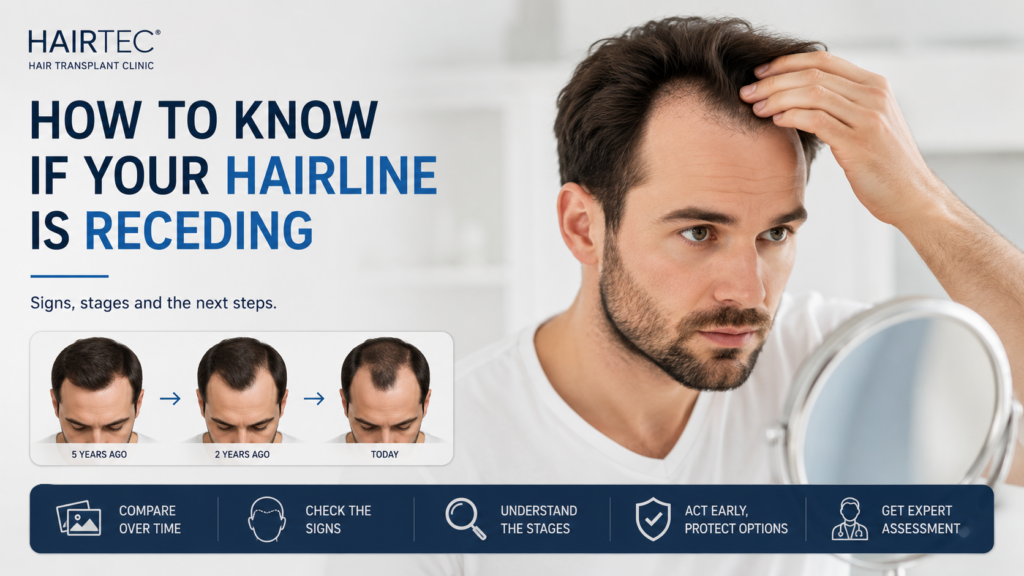
Dig out photos from five and ten years ago. Front-on, hair off the forehead if you can find them. Line them up against a photo you take today in the same lighting. This one comparison tells you more than a month of anxious mirror checks, because a receding hairline is defined by change over time, not by how high your hairline sits on any given morning.
If the corners have crept back and the shape has changed between then and now, that is recession. If it looks the same as it did a decade ago, whatever you have, it is stable, and stable is a very different situation.
Mature hairline versus receding hairline
This trips up more people than anything else, so it is worth pinning down.
Your childhood hairline sits low and straight. Somewhere between the late teens and mid-twenties, almost everyone’s hairline moves back a little and loses that straight juvenile edge. This is a maturing hairline, it is normal, and it is not balding. It typically settles roughly a centimetre or so above the highest forehead crease and then stops.
A receding hairline is different in two ways:
- It keeps going. A mature hairline settles and holds. A receding one carries on retreating year after year.
- The corners lead. Recession usually deepens at the temples first, forming an M shape, rather than moving back evenly.
So the question is not just “has it moved”. Everyone’s moves once. The question is “is it still moving, and are the corners pulling back”. That is the line between normal maturing and genuine loss.
Other signs worth checking
The hairline is the headline, but a few other signals help confirm the picture:
- The temples specifically. Deepening notches at the corners are the classic early sign, often before anywhere else.
- Finer hairs at the front. Recession is preceded by miniaturisation, where the front hairs come back thinner, wispier and shorter each cycle.
- The crown. Check the top and back with a second mirror or your phone. Crown thinning often travels alongside a receding hairline.
- More shedding than usual. Not always present, but a noticeable increase in hair on the pillow or in the shower can accompany it.
None of these on their own is proof. Together with a clear change in the old-photo test, they build a reliable picture.
If you want to place what you are seeing on a proper map, the stages of male pattern recession are set out on our Norwood scale page, from a barely-there temple notch through to more advanced loss. Working out roughly where you sit is a useful sanity check against the panic a single mirror glance can cause.
The “how many fingers” test, and why to take it lightly
You will have seen the trick online: lay fingers between your eyebrows and hairline, and a certain number supposedly means you are safe or doomed.
Treat it as entertainment, not diagnosis. Foreheads and fingers vary enormously, and a high hairline is not the same as a receding one. Someone can have a tall forehead their whole life and never lose a hair. The finger test measures height, and height is not the point. Movement over time is the point, which loops straight back to the photos.
Is Gen Z really balding faster?
It is one of the most searched worries around receding hairlines right now, so it is worth a straight answer. There is no solid evidence that male pattern loss itself has sped up in a generation; the genetics behind it have not changed in twenty years. What has changed is visibility. Front-facing cameras, high-definition screens and a constant feed of other people’s hairlines mean young men scrutinise their own far more closely than any previous generation did. Some of the panic is real early recession spotted sooner, which is genuinely a good thing. A lot of it is a normal maturing hairline being read as a catastrophe at twenty-two. The photo test settles which is which.
What is actually causing it
For most men, a genuinely receding hairline is the opening move of male pattern hair loss, driven by a genetic sensitivity to the hormone DHT. Our male pattern baldness page explains that process and where the hairline sits within it.
It is worth a quick sanity check for other causes, though. Sudden shedding across the whole scalp, patchy bald spots, or a sore, flaky scalp point somewhere other than pattern loss, and those deserve a proper look rather than a self-diagnosis of a receding hairline.
What to do if your hairline is receding
First, do not panic, and do not rush into anything drastic. A receding hairline caught early is the best-case scenario, because early is when you have the most options.
The sensible order of things:
- Confirm it is progressing, using the photo comparison rather than a single bad-mirror day.
- Get it assessed while it is early, so you understand the trajectory, not just today’s snapshot.
- Protect what you have. Early loss is often best managed by holding the line medically before anything surgical is even discussed.
- Understand the hairline specifically, if a transplant ever becomes relevant, since rebuilding a natural front edge is its own skill.
If a rebuilt front edge ever becomes relevant, our hairline hair transplant page explains why designing a natural hairline is a craft in itself.
The worst move is the panic decision. The best is an early, calm assessment while the options are still wide, and our free consultation page covers what that first step involves.
The role of our doctors at Hairtec
Our team includes BIG-registered doctors, listed on the official Dutch medical register, working alongside experienced hair specialists.
Whether a hairline is genuinely receding, or simply maturing, is exactly the kind of thing worth a professional eye rather than a worried guess. In the consultation and assessment the doctors look at the pattern, compare it against the signs of progression, and check for the other causes that can mimic pattern loss.
From there they can tell you whether it is moving, how fast, and what actually helps, including when the honest answer is that it is stable and needs nothing more than keeping an eye on.
Frequently asked questions about a receding hairline
How do I know if my hairline is receding or maturing?
Compare front-on photos from several years ago with one taken today. A maturing hairline moves back once in early adulthood and then settles; a receding one keeps retreating over time, usually deepening at the temples into an M shape.
Is a receding hairline always balding?
Often it is the first sign of male pattern hair loss, but not always. A high or maturing hairline can look similar without being balding, and other causes of hair loss follow different patterns, so an assessment confirms which it is.
Can you regrow a receding hairline?
Hairs that are thinning but still active can sometimes respond to medical treatment, especially early. A hairline that has fully receded is harder to reverse without a transplant, which is why acting while it is early gives the most options.
At what age does a hairline start receding?
Male pattern recession can begin any time after puberty, and for many men becomes noticeable in their twenties or thirties. A one-off backward shift in early adulthood is usually a normal maturing hairline rather than balding.
Does a high hairline mean it is receding?
Not on its own. Plenty of people have a naturally high hairline for life without losing hair. Recession is about ongoing change over time, especially at the temples, not about how high the hairline sits at one moment.
How we reviewed this article:
Hairtec.co.uk has strict sourcing guidelines and relies on peer-reviewed studies, academic research institutions, and medical journals and associations. We only use quality, credible sources to ensure content accuracy and integrity. You can learn more about how we ensure our content is accurate and current by reading our editorial policy.
- Rassman WR, Pak JP, Kim J (2013). Phenotype of normal hairline maturation. Facial Plastic Surgery Clinics of North America https://doi.org/10.1016/j.fsc.2013.04.001
- Sinclair R (1998). Male pattern androgenetic alopecia. BMJ https://pmc.ncbi.nlm.nih.gov/articles/PMC1113949/
Our experts continually monitor the health and wellness space, and we update our articles when new information becomes available


