
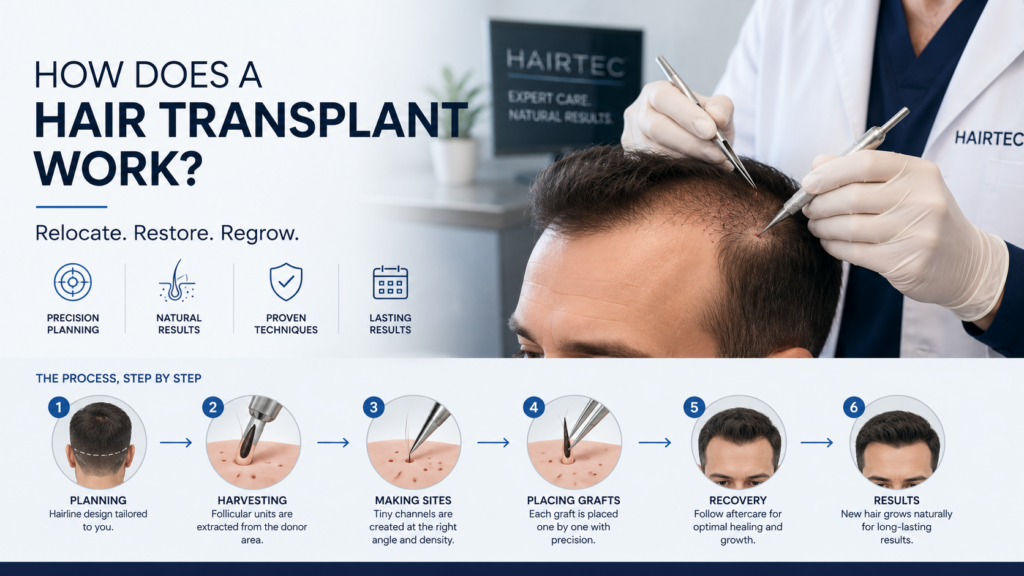
Strip away the marketing and a hair transplant is a simple idea. You have hair at the back and sides of your head that is built to last. You have thinning up top that is not.
A transplant moves the first kind into the space left by the second. That is the whole principle. Everything else, the techniques, the tools, the graft counts, is detail hanging off that one sentence.
This piece walks through how a hair transplant actually works, start to finish, so you know what you would be signing up for.
The idea a hair transplant rests on
Not every follicle on your head is equal. Where a follicle sits decides how long it lasts:
- The crown and hairline. These follicles are often sensitive to DHT, the hormone behind male pattern loss, which is exactly why they thin first.
- The back and sides. This band usually shrugs DHT off entirely, and it is the donor area a transplant draws from.
Here is the clever part. When you move one of those resistant follicles, it keeps its resistance. Plant it in a thinning zone up front and it carries on behaving like back-of-the-head hair, growing where the hair around it is giving up.
The trait travels with the follicle. Without that quirk of biology, there would be no such thing as a hair transplant.
It also explains why the numbers matter. A typical session moves anywhere from around 2,000 to 4,000 grafts, and since a graft holds one to four hairs, that is a lot of individual placements in a single day. The count is capped by how much your donor area can spare without leaving the back and sides looking thin themselves, which is one of the first things an assessment works out.
How a hair transplant works, step by step
The day is longer and less dramatic than most people expect. A single session commonly runs four to eight hours, depending on the graft count, and you are awake throughout under local anaesthetic.
- Planning and the hairline. Before anything is touched, the new hairline is designed, drawn on, and agreed with you. This decides whether the result looks natural or obvious, and it is worth more care than the surgery itself.
- Numbing. Local anaesthetic goes into the donor and recipient areas. There is a sting as it goes in. After that the scalp is numb, and most of the day is more boring than painful.
- Harvesting the grafts. Follicles are taken from the donor area, one small grouping at a time. A follicular unit, the natural bundle hair grows in, holds one to four hairs.
- Making the sites. Tiny incisions, or channels, are created in the thinning area, set at the angle and density that will read as hair that grew there naturally.
- Placing the grafts. Each unit is set into a site, one by one. Slow, meticulous work, and where the artistry of the team shows.
- Done for the day. No large stitches, no bandaged head in most cases. You go home with aftercare instructions and a scalp that will look worse before it looks better.
The two main hair transplant methods, briefly
You will run into two names, FUE and DHI, and clinics love to argue about them. The honest summary is short:
- Both move follicular units, the same natural bundles of hair.
- Both give excellent results in skilled hands.
- The real difference is in how the grafts are extracted and placed, not some secret edge of one over the other.
Because we cover that comparison properly elsewhere, this page will not relitigate it. Our guide to the different hair transplant methods lays out where each one fits.
What hair transplant recovery actually looks like
The timeline surprises people, so here is the honest version rather than the glossy one.
The first week or two, the transplanted area is red, a little swollen, and dotted with tiny scabs around each graft. Normal, and it settles.
Then comes the part nobody warns you about. Somewhere around week two to four, most of the transplanted hairs fall out. This is called shock loss, and it feels like a disaster. It is not. The follicle stays safely under the skin; only the visible hair sheds, and it grows back.
From there it is a waiting game, and the milestones look like this:
| Timeframe | What is happening |
| Days 1 to 14 | Redness, minor swelling, small scabs; grafts settling in |
| Weeks 2 to 4 | Shock loss, the transplanted hairs shed while the follicles stay put |
| Months 3 to 4 | New growth begins to appear |
| Month 6 | Clear, visible improvement |
| Month 12 | Final result, full density and natural look |
A hair transplant is not a quick fix you admire in the mirror next week. It is a year-long process with a good ending.
Aftercare in those first days is not optional either. A few simple things protect the grafts:
- Sleep propped up for the first nights to keep swelling down.
- Leave the grafts alone; no picking at scabs.
- Skip heavy exercise, saunas and swimming for a couple of weeks.
- Keep the new area out of direct sun.
None of it is dramatic, but skip it and you can cost yourself grafts that would otherwise have taken. The surgery is the headline. The fortnight after it does quiet, real work.
The honest limits of a hair transplant
A hair transplant is redistribution, not creation. It relocates what you already have, which leads to two truths clinics do not always volunteer:
- Your donor area is finite. There is only so much resistant hair to move, and a good plan spends it wisely across a lifetime, not all at once on an aggressive hairline at thirty.
- It does not stop your original loss. The native hair around the grafts can keep thinning on its own schedule, which can leave transplanted hair standing in a receding field a few years on.
That second point is exactly why a sensible plan usually pairs surgery with medical treatment to hold the native hair, a point our hair loss treatments page goes into.
It also explains why the right candidate matters as much as the right surgeon. Someone whose loss has stabilised is a very different case from someone in the early, fast-moving stage described on our male pattern baldness page, and that difference often decides whether surgery makes sense yet at all.
How our doctors guide your hair transplant at Hairtec
Our team includes BIG-registered doctors, listed on the official Dutch medical register, working alongside experienced hair specialists.
Before any talk of grafts, the doctors handle the consultation and the medical assessment. In practice that means checking:
- Whether your loss has settled enough to make surgery sensible.
- Whether your donor area can actually supply the coverage you want.
- Whether medical treatment should come first, or run alongside.
They stay involved through the aftercare too. That oversight is the difference between a procedure sold to you and a plan built around you, and sometimes the honest medical answer is that now is not the time.
Frequently asked questions about how a hair transplant works
How long does a hair transplant last?
The transplanted follicles come from the DHT-resistant donor area, so they tend to keep growing for life. What a hair transplant cannot do is stop your other, native hair from thinning, which is why ongoing care around the grafts usually still matters.
Are hair transplants painful?
Most of the day is uncomfortable rather than painful. The anaesthetic injections sting going in, but once the scalp is numb the procedure itself is largely painless. Mild soreness and tightness in the first few days afterwards is normal and manageable.
Is a hair transplant 100% successful?
No procedure is guaranteed, and honest clinics do not claim otherwise. Most grafts survive and grow when the work is done well and aftercare is followed, but results depend on the surgeon, the plan and the individual, and realistic expectations are part of a good outcome.
When will I see results after a hair transplant?
Expect a wait. The transplanted hairs shed within the first month, new growth starts around three to four months, visible improvement lands by six, and the final result settles at roughly twelve months.
Does a hair transplant stop future hair loss?
No. It relocates resistant hair but does nothing to the follicles losing the battle elsewhere. Your original loss can continue, which is why medical treatment is often planned alongside a hair transplant to protect the surrounding hair.
How we reviewed this article:
Hairtec.co.uk has strict sourcing guidelines and relies on peer-reviewed studies, academic research institutions, and medical journals and associations. We only use quality, credible sources to ensure content accuracy and integrity. You can learn more about how we ensure our content is accurate and current by reading our editorial policy.
- Orentreich N (1959). Autografts in alopecias and other selected dermatological conditions. Annals of the New York Academy of Sciences https://pubmed.ncbi.nlm.nih.gov/14429008/
- Rassman WR, Bernstein RM, McClellan R et al. (2002). Follicular unit extraction: minimally invasive surgery for hair transplantation. Dermatologic Surgery https://pubmed.ncbi.nlm.nih.gov/12174065/
- Jimenez F, Alam M, Vogel JE, Avram M (2021). Hair transplantation: Basic overview. Journal of the American Academy of Dermatology https://pubmed.ncbi.nlm.nih.gov/33905785/
Our experts continually monitor the health and wellness space, and we update our articles when new information becomes available


