
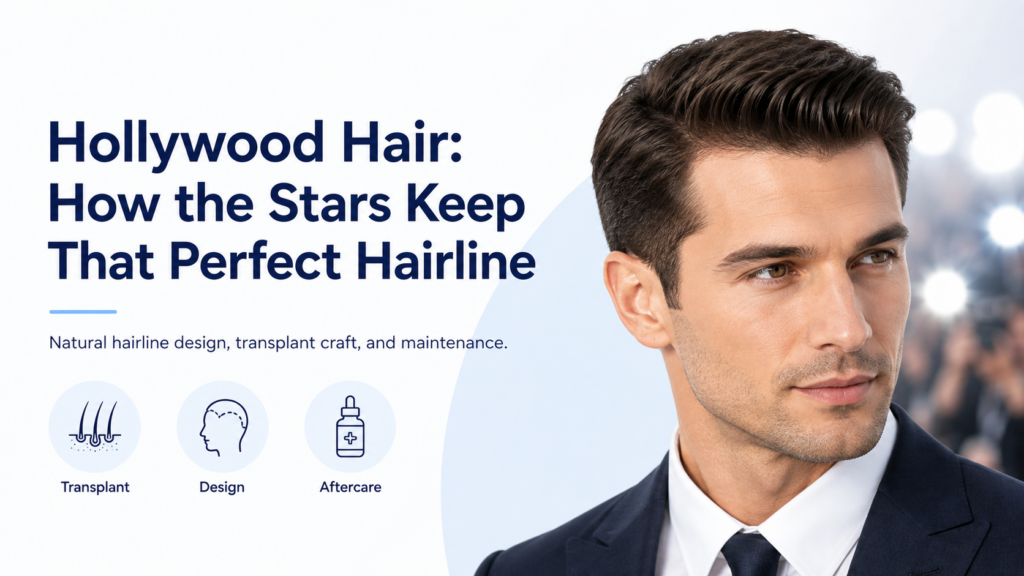
Watch enough red carpets and you notice something odd. Actors who were visibly thinning in one film turn up three years later with a full, sharp hairline, ageing backwards while the rest of us age forwards.
Good genes get the credit. Good surgeons deserve most of it.
Hollywood hair, that dense, precise, camera-proof hairline, is one of the industry’s quietest open secrets. A lot of it is a hair transplant, done well enough that nobody can tell. This is a look at how that look is actually made, and why the gap between a celebrity result and yours is smaller than the mystique suggests.
Why so many stars have “perfect” hair
Think about the pressure. On a leading man, the hairline is part of the job. It is lit, filmed in 4K, and frozen on a poster for a decade. Thinning is not a private worry, it is a career variable.
So the incentive to fix it early and fix it well is enormous, and the budget rarely gets in the way. That combination, catching loss early and spending on real skill, is exactly what produces the results the rest of us assume are genetic luck.
Here is the part worth holding onto: those two things, early action and skilled work, are not Hollywood magic. They are just choices, and they are available to anyone. The A-list simply makes them sooner and louder.
The techniques behind Hollywood hair
There is no secret celebrity-only procedure. The tools that build a red-carpet hairline are the same ones a good clinic uses on a bank manager from Leeds. What changes is how carefully they are used.
The building blocks:
- A hair transplant. The backbone of most transformations. DHT-resistant follicles from the back and sides are moved into the thinning zones, and because they keep growing, the result lasts.
- Medical treatment. Minoxidil and finasteride hold the native hair in place, which is why a star’s result does not unravel a few years later. Our hair loss treatments page runs through these.
- Meticulous hairline design. This is where the money quietly goes. The difference between “obvious plugs” and “always had it” is angle, density and a slightly irregular, natural front edge.
Notice that the transplant itself is only one third of it. The design and the upkeep are what turn a procedure into a look.
There is also the boring advantage nobody photographs: time and access. A star can take the months a transplant needs to grow through without a camera catching the awkward middle stage, and can afford to catch loss at a Norwood 2 rather than a Norwood 5. Early, unhurried, well-maintained. That is most of the “secret”, and none of it is a secret at all.
What actually makes a result look undetectable
Everyone can spot a bad hair transplant. Nobody can spot a good one, and that is the whole point. A few things separate the two:
- An irregular hairline, not a ruler-straight one. Real hairlines are soft and slightly uneven at the front. The natural look is engineered, not accidental.
- Correct angle and direction. Hair leaves the scalp at specific angles. Get that wrong and it reads as fake instantly, even at full density.
- Single-hair grafts at the very front. The leading edge is built from the finest grafts, thickening behind it, mimicking how hair naturally grades.
- A design that suits the face and the age. A 45-year-old with a 20-year-old’s hairline looks stranger than one who simply thinned.
None of this is exotic. It is craft, and craft is what you are really paying for at the top end, not a machine or a brand name.
It is worth saying what does not make the difference: the acronym on the brochure. The modern methods all move the same follicular units, and any of them can produce an invisible hairline in the right hands. A famous face gets a natural result because a careful surgeon designed it carefully, not because a machine with a better name was in the room. The hand beats the tool, on the red carpet as much as anywhere else.
The myth of “they just have good genes”
It is a comforting story, the idea that stars are simply born with unfair hair. Sometimes true. Often not.
Plenty of well-known faces have talked openly about hair loss and what they did about it, and plenty more have said nothing while their hairline quietly reversed. The silence is understandable, but it feeds the myth that the perfect look is genetic rather than obtained.
The healthier way to read it is this: if someone whose face is their living chose a hair transplant and good aftercare to fix their loss, that is not vanity, it is a sensible use of a proven treatment. The same treatment sits behind the same result whether the patient is famous or not.
Can you get Hollywood hair?
Bluntly, the ceiling is set less by fame than by biology. Two things decide how close you can get:
- Your donor area. The denser and healthier the hair at the back and sides, the more there is to build with. This is the real limit, and no budget rewrites it.
- The stage of your loss. Catching it earlier, and holding the rest with medical treatment, is what keeps a result looking natural over time.
A young hairline racing backwards is the one situation where patience beats surgery, at least for now, and the picture on our male pattern baldness page explains why moving too fast can backfire.
For the right candidate, though, the honest answer is yes. The result you admire on screen is not a different species of procedure. It is the same one, planned carefully and maintained properly.
The role of our doctors at Hairtec
Our team includes BIG-registered doctors, listed on the official Dutch medical register, working alongside experienced hair specialists.
The undetectable results people associate with Hollywood hair come from assessment and planning, not from a celebrity price tag. Before anyone talks grafts, the doctors handle the consultation and the medical assessment, weighing up:
- Whether your loss is stable enough for a transplant to hold.
- What your donor area can realistically build.
- Whether medical treatment should come first, or run alongside.
They stay involved through the aftercare, which is the unglamorous stretch that actually protects the final look. Sometimes the honest answer is to wait, and hearing that is part of getting a result you will still be happy with in ten years.
Frequently asked questions about Hollywood hair
Do celebrities get hair transplants?
Many do, though few discuss it. The dense, natural hairlines associated with Hollywood are frequently the result of a well-planned hair transplant combined with medical treatment and careful aftercare, rather than genetics alone.
How do stars get such natural-looking hairlines?
Through meticulous hairline design more than any secret technique: an irregular front edge, correct hair angle, and fine single-hair grafts at the leading edge. That craft is what makes a good result impossible to spot.
Can I get a Hollywood-style result?
For a suitable candidate with a healthy donor area and realistic expectations, a very natural result is achievable using the same techniques. The main limits are your donor supply and the stage of your loss, not fame or budget.
Is Hollywood hair just good genes?
Sometimes, but often not. A lot of flawless celebrity hair is the product of an early hair transplant and ongoing treatment. The perfect look is more often obtained than inherited.
What keeps a celebrity hair transplant looking good over time?
Ongoing medical treatment to protect the native hair around the grafts, plus good aftercare. A transplant relocates resistant hair but does not stop the original loss, so maintenance is what keeps the result intact for years.
How we reviewed this article:
Hairtec.co.uk has strict sourcing guidelines and relies on peer-reviewed studies, academic research institutions, and medical journals and associations. We only use quality, credible sources to ensure content accuracy and integrity. You can learn more about how we ensure our content is accurate and current by reading our editorial policy.
- Shapiro R (2004). Principles and techniques used to create a natural hairline in surgical hair restoration. Facial Plastic Surgery Clinics of North America https://doi.org/10.1016/j.fsc.2003.12.004
- Garg AK, Garg S (2017). Decoding Facial Esthetics to Recreate an Esthetic Hairline: A Method Which Includes Forehead Curvature. Journal of Cutaneous and Aesthetic Surgery https://pmc.ncbi.nlm.nih.gov/articles/PMC5820836/
Our experts continually monitor the health and wellness space, and we update our articles when new information becomes available


