
Recovery from a hair transplant surprises people, mostly because it does not go in a straight line. You look worse before you look better. The new hair falls out before it grows in. There is a stretch in the middle where you quietly wonder whether it worked at all.
None of that is a problem. It is just the process, and it follows a fairly predictable rhythm once you know the shape of it.
This is the honest week-by-week: what the scalp does, when the shedding happens, how long the awkward phase lasts, and when the result you actually paid for finally shows up.
The short answer on hair transplant recovery timelines
Two timelines run at once, and mixing them up is what causes most of the worry.
The first is healing. The scalp itself recovers quickly, within about two weeks, and after that you are physically fine even though the hair is nowhere near done.
The second is growth. The visible result takes far longer, roughly a year, because it moves at the pace of the hair cycle rather than the pace of wound healing. So you can be fully healed at two weeks and still eight or nine months from the final look. Both facts are true at the same time.
Week by week, what actually happens
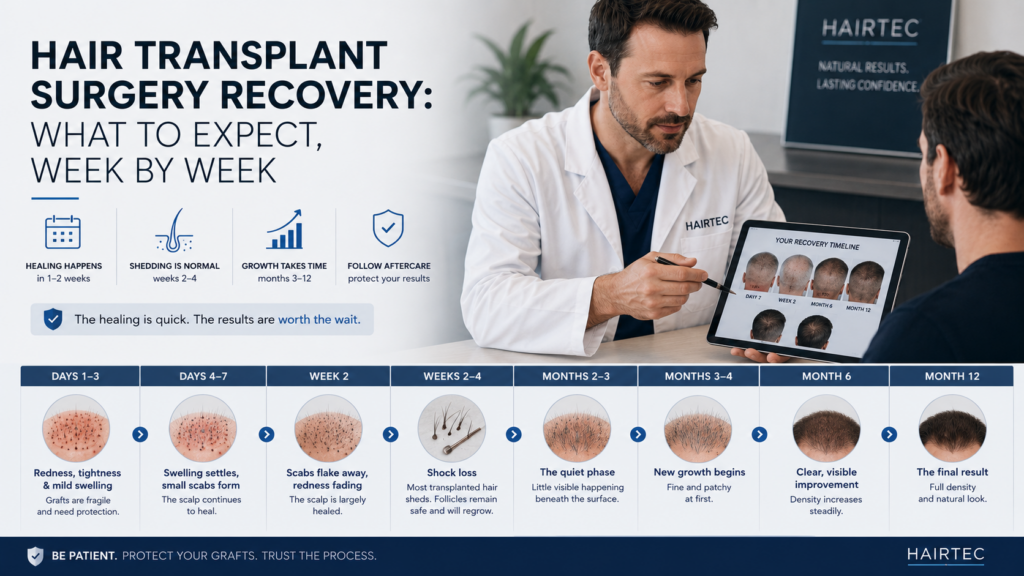
Here is the shape of a typical recovery. Individual timing varies, but the pattern is consistent.
| Stage | What you can expect |
| Days 1 to 3 | Redness, tightness and mild swelling; the grafts are fragile and need protecting |
| Days 4 to 7 | Swelling settles, small scabs form around each graft |
| Week 2 | Scabs flake away, redness fading; the scalp is largely healed |
| Weeks 2 to 4 | Shock loss: most transplanted hairs shed. Alarming, but normal |
| Months 2 to 3 | The quiet phase, little visible happening beneath the surface |
| Months 3 to 4 | New growth begins, often fine and patchy at first |
| Month 6 | Clear, visible improvement |
| Month 12 | The final result, full density settled in |
Each early phase has its own detail, and our day-by-day pages cover them closely, starting with the first few days on our 3 days after hair transplant page.
The first two weeks: healing
This is the only genuinely delicate stretch, and it is short.
In the first few days the scalp is red and tight, sometimes with mild swelling that can drift down to the forehead before it settles. The grafts are at their most vulnerable now, sitting in place but not yet anchored, so this is when careful aftercare matters most.
By the end of week one, small scabs have formed around each graft. Through week two they loosen and flake away on their own, and the redness fades. By around the fourteen-day mark most people look close to normal to a casual glance. For a closer view of that stage, our 2 weeks after hair transplant page walks through it.
The shedding phase: do not panic
This is the part nobody is quite ready for, so brace for it in advance.
Somewhere between week two and week four, most of the transplanted hairs fall out. It looks exactly like the thing you were trying to fix, and it feels like a disaster. It is not. This is shock loss, and it is a normal, expected part of recovery.
The crucial point: the follicle stays put. Only the visible hair sheds. The follicle rests briefly beneath the skin, then starts a fresh growth cycle. Losing that first crop of hair is not losing the grafts, it is the grafts resetting to grow properly.
Worth flagging, since it worries people: sometimes a little of the native hair around the grafts sheds too, a temporary shock reaction to the procedure. That also grows back. By the one-month mark most of this settling has happened, and our 1 month after hair transplant page shows what that stage tends to look like.
The growing phase: patience
From here recovery is less about healing and more about waiting, which is harder than it sounds.
New growth usually starts pushing through at three to four months, and it is often fine, thin and a little uneven at first. Do not judge the result here; early growth always looks sparser than the finished article. By six months there is clear, visible improvement, and by around twelve months the hair has thickened and settled into its final look. The crown can take a little longer than the front.
The whole arc, from surgery to final result, is close to a year. Slow, but with a dependable ending.
What helps hair transplant recovery go smoothly
You influence the outcome more in these weeks than at any point except choosing the clinic. The basics:
- Protect the grafts early. No picking at scabs, and follow the sleeping and washing instructions to the letter.
- Ease off physical strain. Skip heavy exercise, saunas and swimming for the first couple of weeks.
- Keep it out of the sun. The healing scalp is sensitive, so cover up outdoors early on.
- Be patient through the shed. Doing nothing is the correct response to shock loss.
For the full set of instructions rather than the highlights, our hair transplant aftercare page lays them out in detail.
The role of our doctors at Hairtec
Our team includes BIG-registered doctors, listed on the official Dutch medical register, working alongside experienced hair specialists.
Recovery is not the stretch to be left alone with a leaflet, because the first weeks affect how many grafts survive and how good the result looks. The doctors and specialists stay involved through the aftercare, guiding you through the healing, the shedding phase and the long growth period.
That continuity is part of the point. Knowing that the alarming shed is normal, or that early patchy growth is on schedule, is far easier when someone who assessed you is there to confirm it rather than leaving you to search anxiously online.
Frequently asked questions about hair transplant recovery
How long is full recovery from a hair transplant?
The scalp heals within about two weeks, but the full result takes around twelve months because the hair grows at the pace of its natural cycle. So you are physically recovered quickly, while the final look develops slowly over the following year.
How long does the donor area take to heal?
The donor area at the back and sides usually heals over a similar one to two week window as the recipient area, feeling tight and mildly sore in the first several days. Your clinic will give specific instructions for caring for it.
Can I touch the donor area after a hair transplant?
You should avoid touching or rubbing both the donor and recipient areas in the early days while everything is healing, to protect the grafts and the skin. Follow your clinic’s guidance on when normal washing and handling can resume.
When do transplanted hairs start growing?
New growth typically begins at three to four months, often fine and uneven at first. Visible improvement usually appears by six months, with the final density settling at around twelve months.
Is it normal for transplanted hair to fall out?
Yes. Most transplanted hairs shed between weeks two and four, a stage called shock loss. The follicles remain in place and regrow, so this shedding is a normal and expected part of recovery rather than a failure.
How we reviewed this article:
Hairtec.co.uk has strict sourcing guidelines and relies on peer-reviewed studies, academic research institutions, and medical journals and associations. We only use quality, credible sources to ensure content accuracy and integrity. You can learn more about how we ensure our content is accurate and current by reading our editorial policy.
- Bernstein RM, Rassman WR (2006). Graft anchoring in hair transplantation. Dermatologic Surgery https://doi.org/10.1111/j.1524-4725.2006.32033.x
- Vañó-Galván S, Bisanga CN, Bouhanna P et al. (2023). An international expert consensus statement focusing on pre and post hair transplantation care. Journal of Dermatological Treatment https://doi.org/10.1080/09546634.2023.2232065
- Okochi H, Onda M, Momosawa A, Okochi M (2024). An Analysis of Risk Factors of Recipient Site Temporary Effluvium After Follicular Unit Excision. Aesthetic Plastic Surgery https://pubmed.ncbi.nlm.nih.gov/37816944/
Our experts continually monitor the health and wellness space, and we update our articles when new information becomes available


