
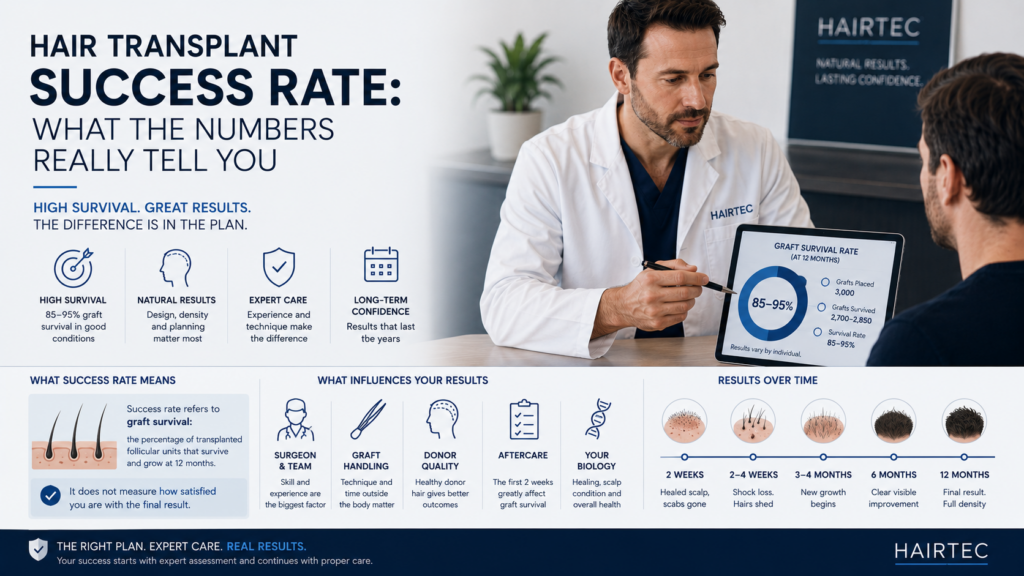
Search the phrase and you get a number fast. Eighty-five to ninety-five percent. It sounds reassuring, and mostly it is, but that figure answers a narrower question than most people think they are asking.
Here is the catch. “Success rate” in a hair transplant usually means graft survival, the share of moved follicles that take and grow. It does not mean the share of patients who walk away happy. Those are two different things, and confusing them is how someone ends up with a technically successful transplant they dislike.
So this is the honest breakdown: what the success rate actually measures, what moves it up or down, and why a good number on paper is only half of a good result.
What the hair transplant success rate actually measures
The headline figure has a specific, narrow meaning worth pinning down.
When a clinic or a study quotes a success rate of 85 to 95 percent, it is talking about graft survival: out of every hundred follicular units transplanted, how many settle in and grow hair in their new location. In good conditions, the large majority do. That is a genuinely strong figure for a surgical procedure.
But notice what it does not measure. It says nothing about whether the hairline was well designed, whether the density suits your face, or whether you are pleased with how it looks. A transplant can hit a 95 percent survival rate and still disappoint, if the plan behind it was wrong. Survival is necessary for a good result. It is not the same as one.
It is also worth knowing the figure is harder to pin down than it looks. Survival is usually judged around the twelve-month mark, once the transplanted hair has fully grown through, by comparing what grew against what was placed. Different clinics measure it differently, and few publish independently verified numbers, so treat any headline percentage as an industry norm rather than a personal guarantee. A clinic quoting a suspiciously exact figure is often quoting marketing, not data.
What decides where you land in that range
The gap between 85 and 95 percent is not luck. A handful of things push you toward one end or the other.
- The surgeon and team. Skill and experience are the single biggest factor in how many grafts survive the move and grow.
- How grafts are handled. Follicles are delicate. Time out of the body, handling and technique all affect survival.
- Your donor area. Healthy, robust donor hair simply travels better than fragile hair.
- Your aftercare. The first two weeks genuinely change the outcome, and this part is partly in your hands.
- Your own biology. Healing, scalp condition and general health play a quiet role too.
Only some of that is inside the operating room. Which is why the choice of clinic and how closely you follow aftercare matter as much as the procedure itself.
Why “success” and “a good result” are not the same
This is the distinction the marketing quietly blurs, so it is worth being blunt about.
Imagine two men, both with 95 percent graft survival. One has a natural, age-appropriate hairline that suits his face. The other has a straight, too-low hairline packed at the wrong angle, technically full of surviving grafts and obviously fake. Same success rate. Very different results.
The number tells you the follicles lived. It cannot tell you whether the design was right, whether the density was planned sensibly, or whether the donor area was spent wisely. Those judgements come from the plan, not the survival rate, which is why the assessment beforehand carries so much weight. Our free consultation page covers what that planning stage involves.
What happens years down the line
A fair question people ask is whether that success holds up over time, or fades.
The transplanted follicles come from the DHT-resistant donor area, so they tend to keep growing for life. In that sense the result is durable; the grafts that took at year one are usually still there at year ten.
The complication is the hair you did not transplant. Your original loss carries on, and native hair around the grafts can keep thinning, which over a decade can change how the overall result looks even though the transplanted hair itself is fine. This is exactly why surgery is so often paired with medical treatment, and why the condition on our male pattern baldness page matters to the long-term picture.
How to give your hair transplant the best odds
You cannot control every variable, but you influence more than you might think. The levers that are actually in your hands:
- Choose the team carefully. This affects survival more than any other single decision.
- Follow the aftercare properly. The unglamorous fortnight after surgery genuinely protects your grafts.
- Have realistic expectations. A plan built on what your donor area can deliver ages far better than one built on what you wish it could.
- Get assessed while loss is stable. Operating at the right time protects the result from being undone by ongoing loss.
None of these is dramatic. Together they are most of the difference between a number on a page and a result you are glad you chose.
One reassurance worth adding, since it comes up a lot alongside success worries: the procedure is not the ordeal people brace for. It is done under local anaesthetic, so once the scalp is numb it is largely painless, and the donor area at the back tends to feel tight and mildly sore for the first several days rather than genuinely painful. Following the aftercare through that early stretch is, conveniently, the same thing that protects your graft survival, so comfort and success pull in the same direction.
For the practical detail of how to look after the grafts in those decisive first weeks, our hair transplant aftercare page sets it out step by step.
The role of our doctors at Hairtec
Our team includes BIG-registered doctors, listed on the official Dutch medical register, working alongside experienced hair specialists.
A high success rate starts long before the procedure, in the assessment. Before grafts or dates are discussed, the doctors lead the consultation and the medical assessment, weighing up whether your loss is stable enough for a result to hold, what your donor area can realistically supply, and whether medical treatment should come first or run alongside.
They stay involved through the aftercare, the stretch that most affects graft survival. And when the honest answer is that the timing or the expectations need adjusting, that is what you will hear, because a genuinely good outcome depends on it.
Frequently asked questions about hair transplant success rates
What is the success rate of a hair transplant?
Graft survival is commonly reported at around 85 to 95 percent when the procedure is done well and aftercare is followed. This measures how many transplanted follicles take and grow, rather than how satisfied the patient is with the overall look.
Does a high success rate mean a good result?
Not necessarily. A high survival rate means the follicles grew, but the final look also depends on hairline design, density and planning. A technically successful transplant can still disappoint if the plan behind it was wrong.
What happens 10 years after a hair transplant?
The transplanted follicles usually keep growing, since they come from the DHT-resistant donor area. Your original hair loss can continue, though, so the overall look may change over a decade unless the native hair is protected, often with medical treatment.
Is a hair transplant 100% successful?
No procedure is guaranteed. Most grafts survive and grow in good conditions, but the exact figure depends on the surgeon, your donor area, your aftercare and your biology, so a strong success rate is earned rather than promised.
How can I improve my hair transplant success rate?
Choose an experienced team, follow the aftercare instructions closely, keep expectations realistic, and be assessed while your loss is stable. These are the factors most within your influence and they make a real difference.
How we reviewed this article:
Hairtec.co.uk has strict sourcing guidelines and relies on peer-reviewed studies, academic research institutions, and medical journals and associations. We only use quality, credible sources to ensure content accuracy and integrity. You can learn more about how we ensure our content is accurate and current by reading our editorial policy.
Our experts continually monitor the health and wellness space, and we update our articles when new information becomes available


