
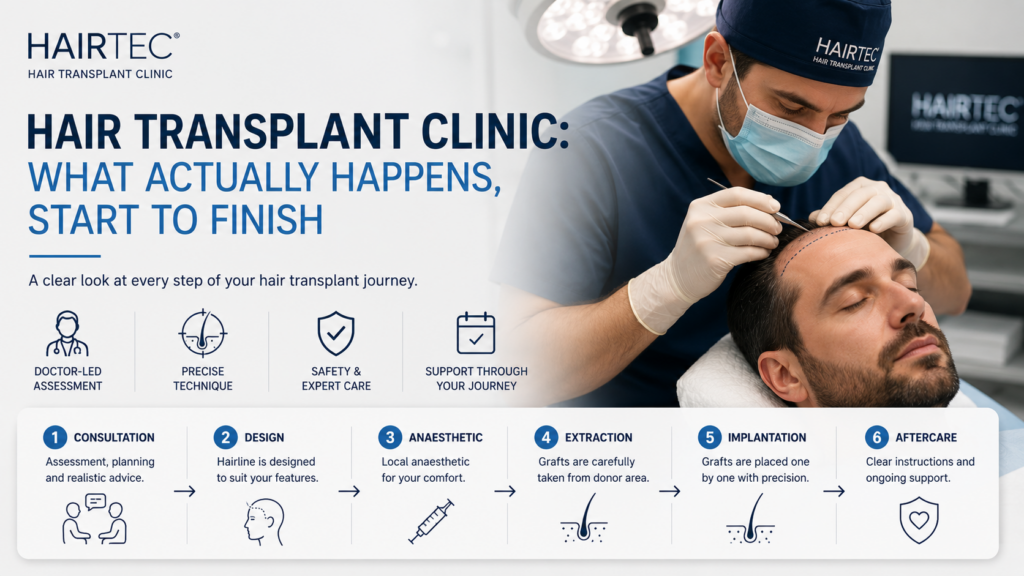
Most people book a hair transplant clinic with almost no idea what the day will be like. They have seen the before-and-after photos. They have seen the price. The bit in between, the actual experience, stays a blank.
That blank is worth filling, and not just for nerves. What a clinic does before, during and after the procedure is the truest measure of whether it is any good. The photos are marketing. The process is the product.
So here is the honest walk-through: what a hair transplant clinic actually does at each stage, and what separates a careful one from a conveyor belt.
It starts with the consultation, not the surgery
A good clinic earns or loses your trust before a single graft is touched.
The first appointment should be an assessment, not a sales meeting. A proper consultation looks at your pattern of loss, your donor area, your medical history and your goals, and ends with an honest view of what is realistic. Sometimes that view is “yes, and here is the plan”. Sometimes it is “wait” or “treat this medically first”.
That second kind of answer is a good sign, not a disappointing one. A clinic willing to turn work away when it is not right is a clinic assessing you rather than selling to you. If you want to see how that first step works in practice, our free consultation page explains what the assessment involves.
Who is actually in the room at a hair transplant clinic
This is the question most people never think to ask, and it matters more than the technique name on the wall.
A hair transplant is a team procedure. Depending on the clinic, different people handle different stages, from the doctors leading the medical assessment to the specialists carrying out the meticulous placement work. What you want to know is simple:
- Who leads the medical assessment, and what are their credentials?
- Who carries out each part of the procedure itself?
- How experienced is the team with cases like yours?
- Will you meet them before the day, or only on it?
A clinic that answers these clearly is being transparent about the thing that most affects your result. One that gets vague is telling you something too. You can see who would actually be involved on our team page.
What the treatment day at a hair transplant clinic is like
The day itself is long and, honestly, a little dull, which is exactly how you want surgery to be.
Here is the shape of it:
- Arrival and planning. The hairline is designed and agreed with you before anything begins. This stage decides how natural the result looks, so it is not rushed.
- Local anaesthetic. The scalp is numbed. There is a sting as it goes in, and after that most of the day is comfortable.
- The procedure. Grafts are taken from the donor area and placed, one by one, over several hours. You are awake, and most people read, watch something, or doze.
- Home the same day. No overnight stay in most cases. You leave with clear aftercare instructions and a scalp that will look worse before it looks better.
A session commonly runs four to eight hours depending on the number of grafts. The unglamorous length is a good sign; careful placement cannot be rushed. Our treatment day page walks through the whole thing hour by hour.
One thing worth knowing before you go: the result is not what you see in the mirror that evening, or even that month. Around week two to four most of the transplanted hairs shed, which alarms people who were not warned. The follicles stay put and regrow, with new growth from about three to four months and the final look settling near the twelve-month mark. A clinic that explains this upfront is doing you a favour a glossier one might skip.
The part hair transplant clinics differ on most: aftercare
Anyone can perform a procedure. What separates clinics is what happens once you have paid and gone home.
The first two weeks genuinely affect how many grafts survive, and the months after that shape the final look. A clinic that hands you a leaflet and disappears is a very different proposition from one that stays reachable. Worth checking before you book:
- What aftercare instructions and support you get, and for how long.
- Whether you can contact the clinic with questions during recovery.
- What follow-up looks like over the year it takes to see the final result.
- Whether medical treatment is offered alongside to protect your other hair.
That last point matters more than it sounds, because a transplant does not stop your original loss. Our hair transplant aftercare page sets out what those first weeks and months should involve.
What a good hair transplant clinic will not do
Just as useful as knowing the green flags. A clinic worth trusting will not:
- Promise a specific, dramatic result, because biology does not allow guarantees.
- Pressure you to decide on the day, or dangle a discount that expires if you leave.
- Skip the medical assessment and jump straight to a quote and a date.
- Sell one package to everyone regardless of donor area or stage of loss.
Any of these should slow you down. Several together should stop you.
There is a quieter warning sign too, easy to miss. If the clinic never mentions your donor area as a limit, be wary. The hair at the back and sides is finite, and an honest clinic plans around that ceiling rather than pretending it does not exist. A place that promises unlimited density from a modest donor supply is either misunderstanding the biology or hoping you do.
The role of our doctors at Hairtec
Our team includes BIG-registered doctors, listed on the official Dutch medical register, working alongside experienced hair specialists.
The whole point of a clinic being run this way is that a transplant is a medical decision first and a cosmetic one second. Before anyone talks grafts or dates, the doctors lead the consultation and the medical assessment, weighing up:
- Whether your loss is stable enough for a transplant to hold.
- What your donor area can realistically supply.
- Whether medical treatment should come first, or run alongside.
They stay involved through the aftercare, which is the stretch that quietly protects your result. And when the honest answer is that now is not the time, that is what you will hear, because that is what an assessment is for.
Frequently asked questions about hair transplant clinics
What should I look for in a hair transplant clinic?
A thorough consultation that assesses you rather than sells to you, a transparent and experienced team, realistic planning, and genuine aftercare. Treat guarantees, pressure and one-size packages as warning signs.
What happens at a hair transplant clinic consultation?
A good consultation reviews your pattern of loss, donor area, medical history and goals, then gives an honest view of what is realistic, including whether to wait or treat the loss medically first. It should feel like an assessment, not a sales pitch.
Is recovery from a hair transplant painful?
Most people find it uncomfortable rather than painful. The anaesthetic stings going in, but the procedure itself is largely painless once numb, and the days afterwards bring mild soreness and tightness that is manageable.
Can I sleep on the donor area after a hair transplant?
Clinics usually advise sleeping propped up and avoiding pressure on the treated areas for the first nights, to reduce swelling and protect the grafts. Your clinic should give you specific aftercare instructions to follow.
How long does a hair transplant at a clinic take?
A single session commonly runs four to eight hours depending on the number of grafts. You are awake under local anaesthetic and usually go home the same day.
How we reviewed this article:
Hairtec.co.uk has strict sourcing guidelines and relies on peer-reviewed studies, academic research institutions, and medical journals and associations. We only use quality, credible sources to ensure content accuracy and integrity. You can learn more about how we ensure our content is accurate and current by reading our editorial policy.
- Patwardhan N, Mysore V (2008). Hair transplantation: standard guidelines of care. Indian Journal of Dermatology, Venereology and Leprology https://ijdvl.com/hair-transplantation-standard-guidelines-of-care/
- Mysore V, Kumaresan M, Garg A et al. (2021). Hair Transplant Practice Guidelines. Journal of Cutaneous and Aesthetic Surgery https://jcasonline.com/hair-transplant-practice-guidelines/
Our experts continually monitor the health and wellness space, and we update our articles when new information becomes available


