
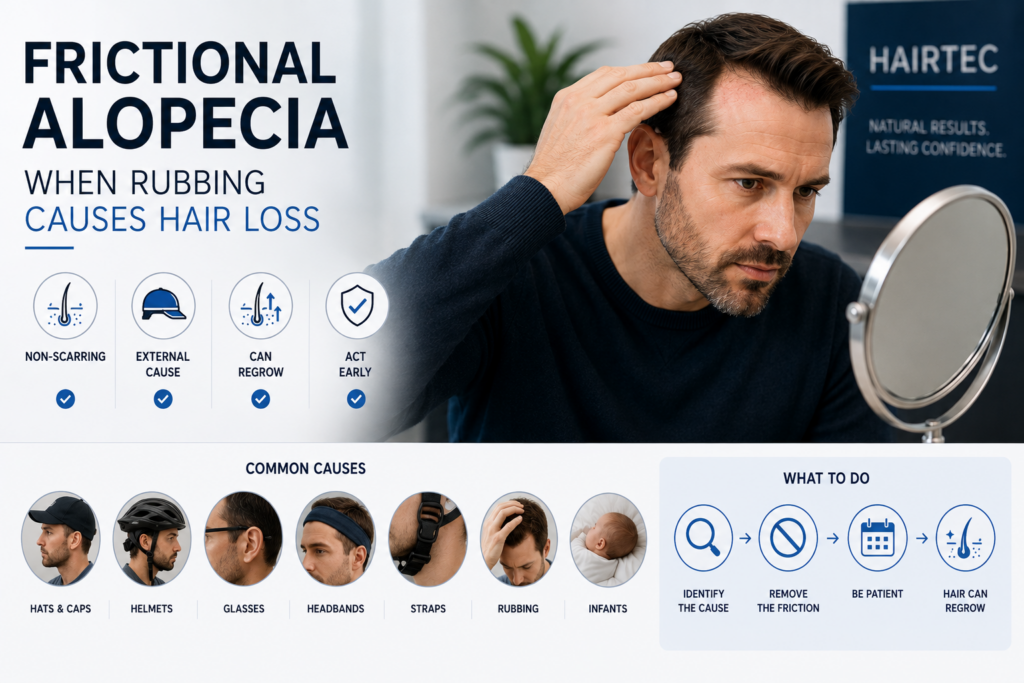
Hormones and genetics get all the blame for hair loss. Sometimes the culprit is far more mundane, and it is sitting on your head right now. Friction.
Frictional alopecia is what the name promises, hair lost to steady rubbing against the scalp. Hardly anyone has heard of it next to pattern baldness, yet it deserves attention for one cheerful reason. It is among the very few kinds of hair loss you can often halt, and reverse, by changing a habit rather than taking a drug. No hormone is behind it. No gene has sealed your fate. Something keeps rubbing the same spot, and eventually the hair there throws in the towel.
Below is what triggers it, how to spot it against the more familiar culprits, and the genuinely good news on regrowth.
What frictional alopecia actually is
The word that matters here is non-scarring, and it is the reason this condition is more nuisance than tragedy.
Non-scarring means the follicle is being harassed, not killed. Under all that repeated pressure the hair thins out or vanishes, but the follicle beneath tends to hang on. Compare that with the scarring types of hair loss, where the follicle is destroyed and gone for good, and you can see why the outlook here is so much brighter. Take away the cause soon enough and the follicle usually has everything it needs to grow again. One more tell worth noting, it shows up as a distinct patch in one place, not the spread-out or patterned thinning you get elsewhere.
What causes frictional alopecia
Look for the pattern and it jumps out. The same patch of scalp, rubbed again and again, over months or years.
Headwear leads the list by a distance. A hat worn every day, a cycling or motorcycle helmet, a headband, a religious head covering, all of them park in roughly the same place and slowly grind at the hair beneath. Glasses are a sneakier version of the same thing, the arm of the frame leaning on one point above the ear year after year. Sports and safety gear pile on too, chin straps, tight goggles, anything that rubs through repeated use. Some people wear a patch away simply by rubbing or scratching it out of habit, often without clocking that they do it at all. And babies frequently develop a bald patch on the back of the head from turning against the bedding, which sorts itself out once they start moving around more.
Strip away the specifics and one thing stays constant. Prolonged pressure on a single spot, driven by something outside the body rather than anything within it.
How to tell it apart from other hair loss
Here is where knowing about it pays off, because it does not look like the usual suspects.
The giveaway is location. Frictional loss turns up exactly where something presses, above the ears, along the hairline under a hat brim, at the back of the head. Pattern baldness ignores all of that and marches back from the temples and crown in its own predictable shape, described on our male pattern baldness page, with no interest whatsoever in where your glasses sit.
So run the simple test. Does the thinning line up with a point of contact, and does it settle once that contact goes? If yes, friction is your answer. If not, look elsewhere, and our hair loss overview walks through the other possibilities.
Does frictional alopecia grow back?
Usually. That is the sentence most people came here to read, so it goes near the front.
Since the follicles are irritated rather than wiped out, hair tends to return once the rubbing stops, as long as you get to it before lasting damage sets in. Early is everything. A patch spotted while the follicles are still healthy, then given a break from the pressure, has an excellent shot at recovering with no treatment at all.
The catch is the clock. Friction that grinds on for years can eventually do more permanent harm, and past that point regrowth turns stubborn. Which is why the smart move is not endless wait-and-see, but pulling the cause promptly and giving the scalp a fair run at recovery.
What to do about it
The fix is refreshingly unglamorous, because it is the cause itself.
First and almost always last, find whatever is rubbing and stop it. Loosen the hat or bin it, adjust the glasses, change the strap. In most cases that single change is the entire treatment. Then let the area rest, free of the pressure that started this, and settle in for a wait, because regrowth runs on the hair cycle and shows up over months rather than weeks. If nothing improves once the friction is gone, or you were never sure it was friction to begin with, get it looked at.
Most people go no further than step one. Frictional alopecia is one of the genuinely reassuring diagnoses in a field that is short on them, and it is worth resisting the pull toward treatments built for other conditions, since those achieve nothing against a problem whose root cause is external. Our hair loss treatments page lays out which options actually suit which type of loss.
When to see someone
Occasionally it earns a professional glance, mostly to be certain of what you are up against.
Book an assessment if there is no obvious source of friction to blame, if the patch stubbornly refuses to recover after you have removed the likely cause, or if you simply cannot tell whether it is friction or something else entirely. The whole value lies in the diagnosis, because treating the wrong thing burns time the follicles may not be able to spare. Our free consultation page sets out what an assessment involves.
The role of our doctors at Hairtec
Our team includes BIG-registered doctors, listed on the official Dutch medical register, working alongside experienced hair specialists.
This condition is a neat illustration of why diagnosis outranks treatment. So much of getting hair loss right is naming the type correctly, and for frictional alopecia the honest verdict is frequently that nothing needs doing at all beyond removing the cause and waiting.
The doctors lead the consultation and the assessment, confirming whether the loss really is frictional, ruling out the conditions that can imitate it, and saying so plainly when the right course is simply patience. When a transplant is not the answer, you will hear exactly that.
Frequently asked questions about frictional alopecia
What causes frictional alopecia?
It is caused by repeated rubbing or pressure on the same area of scalp, commonly from tight headwear, helmets, glasses arms, straps or persistent scratching. Unlike pattern baldness, it comes from external friction rather than hormones or genetics.
Is frictional alopecia permanent?
Usually not. It is a non-scarring type of hair loss, so the follicles are irritated rather than destroyed, and hair generally regrows once the friction is removed. Only friction sustained over many years risks more permanent damage.
Can frictional alopecia be reversed?
Often, yes, especially when caught early. Removing the source of friction and giving the follicles time to recover is usually enough for hair to grow back, since the follicles themselves typically remain intact.
How do I treat frictional alopecia?
The main treatment is removing the cause, loosening or changing whatever rubs the scalp, then allowing time for regrowth. If hair does not return after the friction is gone, an assessment is worth arranging to rule out other conditions.
How is frictional alopecia different from pattern baldness?
Frictional alopecia appears as a defined patch that matches a point of contact and often recovers when the friction stops. Pattern baldness follows the hairline and crown in a predictable shape, is driven by hormones and genetics, and does not resolve on its own.
How we reviewed this article:
Hairtec.co.uk has strict sourcing guidelines and relies on peer-reviewed studies, academic research institutions, and medical journals and associations. We only use quality, credible sources to ensure content accuracy and integrity. You can learn more about how we ensure our content is accurate and current by reading our editorial policy.
Our experts continually monitor the health and wellness space, and we update our articles when new information becomes available


