
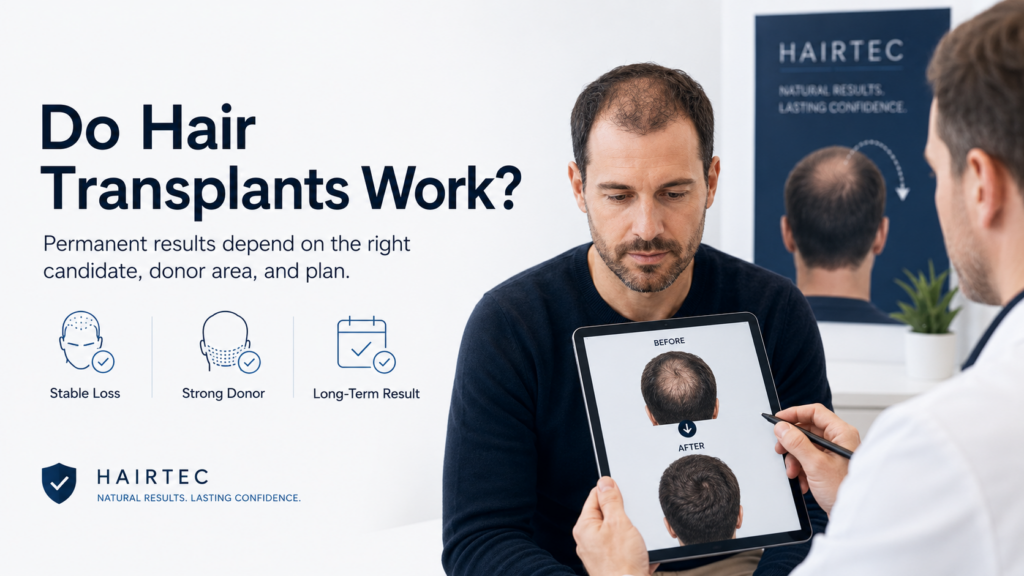
Yes. For the right person, done properly, a hair transplant works, and unlike almost everything else on the hair loss shelf, the result is permanent.
That is the part worth sitting with. A tube of minoxidil buys you hair for exactly as long as you keep buying it. A transplant, once it has grown in, is simply yours. The follicles that get moved are built to last, and the biology behind that is settled rather than hopeful.
But “do hair transplants work” is not really a yes-or-no question, whatever the adverts imply. It is a question with conditions bolted to it, and the conditions are where the honest answer lives. So here is the honest answer: why transplants work at all, how often they succeed, who they suit, and the cases where they quietly fail.
Why hair transplants work in the first place
The whole thing rests on one quirk of biology. Get that, and the rest of the article makes sense.
The hair around the back and sides of your head is genetically resistant to DHT, the hormone that drives male pattern loss. That resistance is why that band survives while the crown and hairline thin. Move one of those stubborn follicles into a balding patch and it does not suddenly change its nature. It keeps its resistance. It carries on growing in its new home, largely deaf to the process that emptied the ground around it.
That is the engine of the whole procedure. It is also why a good transplant lasts for decades rather than fading after a year, because you have planted hair that was never going to fall out in the first place.
One thing this biology does not do, though, is create new hair. A transplant only ever redistributes what you already have. Nobody grows extra follicles. They are moved from a place with plenty to a place with none, and that single fact shapes every limit further down this page.
So how often do hair transplants actually succeed?
Honest numbers beat glossy before-and-afters here, so let us talk survival rates.
When the work is done by skilled hands and the aftercare is followed, the large majority of transplanted grafts take and grow. Reputable clinics and studies tend to report graft survival high up the scale, commonly cited in the region of 90 to 95 percent in good conditions. For a surgical procedure, that is a strong, dependable success rate.
The word “conditions” is carrying weight in that sentence. Where you land inside that range is decided by several things, and most of them are not the operation itself:
- The surgeon and team. Skill and experience shift the outcome more than any branded technique ever will.
- Your donor area. Dense, healthy donor hair gives more to work with, and a better final look.
- Aftercare. Those first two weeks genuinely change how many grafts survive.
- Realistic planning. A result promised beyond what your donor area can supply will let you down, no matter how neat the surgery.
Read that list again and the pattern jumps out. Only one item happens on the day of the operation. The other three are about who you chose, what you started with, and what you were promised before you ever sat in the chair.
Who hair transplants work best for
They are not for everyone, and a clinic worth trusting will tell you so to your face. A transplant tends to work best when a few things line up:
- Your loss has stabilised, or is being held steady with medical treatment, rather than racing ahead.
- You have a solid donor area at the back and sides to draw from.
- Your expectations match what that donor supply can realistically cover.
- Your loss follows the usual pattern rather than a diffuse thinning or patchy shedding.
Age plays into this more than people expect. A man of twenty-five losing hair fast is a riskier candidate than a man of forty-five whose pattern has settled, even if they look similar in the mirror today. The younger man’s loss has further to travel, and a hairline built now can end up stranded later.
If your thinning is early and moving quickly, the picture on our male pattern baldness page is the one that matters, because operating too soon is one of the surest ways to end up disappointed.
When hair transplants do not work
This half gets skipped in most clinic brochures, which is exactly why it belongs here. The failures are usually predictable, and almost none of them are the concept letting you down.
A transplant underdelivers when the plan was wrong, not when the biology was. Here is how it tends to go sideways:
- Operating too early. The native hair keeps thinning around the grafts, and three or four years on you are left with islands of transplanted hair sitting in a receding sea.
- A weak donor area. You cannot move hair you do not have. Stretch a thin donor supply across a large bald area and you get thin coverage everywhere.
- Oversized promises. A dense, low hairline designed for a twenty-year-old, planted on a head that will not support it for life, ages badly and looks worse each year.
- Poor technique or careless aftercare. Grafts that do not survive the move never grow, and no amount of patience brings them back.
Every one of those is a planning failure or a skill failure, not a flaw in the idea. That is the single strongest argument for treating the assessment beforehand as seriously as the surgery itself. The consultation is where a good outcome is really decided.
Are hair transplants worth it?
That is the question hiding under the first one, and it deserves a straight answer rather than a sales pitch.
For someone with stable loss, a decent donor area and grounded expectations, a transplant offers something very few hair treatments can: a permanent, natural-looking result you do not have to keep paying for forever. That is a genuine difference. Medical treatments hold the line only while you use them; stop, and the loss resumes. Transplanted hair, once it has grown through, just stays.
The trade-offs are real and worth naming. It is surgery, with a recovery, a real cost, and a wait of roughly a year before you see the final result. It does nothing to stop your other hair thinning, which is why it so often needs pairing with ongoing medical treatment, a point our hair loss treatments page goes into properly.
Worth it, in the end, is a personal sum. But for a well-chosen candidate with a sensible plan, the maths usually comes out in favour.
The role of our doctors at Hairtec
Our team includes BIG-registered doctors, listed on the official Dutch medical register, working alongside experienced hair specialists.
Whether a transplant will actually work for you is a medical judgement, not a sales decision, and that is precisely where the doctors earn their place. In the consultation and assessment they weigh up:
- Whether your loss is stable enough for surgery to hold its result.
- Whether your donor area can realistically supply the coverage you want.
- Whether medical treatment should come first, or run alongside a procedure.
They stay involved through the aftercare too, which is the stretch that quietly protects your graft survival. Sometimes the honest answer is that a transplant would work beautifully for you. Sometimes it is that now is not the time, or that the tablets should come first. Both answers are worth hearing before you commit to anything.
Frequently asked questions about whether hair transplants work
Do hair transplants really work?
Yes, for a suitable candidate. The relocated follicles come from the DHT-resistant donor area and keep growing in their new position, which is why the result lasts. Success still hinges on the surgeon, your donor area and a realistic plan, so it is not automatic.
How long do hair transplant results last?
The transplanted follicles tend to keep growing for life, because they hold onto their resistance to the hormone behind male pattern loss. What a transplant cannot do is stop your other, native hair from thinning, so some ongoing care around the grafts often still matters.
Are hair transplants worth it?
For someone with stable loss, a good donor area and realistic expectations, plenty of people find it well worth it, since the result is permanent and natural rather than something topped up forever. It is still surgery with a cost and a recovery, so it stays a personal call.
Can a hair transplant fail?
It can underdeliver, and usually the reason is poor planning rather than the concept: operating too early, a weak donor area, oversized promises, or careless aftercare. A careful assessment beforehand prevents most of those outcomes.
Do hair transplants look natural?
They can look genuinely natural when the hairline is well designed and the grafts are placed at the right angle and density. That planning stage matters as much as the surgery, which is why an experienced team makes such a visible difference.
What percentage of hair transplants are successful?
Graft survival is commonly reported in the region of 90 to 95 percent when the procedure is done well and aftercare is followed. The figure depends heavily on the surgeon, the donor area and the plan, so a strong success rate is earned rather than guaranteed.
How we reviewed this article:
Hairtec.co.uk has strict sourcing guidelines and relies on peer-reviewed studies, academic research institutions, and medical journals and associations. We only use quality, credible sources to ensure content accuracy and integrity. You can learn more about how we ensure our content is accurate and current by reading our editorial policy.
- Hwang S, Kim JC, Ryu HS et al. (2002). Does the recipient site influence the hair growth characteristics in hair transplantation? Dermatologic Surgery https://pubmed.ncbi.nlm.nih.gov/12269871/
- Vasudevan B, Neema S, Ghosh K et al. (2020). Hair transplantation by follicular unit extraction for male androgenetic alopecia: A retrospective observational study from two centers. Medical Journal Armed Forces India https://pmc.ncbi.nlm.nih.gov/articles/PMC7606102/
- Parsley WM, Perez-Meza D (2010). Review of factors affecting the growth and survival of follicular grafts. Journal of Cutaneous and Aesthetic Surgery https://pmc.ncbi.nlm.nih.gov/articles/PMC2956960/
Our experts continually monitor the health and wellness space, and we update our articles when new information becomes available


