
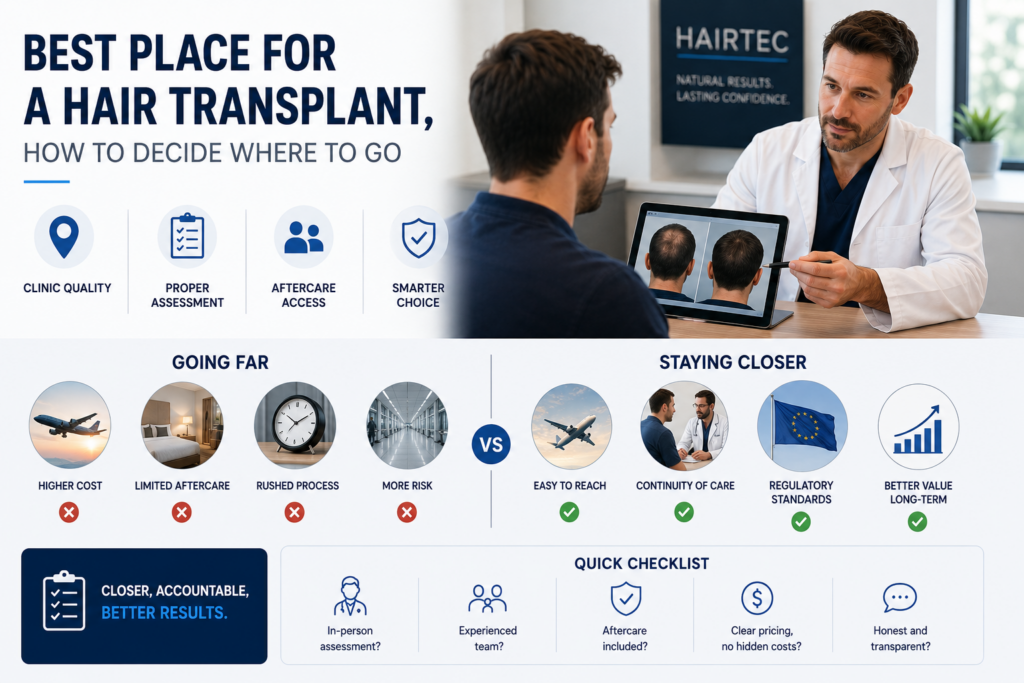
Ask where the best place for a hair transplant is and you will get a country as the answer. That is the wrong unit of measurement.
Countries do not perform transplants. Clinics do, and the quality gap between two clinics in the same city is wider than the gap between the average of one country and another. So the honest way to think about location is not “which country wins”, but “which place gives me a good result and lets me look after it afterwards”. Those two things, the result and the aftercare, are what location actually affects.
Here is how to weigh up where to go, and why the nearest good option often beats the furthest cheap one.
Why country is the wrong question
The instinct to rank countries is understandable, because the price differences between them are real and large.
But a headline price on a foreign package is not the same as value. Within every destination, popular or not, you will find excellent clinics and poor ones side by side. Picking a country and assuming the quality follows is how people end up judging a clinic by its airport rather than its work. The unit that matters is the individual clinic, its team, and its plan. What that clinic can do for you starts with a proper look at your loss, which our hair loss overview sets out.
Location still matters, but for a reason people underrate. It shapes what happens after the surgery, not just the surgery itself.
The part that gets forgotten, aftercare
A transplant is not a single day. It is a year, and most of that year happens after you have gone home.
The first two weeks affect how many grafts survive. The following twelve months are when the result actually grows in, with a shedding phase and a long wait that raise perfectly normal questions. If your clinic is a short trip away, a check-up, a worry, a quick question is easy. If it is a flight away, it is not. That distance turns a five-minute reassurance into an anxious search online, and it makes fixing anything that does need attention far harder.
So when you weigh up a place, weigh up whether you could actually get back to it. Our hair transplant surgery recovery page shows just how much of the journey sits in that after-period.
The trade-offs of travelling far
Going abroad for a lower price is a real option, and plenty of people do it. It is worth going in with the trade-offs clear rather than hidden.
A long-haul package usually buys the procedure and little of what surrounds it. The assessment can be rushed or done remotely from photos, the aftercare thins out the moment you fly home, and follow-up means either another flight or nothing. Flying immediately after surgery, with a healing scalp, is its own small risk. None of this makes travelling wrong, it just means the low number on the package is rarely the whole cost, and the missing parts are the ones that protect your result.
We cover one common version of this decision directly on our hair transplant in the Netherlands versus Turkey page.
There is also the maths people skip. Once you add the flights, the hotel nights, the time off work, and the possibility of a second trip if anything needs sorting, the gap between a far-off bargain and a nearer option narrows fast, sometimes to nothing. A saving that vanishes the moment something goes slightly wrong was never much of a saving.
The case for staying closer to home
For a lot of people in the UK and nearby, the sensible answer is a good clinic within easy reach, or a short hop into Europe rather than a long-haul trip.
Somewhere like the Netherlands sits in a useful spot for this. It is a quick, cheap flight from the UK, close enough that a follow-up is a day trip rather than an expedition, inside a European regulatory framework, and without the volume-clinic reputation that trails some cheaper destinations. You get the shorter-travel advantages without simply defaulting to the most expensive option at home. Our best hair transplant in the Netherlands page explains how that balance works in practice.
The point is not that one country is best. It is that closeness has real, practical value for a treatment whose result unfolds over a year.
A simple way to decide
Strip it back and the location question comes down to a few honest checks rather than a league table of countries.
Can you get a proper in-person assessment before committing, rather than a quote from photos? Could you realistically return for follow-up if you needed to? Does the price include the aftercare, or only the day itself? Is the clinic, wherever it sits, transparent about its team and willing to say no? Answer those, and the right place tends to reveal itself, and it is usually closer and more accountable than the cheapest flight suggests.
The role of our doctors at Hairtec
Our team includes BIG-registered doctors, listed on the official Dutch medical register, working alongside experienced hair specialists.
The reason we frame location around assessment and aftercare is that both are medical, not logistical. Before anything is booked, the doctors lead the consultation and the assessment in person, judging whether a transplant suits you, what your donor area can support, and whether to proceed at all. Then they stay involved through the aftercare, the long part that distance tends to strip away.
Being reachable through that year is not a small thing. When the shed hits at week three or growth looks patchy at month four, a team you can actually get to is worth more than a saving you spent on the flight. If you want to see where it starts, our free consultation page lays it out.
Frequently asked questions about the best place for a hair transplant
Which is the best place for a hair transplant?
There is no single best country, because quality varies enormously within each one. The best place is a specific clinic with a strong team and honest planning that you can also reach for aftercare, which often means closer to home rather than the cheapest destination abroad.
Is it better to have a hair transplant abroad or at home?
Both can work, but travelling far usually buys the procedure and little of the assessment or aftercare around it. A clinic you can return to easily protects the result over the year it takes to grow in, so proximity has real practical value.
Which country is best for hair transplants?
No country holds the title outright. Every destination contains excellent and poor clinics, so judging by country misses the point. The clinic, team and plan decide the outcome far more than the location does.
Does travelling for a hair transplant affect the result?
It can, indirectly. A rushed or remote assessment, limited aftercare, and difficulty returning for follow-up all sit alongside long-distance packages, and each can affect how well the result is planned and protected. Flying straight after surgery carries its own minor risk too.
Why choose a clinic closer to home?
A transplant plays out over about a year, most of it after the procedure. A clinic within easy reach makes the assessment, aftercare and any follow-up far simpler, which is why proximity often outweighs a lower price far away.
How we reviewed this article:
Hairtec.co.uk has strict sourcing guidelines and relies on peer-reviewed studies, academic research institutions, and medical journals and associations. We only use quality, credible sources to ensure content accuracy and integrity. You can learn more about how we ensure our content is accurate and current by reading our editorial policy.
Our experts continually monitor the health and wellness space, and we update our articles when new information becomes available


