
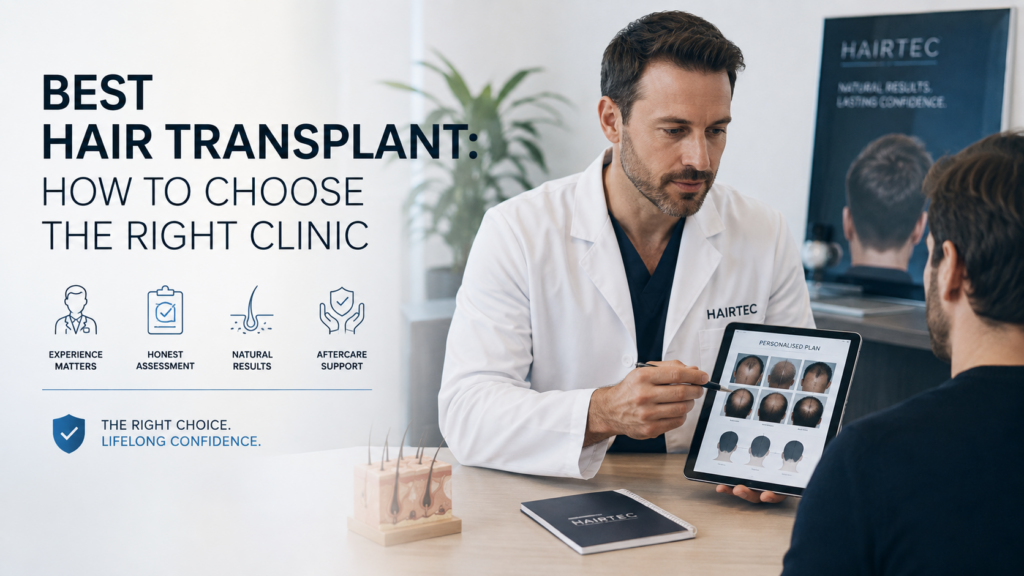
Search “best hair transplant” and every result claims the title. Naturally. No clinic advertises itself as second best.
So the word “best” is close to useless as a filter, and chasing it leads people straight into the cheapest flight to the busiest clinic. A better question is quieter and far more useful: what actually makes a hair transplant good, and how do you spot it before you book rather than after?
This is a guide to exactly that. Not a ranking, because an honest ranking of “best” does not exist. A checklist of what separates a result you are glad you paid for from one you spend years regretting.
Why “best” is the wrong word for a hair transplant
Here is the uncomfortable truth the marketing skips. There is no single best hair transplant, because the best transplant for a 30-year-old with early recession and dense donor hair is not the best transplant for a 55-year-old with advanced loss and a thin donor supply.
Best is a match, not a medal. It is the right technique, the right surgeon and the right plan lined up against your particular head, your particular loss and your particular expectations. A world-class clinic can still give you a poor result if the plan was wrong for you, and a sensible plan can give you an excellent one somewhere less famous.
So drop “best” and pick up “right for me”. Everything below is how you test for that.
What actually makes a hair transplant good
Strip out the branding and a handful of things genuinely decide the outcome. These are what to weigh up:
- The team’s skill and experience. This moves the result more than any machine or trademarked method. Ask how long they have done this, and how many cases like yours.
- Honest assessment over the hard sell. A clinic that tells you to wait, or to try medical treatment first, is showing you something valuable. One that says yes to everyone is selling, not assessing.
- Realistic hairline design. A great result at 30 that looks absurd at 50 is not a great result. Good planning designs for your whole life, not just the consultation photo.
- Donor management. Your donor area is finite. A good clinic spends it carefully, with an eye on future loss, rather than emptying it in one aggressive session.
- Aftercare that is actually offered. The first two weeks affect graft survival, and the months after affect the final look. Ask what support you get once you have paid and gone home.
Notice what is missing from that list: the word “cheapest”, and the phrase “most grafts for the price”. Neither belongs anywhere near a decision about surgery on your own head.
What about the technique itself?
You will be pitched technique names as if the acronym is the deciding factor. It rarely is. The main modern approaches all move follicular units, the natural bundles of one to four hairs, and each can produce excellent, natural results when the person holding the instrument knows what they are doing.
The differences between methods are real but smaller than the marketing suggests, mostly about how grafts are extracted and placed. A skilled surgeon using an older method will beat an average one using the newest. So treat technique as a detail to understand, not the headline to choose on. The hand matters more than the tool.
The questions worth asking before you book a hair transplant
A consultation runs both ways. You are assessing them as much as they are assessing you. A few questions cut through the polish fast:
- Who exactly will carry out each stage, and what is their experience?
- Is my loss stable enough for surgery, or should I wait?
- Will I need medical treatment alongside to protect my other hair?
- What does my donor area realistically allow, and what will it look like in ten years?
- What happens if the result is not what we planned?
The answers matter, but so does the manner. A clinic that welcomes hard questions is a different proposition from one that deflects them. For the medical side of what a good assessment covers, our male pattern baldness page sets out what a proper diagnosis looks at.
Red flags that should make you pause
Just as telling as the green flags. If you see these, slow down:
- A guarantee of a specific, dramatic result. No honest clinic promises an exact outcome, because biology does not allow it.
- Pressure to decide today, or a discount that vanishes if you leave the room.
- No proper medical assessment, just a quote and a date.
- A one-price-fits-all package with no discussion of your donor area or the stage of your loss.
- Reviews that are all perfect and all vague. Real results include realistic timelines and honest recoveries, not just miracles.
Any one of these on its own is a reason to ask more questions. Several together is a reason to walk.
Does the country or the price make a hair transplant best?
Two things people fixate on, so they are worth addressing head-on.
Price first. A low headline price often means a high graft count sold cheaply in a high-volume setting, and volume is not the same as care. Some clinics run several patients at once with the surgeon barely present, the actual work handed to technicians you never met. The real cost of a transplant that ages badly, or fails outright, is a second corrective procedure, which is harder, pricier and limited by the donor hair the first one already spent. Cheap is only cheap if it works the first time.
Country next. A clinic being in a popular hair transplant destination tells you very little on its own; the quality range within any country is enormous. What matters is the specific team and the specific plan, not the flag over the door. For more on where surgery sits among the other options, our hair loss treatments page puts it in context, which is where any sensible decision starts.
The role of our doctors at Hairtec
Our team includes BIG-registered doctors, listed on the official Dutch medical register, working alongside experienced hair specialists.
We would rather show you what a careful process looks like than claim a title. In practice that means the doctors lead the consultation and the medical assessment before anyone talks grafts or dates, checking:
- Whether your loss has settled enough for surgery to hold.
- Whether your donor area can supply the coverage you want, now and later.
- Whether medical treatment should come first, or run alongside.
They stay involved through the aftercare too. And when the honest answer is that now is not the time, that is what you will hear, because a good outcome starts with an assessment that is willing to say no.
Frequently asked questions about the best hair transplant
What is the best hair transplant?
There is no single best. The best transplant is the one matched to your stage of loss, your donor area and your expectations, carried out by an experienced team with an honest plan. A clinic that assesses you properly is worth more than one that simply calls itself the best.
What is the most effective hair transplant technique?
The modern techniques all move follicular units and can give excellent results in skilled hands. The bigger difference is the surgeon and the plan rather than the method name, so effectiveness comes from who does the work and how well it suits you.
How do I choose a good hair transplant clinic?
Look for experience, an honest assessment that is willing to say wait or no, realistic hairline design, careful donor management and real aftercare. Treat guarantees, pressure and one-size packages as warning signs.
Does a cheaper hair transplant mean a worse result?
Not always, but a very low price often reflects high-volume, low-attention work, and a poor result costs far more to correct later. Judge value by the plan and the team, not the headline figure.
Is the best hair transplant in a particular country?
No single country holds the title. The quality range within any destination is wide, so the specific clinic, team and plan matter far more than where it is located.
How we reviewed this article:
Hairtec.co.uk has strict sourcing guidelines and relies on peer-reviewed studies, academic research institutions, and medical journals and associations. We only use quality, credible sources to ensure content accuracy and integrity. You can learn more about how we ensure our content is accurate and current by reading our editorial policy.
- General Medical Council. Guidance for doctors who offer cosmetic interventions https://www.gmc-uk.org/cdn/documents/guidance-for-doctors-who-offer-cosmetic-interventions-210316_pdf-65254111.pdf
- True RH (2021). Is Every Patient of Hair Loss a Candidate for Hair Transplant? Deciding Surgical Candidacy in Pattern Hair Loss. Indian Journal of Plastic Surgery https://doi.org/10.1055/s-0041-1739247
Our experts continually monitor the health and wellness space, and we update our articles when new information becomes available


