
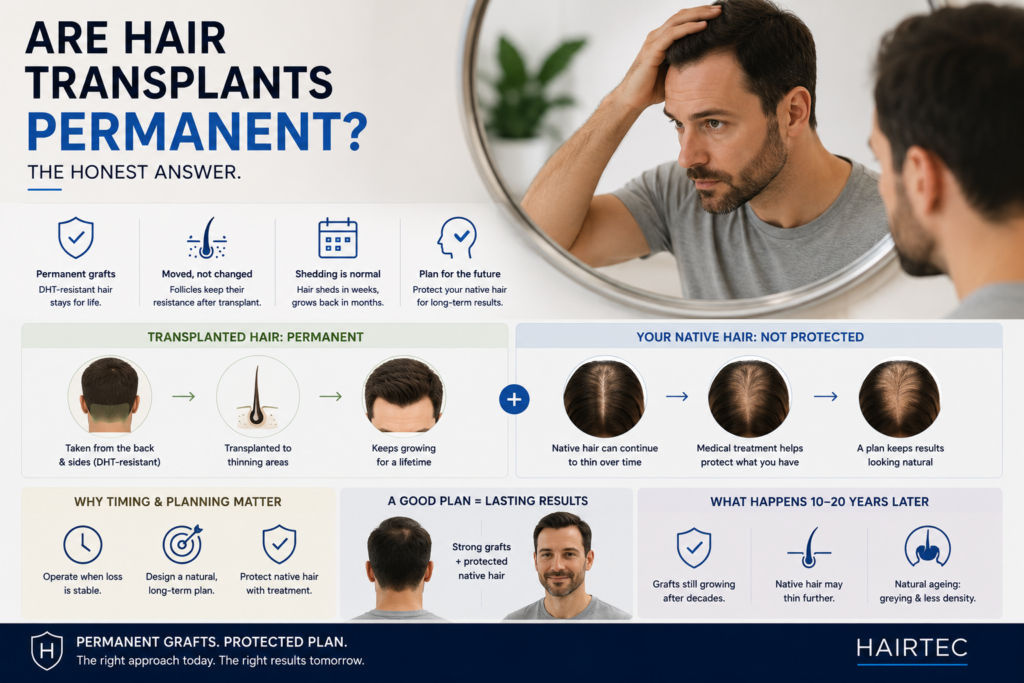
Yes. The hair a transplant moves is permanent, and that is not marketing, it is biology.
But the honest answer has a second half that clinics tend to mumble. The transplanted hair lasts. Your original hair carries on doing whatever it was going to do. Understand both halves and you understand why a transplant is permanent and still not a one-and-done fix. This piece takes the question apart properly, because “permanent” turns out to mean something more specific than most people assume.
Why the transplanted hair is permanent
It comes down to where the hair is taken from, and one useful quirk of male pattern loss.
The follicles on top of the scalp are sensitive to a hormone called DHT, which is why they thin. The follicles at the back and sides are not, which is why that ring survives. A transplant moves those resistant follicles into the thinning areas, and here is the key point, they keep their resistance after the move. They do not suddenly become vulnerable because of their new address. They carry on growing, largely immune to the process that emptied the ground around them.
That is why the transplanted hair is considered permanent. You have planted hair that was never programmed to fall out. The condition it resists is explained on our male pattern baldness page.
There is one wrinkle worth being straight about. After surgery, the transplanted hairs shed within the first few weeks, which alarms people into thinking the permanence was a myth. It was not. That shedding is the visible hair dropping while the follicle stays anchored under the skin, resetting to grow again from around three to four months. The follicle is permanent from the day it is placed. The first crop of hair on it is not, and that difference trips up a lot of worried people in month one.
The catch nobody mentions, your other hair
Here is where “permanent” needs its asterisk. A transplant does nothing to protect the hair you did not move.
Your native hair, the original growth around and between the grafts, is still subject to the same pattern loss it always was. It can keep thinning on its own schedule, entirely independent of the transplanted follicles sitting happily beside it. So while the grafts are permanent, the overall picture is not frozen, and this is the single most misunderstood thing about transplants.
Picture it a few years on. The transplanted hairline holds firm while the hair behind it quietly recedes, and suddenly there is a gap that was not there on the day. The grafts did not fail. The untouched hair simply carried on. That scenario is exactly what good planning sets out to avoid.
So can you go bald again after a transplant?
Not in the transplanted areas, as a rule. But you can lose more ground elsewhere, which amounts to the same worry if it is left unmanaged.
This is why a sensible plan rarely stops at the surgery. Pairing a transplant with medical treatment holds the native hair, so the result stays coherent rather than becoming an island of grafts in a receding sea. Our hair loss treatments page covers the options that do that job. Skip that step and a perfectly permanent transplant can still end up looking patchy, not because it failed, but because everything around it moved.
It is worth saying that this is not a reason for gloom. It is a reason for a plan. Managing the native hair is straightforward once you know it is part of the deal, and a great many people keep an entirely natural result for decades precisely because they treated the transplant as the start of a strategy rather than the end of the problem. The failures tend to be the people who were told, or assumed, that surgery alone would settle it forever.
What a transplant looks like at ten and twenty years
The long view is reassuring on the grafts and honest about the rest.
Twenty years after a well-done transplant, the moved follicles are typically still growing, because their DHT resistance does not wear off with time. What changes over those decades is the native hair, which may have thinned further, and the natural ageing of all your hair, which greys and loses some density regardless. A transplant done young, before the pattern of loss has declared itself, is the one most likely to need a follow-up plan, since more native hair is still at risk. One designed around stable loss ages far more gracefully.
Why this makes timing and planning matter
Permanence, then, is less about the procedure and more about the plan wrapped around it.
A transplant carried out too early, on fast-moving loss, is the classic way to end up chasing the recession for years. A transplant planned around stable loss, with the donor area spent carefully and the native hair protected, is the one that still looks right a decade later. The permanence of the grafts is the easy part. Making the whole head still look natural in ten years is the skill, and that is decided long before surgery, in the assessment. Whether a hairline or a crown is being rebuilt, the same logic applies, as our crown hair transplant page shows for one common case.
The role of our doctors at Hairtec
Our team includes BIG-registered doctors, listed on the official Dutch medical register, working alongside experienced hair specialists.
The permanence question is really a planning question, which is why it belongs with a medical assessment. The doctors lead the consultation, judge whether your loss is stable enough for a result to hold its shape over time, work out what the donor area can support long term, and decide whether medical treatment should run alongside to protect the native hair.
That forward planning is what turns a permanent graft into a permanently good result. When the honest answer is to wait, or to treat the loss medically first, that is what you will hear. Our free consultation page explains where it begins.
Frequently asked questions about whether hair transplants are permanent
Are hair transplants permanent?
Yes, the transplanted hair is permanent, because it comes from DHT-resistant follicles that keep their resistance after being moved. What a transplant does not do is stop your original, native hair from thinning, so the overall look still needs managing over time.
Can you go bald again after a hair transplant?
Not in the transplanted areas, which tend to keep growing for life. You can lose more of your original hair elsewhere, though, which is why medical treatment is often used alongside a transplant to protect the native hair and keep the result looking even.
How long do hair transplants really last?
The transplanted follicles typically last a lifetime, since their resistance to DHT does not fade. The variable is the surrounding native hair, which can continue to thin, so long-term appearance depends on managing that as well as on the grafts themselves.
What happens 20 years after a hair transplant?
The moved follicles are usually still growing after twenty years. The native hair around them may have thinned further, and all hair greys and loses some density with age, so the long-term look depends heavily on how the original loss was planned for.
Do I need medication after a hair transplant?
Not always, but it is often recommended, especially for younger patients or ongoing loss, to protect the native hair around the grafts. Whether it suits you is part of what a medical assessment decides.
How we reviewed this article:
Hairtec.co.uk has strict sourcing guidelines and relies on peer-reviewed studies, academic research institutions, and medical journals and associations. We only use quality, credible sources to ensure content accuracy and integrity. You can learn more about how we ensure our content is accurate and current by reading our editorial policy.
Our experts continually monitor the health and wellness space, and we update our articles when new information becomes available


